Showing posts with label television. Show all posts

Monday, August 5, 2019

Just For Fun: A Simpsons Makeover

Creative content consultancy firm NeoMam and interior design consultant Pat McNulty collaborated to give the cartoon family The Simpsons a much needed hone make over. They rendered the original house as well as the proposed spaces in photorealistic 3D and the results are superb.

The living room is done in a modern luxe style.


The kitchen got a smart-home makeover with appliances connected to the internet.


Homer and Marge's bedroom has an urban, industrial feel.


Maggie's nursery received a soothing, gender-neutral scheme with a bit of tradition.


Lisa, true to her character, got a biophilic bedroom that makes space for oxygen-giving plants.


Bart's bedroom is covered in patterns, colors, and designs from the Italian Memphis design movement from the 80s, previously seen here.


And the family bathroom now feels like a tranquil spa.


Happy designing!

Monday, February 5, 2018

The Serif TV by the Bouroullec Brothers for Samsung

I previously wrote about Yve Behar's marvelous The Frame television, and now Samsung has introduced another television that is just as interesting.

While Behar's approach was to make the television disappear (an approach I utilize in my own designs), the award-winning Paris-based Bouroullec Brothers who designed the Serif TV envisioned it to be an object that fits into everyday life—a hybrid of furniture design and technology. It is an appealing prospect to incorporate the technology into an object that will join furniture and furnishings seamlessly.

A distinct stand design, featuring attachable legs that easily screw into the bottom four corners, works in unison with the Serif TV's design and evokes a Mid-Century aestehetic. The custom legs, included with the TV, allow it to sit comfortably and blend more naturally into the home.

The user interface includes a transition between standby and normal viewing options called "curtain mode". This feature allows users to apply a filter over the content, creating a "curtain" effect in which viewers can access services such as a clock, Bluetooth speakers, apps and their photo gallery.

A woven fabric cover magnetically attaches to the back panel of the television to conceal component connections, ensuring it looks great from all angles.

I love the idea of taking this piece of technology that has become shunned and despised from a design perspective and returning it to the days when televisions were housed in casework. The Seif TV feels modern but also a bit retro!


And best of all, the television is fairly affordable at $1,499. It is available at Samsung On-Line.

Happy designing!

Monday, May 8, 2017

The Frame by Yves Behar for Samsung

I have had so many clients over the years tell me that while they may require a television in a family or living room, they don't want to have to look at it when it is off. And I don't blame them: a big, yawning, black rectangle is a waste of visual space.

But now, renowned product and commercial designer Yves Behar has created a new kind of television called The Frame for electronics manufacturer Samsung. Behar's company fuseproject outlines the new TV:

A home is an expression of personal taste, functional needs and interests. Every piece of furniture, every work of art on the wall, every object, becomes part of an aesthetic and style. The television is no exception. Whether it is small or large it has a strong visual presence in a room, even if you try to hide it. In our smaller homes and apartments, when a television is off its black square takes up valuable real estate.

As part of an ongoing collaboration with Samsung, we began to think about the television not as a consumer electronics product, but as part of our home and of our daily life. What if the TV display in my home delivered a different experience? What if the TV disappeared in the décor when it’s not in use?

The Frame is a beautiful display designed specifically to bring walls to life whether it is in use or not. When someone turns entertainment TV off, rather than going to black, the display goes into ‘Art Mode.’ We worked with world-renown curator Elise Van Middelem to find stunning works of art exclusive to The Frame – more than 100 pieces across 10 diverse genres, scanned at 4000K resolution and shown in Ultra High Definition (UHD). The Frame is not just another television, but a new experience of displays in the home.


For The Frame’s physical design, we looked to the art world experts – ensuring that every aspect of the display properly presents the work. Rather than built-in matting, we have added this in digitally: in ultra high-definition, it appears absolutely real. We consulted with expert framers from some of the most prestigious museums to format digital matting and display details. The Frame’s physical bezel is customizable, with white, black, and wood veneer available at launch. The smooth visual transition from Art mode to the entertainment 16:9 aspect ratio, is both beautiful and a magical moment in the Frame experience.


The digital interface of ‘Art Mode’ became as important a design challenge as the form itself. The platform needed to be accessible for any user, while still respecting the integrity of the art. We designed a gallery-style platform utilizing a clean, minimalist aesthetic similar to a traditional gallery. In the gallery setting, users can explore art by artist or genre, selecting which pieces get displayed. At launch, we’re providing Frame customers with 100 pieces of extraordinary artwork, from 38 different artists, in 10 genres. And of course, if you’d rather display your own artwork or family photos, there is an option for that as well.


Each artwork is converted to a digital media through the highest scanning standards and looks stunning and real. Artworks can be shown with white or color mattes and other framing conventions according to the artist’s preferences. In addition, the brightness sensor adjusts the image based on the room lighting, making artworks closely resemble the original. The result is art that blends in the environment in the same way that printed photography or a painted canvas would look. When you buy The Frame, you are also investing in these artists – pulling work specifically for this display, and presented as a piece of stunning artwork in your home.


Happy designing!

Monday, August 8, 2016

Know Your Chairs: The Elda

For this installation of Know Your Chairs, I want to share with you a marvelous chair I have loved for decades.


Created in 1963 by Italian artist and product/furniture designer Joe Colombo, the Elda chair is a classic known only to a few. Not as popular as other pieces of furniture from the Mid Century, such as the Barcelona chair or the Tulip chair, the Elda is both puzzling and inviting. A hard shell of fiberglass (one of the first such pieces of furniture to incorporate the material) on the outside protects a soft leathered inside, shaped and contoured into puffy rectangular tubes. While Colombo took his cue for the exterior from the hull of boats, there is something almost organic about the interior upholstery configuration, like intestines.

Designer Joe Colombo with sketches for his Elda chair

Even now, the chair's object-oriented quality makes it a fascinating addition to an interior plan. It looks retro, it looks modern, it looks soft and cushy, it looks shiny and sleek. Originals are highly sought after and can cost up to $10,000. Considering that the Elda is on display at both the Museum of Modern Art in Manhattan and at the Louvre in Paris, it is small wonder the chair can be so pricey.


Here is the Elda chair in a luxuriously minimalist living room by Portuguese interior designer Cristina Jorge de Carvalho.


This next image is from the home of vintage furniture collector Catherine Bujold...and it segues nicely into my next point:


The Elda chair was featured heavily on an English science fiction television show from the 70s called "Space: 1999" starring Martin Landau. It took place in the future when mankind had established a colony on the moon, Moonbase Alpha. The set designer utilized lots of great 60s and 70s Italian furniture and lighting since it all appeared so futuristic at the time... and it still does. Below are some screen shots of the chair in various episodes.


And more recently, the Elda was featured in "The Hunger Games," again, for the reason that the chair looks like it has yet to be invented!


Thankfully the Elda is still in production through Italian furniture manufacturer Longhi. I'd love to have one in my own home. If you'd love one too, give me a call!

Happy designing!

Monday, September 8, 2014

Westside House by Fiorito Interior Design

After more than a decade of being bi-coastal, my clients decided to retire from the east coast to the west. But the task of packing up a whole lifetime in a home was quite daunting so they hired me to comb through their furniture and accessories to see what could fit, what should be left behind, and what should make the move. The job proved difficult since my clients have a wealth of absolutely gorgeous objects and furnishings collected from trips to exotic, far-flung locales like Nepal, or amazing antiques inherited from relatives in England. It was tough to pare down, but after hours of diligent measuring, I mapped out what would migrate west and where it would be placed once here. Several key rooms in the new house turned out to require all new furniture configurations so I then filled in some blank spaces with new, custom pieces.

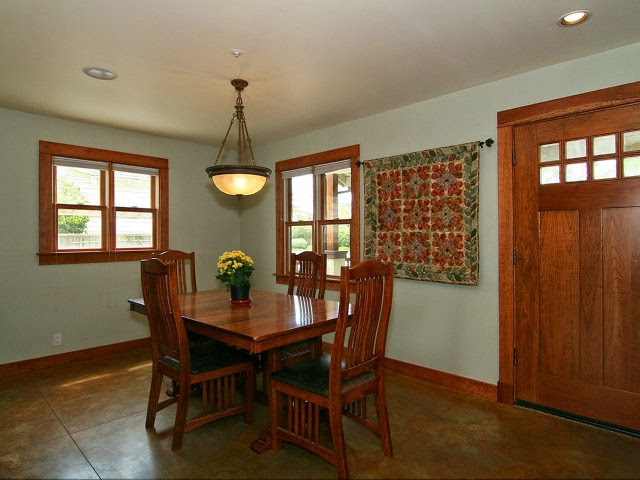
They bought their recent Craftsman-style home from the contractor who had designed and built it for his family. While the house is extremely well made, the interiors were bland, as you can see from the "Before" photos below.


The only architectural work we did was to transform the den at the rear of the house into a television/garden room. My clients did not want the television to be on display, and from a design point of view, sticking a TV in an armoire just doesn’t cut it anymore. I recommended installing a hidden, mirror TV from The Art of TV, along with accompanying invisible in-wall speakers. To do this, we removed an unnecessary small door in the corner of the room (there is another existing small door right next to it leading from the kitchen to the backyard) to free up the entire wall. Now, at the touch of a remote, what looks like a beautiful wall mirror mounted over a low Japanese tansu comes to life, and theater-quality sound magically floats out from the wall around it! Since we removed the small door, we replaced an existing bank of windows with glorious French doors to allow easy access to the garden. A warm color palette in the TV room, seen below, contrasts nicely with the greenery visible through the new French doors since the garden now plays such a prominent and important role in the design and ambiance of the room.

Above, you can see the custom wall mirror as an element of decor in the room. The carved bamboo-like frame is from Larsen Juhl. The new Shinto media console is a place for my clients to display their collection of exquisite art pottery and ceramics.

Above, a SuperBright Samsung Smart television comes to life: TV when you want it, a mirror when you don't, solving the problem of "what to do with the television." The curry colored wall anchors the television within the space. My clients' striped silk and nettle woven rug is from Nepal.

Above, a large, custom sectional with nickel nailhead trim, and a leather topped/baseball stitched cocktail table add comfort and convenience. My clients can now host their movie group for movie night! Below, brightly colored custom pillows blend beautifully with some of my clients' textiles collected from around the world.

Photo by Jeff Fiorito

The warm woodwork was lost in a sea of beige. It felt heavy and clunky, and I was not at all a fan (I had actually considered painting out all the woodwork white). I knew the only way to make the woodwork succeed was to pair it with a color that would accentuate it, not make it blend. I chose a deep aqua color palette for the rooms at the front of the house which makes the woodwork sing. And we discovered a wonderful art niche over the living room fireplace that the previous owners had covered with a framed print.

The previous owners' arrangement of smaller yet oddly puffy pieces of furniture made the living room feel cramped. It may seem counterintuitive, but the best way to combat that feeling is to put larger pieces of furniture, properly scaled, in the space. When I use all the space in a design, the eye reads a larger expanse, making the room feel larger. Above, a generous three-cushion custom sofa in a luxurious Butternut chenille provides plenty of seating for guests to gather around the fireplace after dinner in the nearby dining room. And the niche above is now home to one of my clients' prized carved Asian figures.

The aqua color palette continues throughout the space, visually connecting the living and dining areas. The color makes the woodwork seem richer, deeper, warmer. It now reads as a special element in the house and not simply "trim." Even the beautifully stained concrete floors (with radiant heat) look better. I replaced the old out-of-scale chandelier with a sleek, glass and marble slab light fixture that is more appropriately shaped for the space and echoes the Craftsman elements of the home. The table runner is a vintage embroidered textile from Turkey.

All "After" photos by Bernardo Grijalva except as noted.

Help with furniture placement or new pieces? Color selection? Art placement? Give me a call!
Happy designing!