Showing posts with label lounge chair. Show all posts

Monday, April 14, 2025

Know Your Chairs: The Bertoia Diamond Chair

This installation of Know Your Chairs focuses on a hallmark of mid-century design. Harry Bertoia's wire-framed Diamond chair emerged from the luxury of the time and space required for its creation.


Bertoia was born in Italy but moved to the United States at the age of 15 with his older brother, Oreste. He learned English and studied jewelry making from 1930 to 1936. But in 1937, something happened that would change his life and contribute to art and design in a meaningful way. He received a scholarship to study at the Cranbrook Academy of Art where he encountered Walter Gropius (founder of the legendary Bauhaus School in Germany, previously here), Ray and Charles Eames (influential pioneers of architecture and design, previously here), and Florence Knoll (architect and interior/furniture designer who, along with her husband Hans, started the revolutionary company Knoll Associates, now known simply as Knoll).

After moving from a student of painting to teaching jewelry and metal work, he was recruited to join Charles and Ray Eames in California to work on the development of their molded plywood products. But what happened next is a wonderful example of networking and simply putting yourself "out there" as the saying goes. The official Knoll site describes it well:

"On the suggestion of Herbert Matter, who had worked alongside Eames and Bertoia, Florence and Hans [Knoll] traveled to California and encouraged Bertoia to move east and set up his own metal shop in a corner of Knoll’s production facility. Having studied with Bertoia at Cranbrook, Florence was sure that he would produce something extraordinary if given the time and space to experiment.

Characteristic of the early environment at Knoll, Hans and Florence never demanded that Bertoia design furniture, but instead encouraged him to explore whatever he liked. They simply asked that if he arrived at something interesting, to show them. Needless to say, Harry Bertoia arrived at something outstanding. His iconic wire furniture collection, introduced in 1952, is recognized worldwide as one of the great achievements of 20th century furniture design."


The chair can be used without a seat pad for outdoor--or even indoor--lounging...


The pad provides some cushion and presents an opportunity to introduce color into a space.


The Diamond Chair is also offered with a full body pad!


The Diamond Chair is still in production and can be purchased from Knoll or Design Within Reach!

Take a look at the official Harry Bertoia website to see his marvelous paintings and sculptures as well.

Happy designing!

Monday, April 24, 2023

Know Your Chairs: The Womb Chair

For this installation of Know Your Chairs, let's look at another classic of Mid-Century Modern design: the Womb Chair. Created in 1946 by Finnish-American designer and architect Eero Saarinen (previously here), around the same time he was working on designs for the gateway Arch in St. Louis, he was approached by Florence Knoll who challenged him to make a new kind of chair: "I told Eero I was sick and tired of the one-dimensional lounge chair...long and narrow...I want a chair I can sit in sideways or any other way I want to sit in it...a chair that was like a basket of pillows...something I could really curl up in."

Saarinen set about reinventing the concept of a chair so that it was not comfortable from all the cushioning or padding, but from the actual shape of the chair itself. Wrapping foam around a fiberglass shell and setting it all on a set of splayed steel legs, the organic, welcoming Womb Chair was born. Speaking to the chair's name, Saarinen said, "It was designed on the theory that a great number of people have never really felt comfortable and secure since they left the womb. The chair is an attempt to rectify this maladjustment in our civilization. There seemed to be a need for a large and really comfortable chair to take the place of the old overstuffed chair. Today, more than ever before, we need to relax."


This classic of modernist design is still available from the original manufacturer and license holder, Knoll.

Happy designing!

Monday, May 29, 2017

Know Your Chairs: The Thonet No. 14

In this installment of "Know Your Chairs," we are looking at a chair some of us may have overlooked since it is a staple of public seating: the classic Thonet No. 14 chair, also known as a "bistro chair" since it occupies a prominent place in many a Parisian café.

Its creator Michael Thonet (pronounced "toe-net" and not the French pronunciation "tho-NAY") was a German-Austrian carpenter and cabinet maker who, in the 1840s and 1850s, invented and pioneered the process of making bentwood furniture.


In 1859, he gave the world an exquisitely designed, simple, lightweight chair, the No. 14. Made of six pieces of steam-bent wood, ten screws, and two nuts, the chair was a miracle of engineering. The wooden parts were made by heating beechwood slats to 100 °C, pressing them into curved cast-iron molds, and then drying them at around 70 °C for 20 hours. The chair could be sold ans shipped in an early version of what we now know as a "flat pack." Later, the six-piece chair turned into eight as two extra braces were included for the join of the seat and the back.


The chair may have been created in the 19th century, but it looks fresh and clean even today. These next two photos pair the No. 14 with Saarinen tables and the look is perfect.


The chair takes on a slightly stately, classic, retro look when presented in a café or restaurant setting.


Here is the No. 14 with its side braces...they only serve to add a bit more curve-y elegance to the already elegant design.


The Thonet arm chair No. 09 has a more inviting sensibility with a curved side and a place to rest one's arm (seen here with a Saarinen table, again). This was a favorite of Le Corbusier (previously here) and he used it extensively in his modernist interiors throughout the 1920s.


Of course a Thonet rocking chair, known as Thonet No. 10, was invented as well.


Even Picasso had one in his studio!


Naturally there have been many variations on the chair with lovely iterations featuring different Arabesque shapes on the back. I love this display of original Thonet chairs in the Wien Musueum Karlsplatz, in Vienna.


The Thonet No. 14 is still available from the original Thonet company in Germany. There is another Austrian Thonet company that has nothing to do with the original as well as a splinter company here in the United States that seems to sell only modern modular pieces. But luckily, Design Within Reach is one of the official license holders and the No. 14 chair is available through them.

Happy designing!

Monday, August 8, 2016

Know Your Chairs: The Elda

For this installation of Know Your Chairs, I want to share with you a marvelous chair I have loved for decades.


Created in 1963 by Italian artist and product/furniture designer Joe Colombo, the Elda chair is a classic known only to a few. Not as popular as other pieces of furniture from the Mid Century, such as the Barcelona chair or the Tulip chair, the Elda is both puzzling and inviting. A hard shell of fiberglass (one of the first such pieces of furniture to incorporate the material) on the outside protects a soft leathered inside, shaped and contoured into puffy rectangular tubes. While Colombo took his cue for the exterior from the hull of boats, there is something almost organic about the interior upholstery configuration, like intestines.

Designer Joe Colombo with sketches for his Elda chair

Even now, the chair's object-oriented quality makes it a fascinating addition to an interior plan. It looks retro, it looks modern, it looks soft and cushy, it looks shiny and sleek. Originals are highly sought after and can cost up to $10,000. Considering that the Elda is on display at both the Museum of Modern Art in Manhattan and at the Louvre in Paris, it is small wonder the chair can be so pricey.


Here is the Elda chair in a luxuriously minimalist living room by Portuguese interior designer Cristina Jorge de Carvalho.


This next image is from the home of vintage furniture collector Catherine Bujold...and it segues nicely into my next point:


The Elda chair was featured heavily on an English science fiction television show from the 70s called "Space: 1999" starring Martin Landau. It took place in the future when mankind had established a colony on the moon, Moonbase Alpha. The set designer utilized lots of great 60s and 70s Italian furniture and lighting since it all appeared so futuristic at the time... and it still does. Below are some screen shots of the chair in various episodes.


And more recently, the Elda was featured in "The Hunger Games," again, for the reason that the chair looks like it has yet to be invented!


Thankfully the Elda is still in production through Italian furniture manufacturer Longhi. I'd love to have one in my own home. If you'd love one too, give me a call!

Happy designing!

Monday, November 9, 2015

History of Furniture: The Eameses

What would Mid-Century style and design be without the enormous contributions of architect/designer duo and husband and wife team Charles and Ray Eames?


Starting in 1941, Charles and his wife Ray pioneered the early technique of using molded plywood for the construction of furniture. When World War II began, they were tapped to use their molded plywood technique to create splints, stretchers, and glider shells, but thankfully, after the war, they continued their fruitful and imaginative furniture design.

The LCW Chair (Lounge Chair Wood)

The first piece of furniture produced at the close of WWII was the LCW chair which utilized all they learned about molded plywood during the war.


The DCW Chair (Dining Chair Wood)

The LCW Chair was followed by the DCW Chair which, as a dining chair, was created in a slightly different scale...more erect and upright for dining at a table.


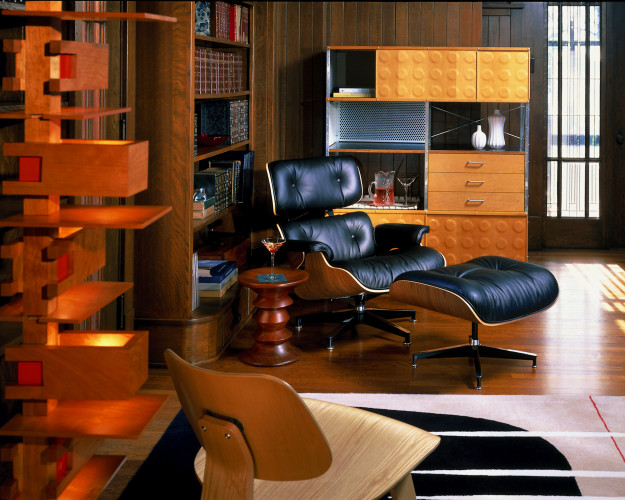
Eames Lounge Chair and Ottoman

Wanting to create a chair that has the “warm receptive look of a well-used first baseman’s mitt,” the Eameses introduced their Lounge Chair and Ottoman in 1956. This chair is sometimes referred to as the 670/671 Chair since that was the name of the Herman Miller part numbers used to make the seating!


While traditionally produced in black--and sometimes white--leather, the Eames Lounge chair looks great upholstered in unexpected fabrics, like this ethnic ikat shown below! Herman Miller currently sells the chair in many different leather and wood choices.


Eames Molded Plastic Chair

When Charles and Ray were creating their molded plywood chair, they initially wanted it to be composed of a single shell but the chair had issues at the curve where the seat met the back. With advances in plastics and fiberglass, they were finally able to fulfill their vision of a single shell (integrated deck and back) seat in their Molded Plastic and Fiberglass Chairs.


Eames Molded Fiberglass Chair

Designed in 1950, the fiberglass shell chair was the first mass-produced plastic chair in the world. The wire seat base is sometimes referred to as an "Eiffel Tower base" because of its resemblance to the famous Parisian landmark. The chair is also available with a wooden dowel base and a rocking base. And if you're worried about the environmental impact of fiberglass, fear not: Herman Miller now produces the chair by means of a less volatile, monomer-free "dry bind" process that is environmentally friendly and recyclable through the Herman Miller Take Back Program.


La Chaise

Charles and Ray designed the La Chaise lounge chair for The Museum of Modern Art’s 1948 “International Competition for Low-Cost Furniture Design.” Its name references both its function as well as Franco-American sculptor Gaston Lachaise’s Floating Figure (second image below), whose shape the Eameses thought would fit the chair perfectly. Although the chair was not produced for sale while Charles and Ray were alive, in 1996, long-time Eames partner Vitra International began manufacturing and distributing the La Chaise in response to public interest and demand. It has since become an icon of modern design.


Charles and Ray lived in a very special home in Pacific Palisades in Southern California. As part of the famous Case Study House program for John Entenza's Arts & Architecture magazine, the Eameses designed and built the now-legendary Case Study House No. 8, also known simply as The Eames House. Built in 1949, the modernist structure--with nods to Bauhaus and Mondrian--was not a cold, sterile shrine to minimalism but was instead lovingly filled with thousand of books, Isamu Noguchi floor lamps, Japanese kokeshi dolls, Chinese lacquered pillows, and Native American baskets. On September 20, 2006, the Eames House was designated a National Historic Landmark.


To learn more about Charles and Ray Eames and their other amazing creations and designs including film and textiles, visit the official Eames website. Their on-line shop is a treasure of original Eames designs.
http://www.eamesoffice.com/

The authentic and licensed Eames pieces in this post are also available through Herman Miller and Vitra International.
http://www.hermanmiller.com/
http://www.vitra.com/en-us/living

Happy designing!