In this continuing series of Legends of Design, let's look at an underrated figure of 20th century Modernism, Charlotte Perriand.
She was born in 1903 in Paris to a tailor and seamstress. After showing exceptional artistic talent in her youth, she attended the École de L'Union Centrale des Arts Décoratifs in 1920 to study furniture design. In 1927, only two years after graduating, Perriand renovated her apartment at Place Saint Sulpice in Paris into a room with a built-in wall bar made of aluminum, glass and chrome. For this design, she created her first piece of iconic furniture: the Siège Pivotant or Swivel Seat.
She recreated this entire room for the 1927 Salon d'Automne, and christened it the Bar sous le Toit or Bar In The Attic. And it of course featured the same Swivel Seat.
This small revolving armchair is characterized by a polished trivalent chrome plated enamel steel frame, and a unique tubular back rest of padded leather. It fit right in with the Modernist room of light-reflecting aluminum, nickel-plated surfaces, and glass shelves.
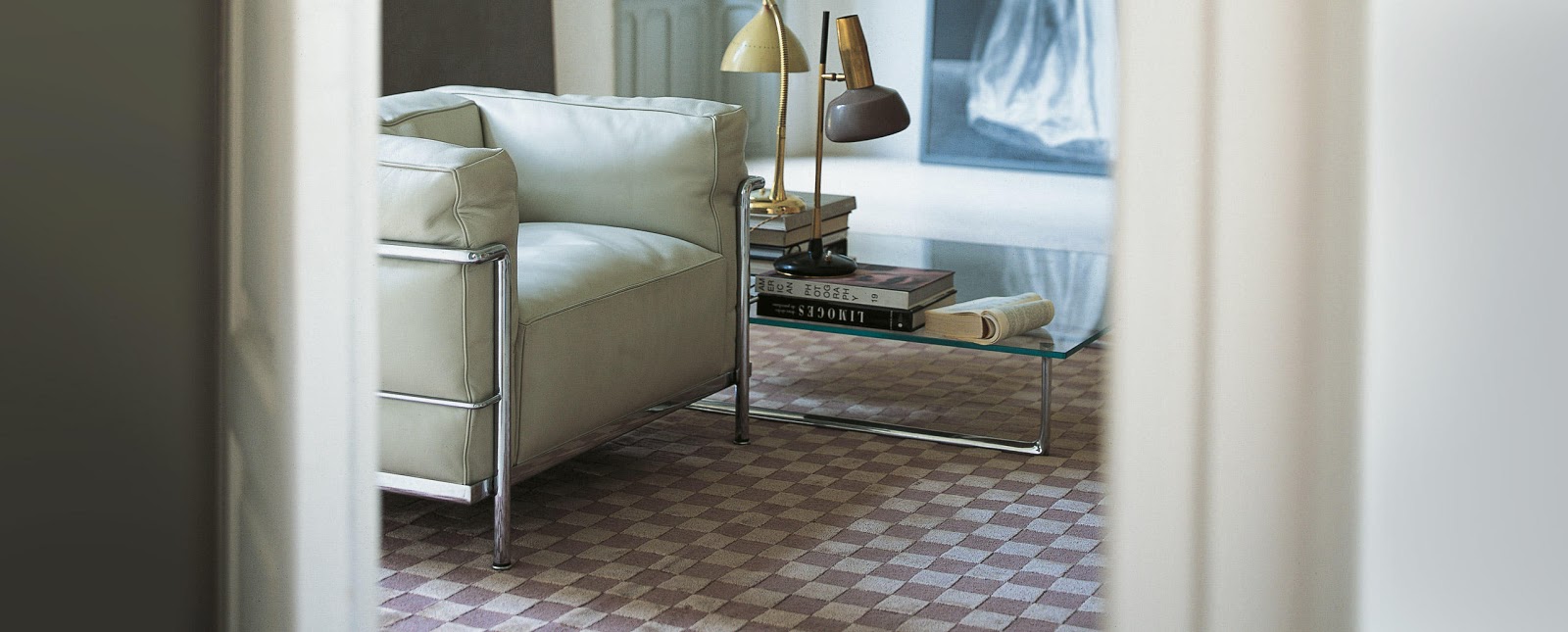
In a bit of kismet, the famed architect and furniture designer Le Corbusier visited the Salon a month later and saw her Bar sous le Toit. Suitably impressed, he offered Perriand a job and for the next decade, she, with Le Corbusier and Corbusier's cousin Pierre Jeanneret, created some of the most iconic Modernist furniture pieces ever. I covered these in another post here, but they are: the LC-1 chair with its sling back (first photo below), the LC-2 and LC-3 cube chairs (in the second photo below, you can see why the LC-2 is called the Petit Confort chair and the LC-3 is called the Grand Confort chair!, and the third photo shows the Grand in situ), and finally the LC-4 chaise longue (photos four and five), which when taken off its base and placed directly onto the floor, can rock!.
She went on to create other classic and influential designs including the 1953 Maison du Mexique bookcase, seen below in different color iterations.
In 2019 and 2020, the Fondation Louis Vuitton hosted a marvelous retrospective of Perriand's life and work entitled Charlotte Perriand: Inventing A New World. The Fondation noted, "She was an exceptional personality, a woman committed to leading a veritable evolution, or perhaps more aptly, a revolution. Her keen observation and vision of the world and its cultural and artistic expressions place her at the heart of a new order that introduced new relationships between the arts themselves – from architecture and painting to sculpture – as well as between the world’s most diverse cultures, from Asia (Japan, Vietnam and other countries) to Latin America, notably Brazil. Her work resonated with changes in the social and political order, the evolution of the role of women and changes in attitudes towards urban living. She embodied a transition from 19th century traditions towards the contemporary model of the 20th century, scarred by the cataclysms unleashed by totalitarian regimes and world wars, followed by both physical and moral reconstruction."
Since we have spent the last many installations of our ongoing History of Furniture series in the past, let's spend a bit of time in the 21st century. Now, arguably, something that is from our immediate time period might not be part of history as time moves on, but the Abyss table by Swiss-born and Paris-based designer Mattia Bonetti is part of a long line of furniture that is also rightfully considered a sculpture or a piece of art (see my previous post about the Lalanne sheep here, and see the work of the late Wendell Castle whom we will visit in a future installment).
Bonetti starts all of his pieces completely conceptually, with a colored pencil sketch.
Only if a client expresses interest in a piece does he then embark upon the time-consuming and costly process of realizing his vision. Bonetti has worked with the same fabricators and craftsmen for decades and relies on them to transform his sketches into actual, real-life objects. Sometimes the team says that a certain object cannot be built the way Bonetti has imagined it. But sometimes, as is the case with the delightful Abyss table, an idea springs forth and manifests in the world.
Bonetti describes the vision. "The main idea was to make a piece of sculpture. I was imagining something telluric, from an abyss under the surface of the sea or in a very deep cave. Trees, corals, bubbling volcanoes—all these shapes together become a table, et voilà!"
Because it can be made to be completely flat, sheet rolled steel was used for the table top. But the table base was cast in bronze and gilded with white gold leaf and colored transparent varnishes. In 2004, the table was issued in an initial run of eight, and debuted at the David Gill Gallery in London. The original pink and green colorway has been joined by orange and gold, and two different shades of blue which seems fitting for a table with an underwater theme.
Because of its price ($300,00 roughly) and weight (it tips the scale at a whopping 838 pounds) one sees it in the homes of art collectors and gallerists.
The original commission came from collector George Lindemann who has moved his Abyss table from a previous home (first photo below) to a new home on Miami Beach (second photo below). (The whimsical, Op-Art-style Louis XVI chairs were designed by Bonetti as well!)
Parisian gallerist Pierre Passebone has one in his home...
...as does David Gill. Here it is in the vacation home he and his partner, interior designer Francis Sultana, share on the island of Malta.
The work of Mattia Bonetti is included in numerous public collections, including the Centre Pompidou in Paris, the Cooper-Hewitt National Design Museum in New York, the Musée des Arts Décoratifs in Paris and the Victoria & Albert Museum in London.
For this installment of The History of Furniture, let's take a look back at a staple of modernist design, the Eileen Gray Side Table.
Between 1926 and 1929, Irish interior and furniture designer and architect Eileen Gray (above) collaborated on the design and construction of a modernist villa with her lover, the French architect Jean Badovici. Located in Roquebrune-Cap-Martin in the south of France, the house was very forward-looking with a flat roof and floor to ceiling glass windows to take advantage of the views of the Mediterranean. Gray named it the E-1027 “Maison en bord de mer” house, a name which contained a secret code: E for Eileen, 10 for Jean (J is the tenth letter of the alphabet), 2 for Badovici and 7 for Gray.
For this home, Gray designed the interiors and pieces of furniture as well. And one of the most enduring of her designs is the iconic side table she created for her sister, who liked to have breakfast in bed. The table has an open circular base that allows it to slip under a bedside or sofa, letting the user bring it as close as possible. For maximum function, the table itself adjusts up and down. Featuring a tempered glass top, the body is made of stainless steel, inspired by some of the tubular steel experiments of Marcel Breuer at the Bauhaus (previously here).
Here is an archival photo of the table in situ at the E-1027 house in 1929!
As you can see, the design, while minimal and streamlined, is timeless and can go with furnishings from the 1930s, the 1960s or 70s, or with any current styles. It is a perfect accent or occasional table.
The table is now produced by ClassiCon, under authorization of The World Licence Holder Aram Designs Ltd, London. Design Within Reach is an authorized dealer as well.
For this installment of History of Furniture, let's look at another staple of modernism: furnishings by Le Corbusier.
Charles-Édouard Jeanneret-Gris was a Swiss architect, designer, urban planner, artist, and writer who participated in the birth of Modernism as an artistic and civil movement. In 1920, early in his career, he adopted the pseudonym Le Corbusier (a version of his mother's father's name). Starting in 1928, Le Corbusier collaborated with Charlotte Perriand, another architect he invited to join his design studio, to create a series of chairs and lounges that are still being used today.
The first chair to be produced was the LC-1, consisting of a frame of steel tubing with tightly wrapped leather panels for the seat, seat back, and arm rests. Black or white leather was common but the chair is now available in options like hair-on-hide, seen below. (Note: this chair is often confused with the Marcel Breuer Wassily chair which was covered here in a History of Furniture post about Bauhaus and De Stijl.)
This was followed by the iconic LC-2 and LC-3 chairs whose designs were based on the idea of a cube. The LC-2 is smaller but the LC-3 is scaled a little larger, with ever-so-slightly lower arms.
The frame is made of--you guessed it--chrome on steel tubing. The only company that holds the license for Le Corbusier's designs, Cassina, now make these pieces with powder coated tubing in different colors.
And finally, the LC-4 lounge chair is a modernist masterpiece, taking its place alongside Mies van der Rohe's legendary day bed, previously seen here.
Le Corbusier designed many influential and famous buildings, structures, and homes. He became a French citizen in 1930 and died on August 27, 1965 while swimming in the Mediterranean Sea.
These timeless pieces he gifted us will add a bit of architectural interest to any space. They are available through Cassina: http://cassina.com/en