Showing posts with label LC-2. Show all posts

Monday, May 31, 2021

Legends of Design: Charlotte Perriand

In this continuing series of Legends of Design, let's look at an underrated figure of 20th century Modernism, Charlotte Perriand.


She was born in 1903 in Paris to a tailor and seamstress. After showing exceptional artistic talent in her youth, she attended the École de L'Union Centrale des Arts Décoratifs in 1920 to study furniture design. In 1927, only two years after graduating, Perriand renovated her apartment at Place Saint Sulpice in Paris into a room with a built-in wall bar made of aluminum, glass and chrome. For this design, she created her first piece of iconic furniture: the Siège Pivotant or Swivel Seat.


She recreated this entire room for the 1927 Salon d'Automne, and christened it the Bar sous le Toit or Bar In The Attic. And it of course featured the same Swivel Seat.


This small revolving armchair is characterized by a polished trivalent chrome plated enamel steel frame, and a unique tubular back rest of padded leather. It fit right in with the Modernist room of light-reflecting aluminum, nickel-plated surfaces, and glass shelves.

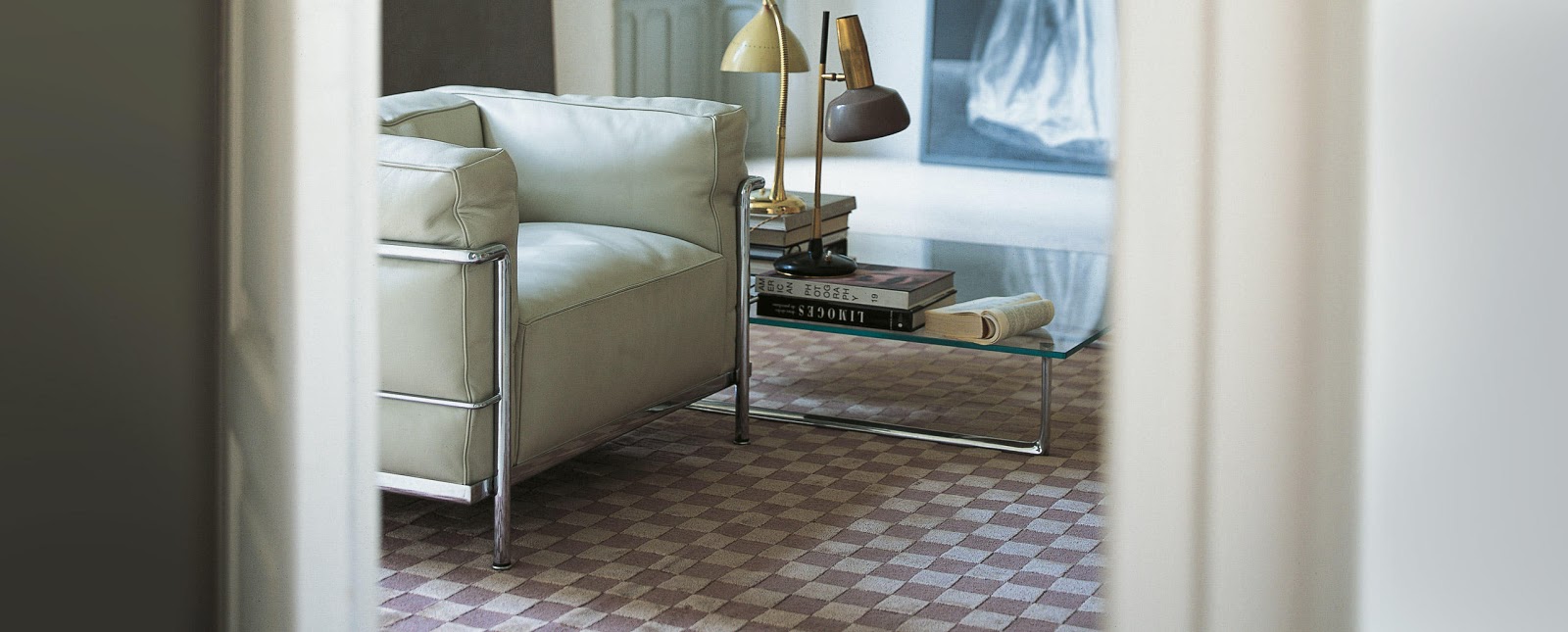
In a bit of kismet, the famed architect and furniture designer Le Corbusier visited the Salon a month later and saw her Bar sous le Toit. Suitably impressed, he offered Perriand a job and for the next decade, she, with Le Corbusier and Corbusier's cousin Pierre Jeanneret, created some of the most iconic Modernist furniture pieces ever. I covered these in another post here, but they are: the LC-1 chair with its sling back (first photo below), the LC-2 and LC-3 cube chairs (in the second photo below, you can see why the LC-2 is called the Petit Confort chair and the LC-3 is called the Grand Confort chair!, and the third photo shows the Grand in situ), and finally the LC-4 chaise longue (photos four and five), which when taken off its base and placed directly onto the floor, can rock!.


She went on to create other classic and influential designs including the 1953 Maison du Mexique bookcase, seen below in different color iterations.


In 2019 and 2020, the Fondation Louis Vuitton hosted a marvelous retrospective of Perriand's life and work entitled Charlotte Perriand: Inventing A New World. The Fondation noted, "She was an exceptional personality, a woman committed to leading a veritable evolution, or perhaps more aptly, a revolution. Her keen observation and vision of the world and its cultural and artistic expressions place her at the heart of a new order that introduced new relationships between the arts themselves – from architecture and painting to sculpture – as well as between the world’s most diverse cultures, from Asia (Japan, Vietnam and other countries) to Latin America, notably Brazil. Her work resonated with changes in the social and political order, the evolution of the role of women and changes in attitudes towards urban living. She embodied a transition from 19th century traditions towards the contemporary model of the 20th century, scarred by the cataclysms unleashed by totalitarian regimes and world wars, followed by both physical and moral reconstruction."

Happy designing!

Monday, November 3, 2014

History of Furniture: Le Corbusier

For this installment of History of Furniture, let's look at another staple of modernism: furnishings by Le Corbusier.


Charles-Édouard Jeanneret-Gris was a Swiss architect, designer, urban planner, artist, and writer who participated in the birth of Modernism as an artistic and civil movement. In 1920, early in his career, he adopted the pseudonym Le Corbusier (a version of his mother's father's name). Starting in 1928, Le Corbusier collaborated with Charlotte Perriand, another architect he invited to join his design studio, to create a series of chairs and lounges that are still being used today.

The first chair to be produced was the LC-1, consisting of a frame of steel tubing with tightly wrapped leather panels for the seat, seat back, and arm rests. Black or white leather was common but the chair is now available in options like hair-on-hide, seen below. (Note: this chair is often confused with the Marcel Breuer Wassily chair which was covered here in a History of Furniture post about Bauhaus and De Stijl.)


This was followed by the iconic LC-2 and LC-3 chairs whose designs were based on the idea of a cube. The LC-2 is smaller but the LC-3 is scaled a little larger, with ever-so-slightly lower arms.


The frame is made of--you guessed it--chrome on steel tubing. The only company that holds the license for Le Corbusier's designs, Cassina, now make these pieces with powder coated tubing in different colors.


And finally, the LC-4 lounge chair is a modernist masterpiece, taking its place alongside Mies van der Rohe's legendary day bed, previously seen here.


Le Corbusier designed many influential and famous buildings, structures, and homes. He became a French citizen in 1930 and died on August 27, 1965 while swimming in the Mediterranean Sea.

These timeless pieces he gifted us will add a bit of architectural interest to any space. They are available through Cassina:
http://cassina.com/en

Happy designing!