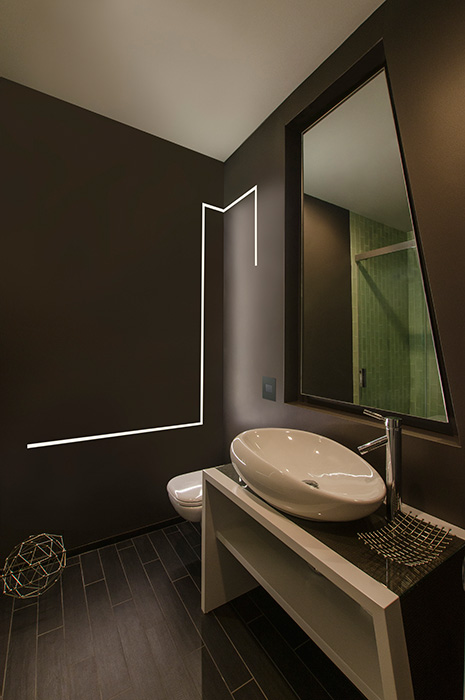
I am beyond excited with the possibilities of the amazing fixtures Chicago-based PureEdge Lighting are creating. Their Tru Line series shouldn't even be called "fixtures" because they are installed into walls and ceilings, becoming part of the structure of the building itself. Lines of embedded LED lights can run across a ceiling and down a wall...
...or wrap around a corner. They can be used in places where traditional fixtures cannot.
Tru Line can offer illumination in crucial areas like stairways.
My imagination is already running, thinking of ways this product can be incorporated into a design. The possibilities seem nearly endless.
Happy designing!
Monday, September 21, 2020
Monday, September 7, 2020
A Wine Connoisseur's Home by Fiorito Interior Design
Like many projects, this one started with a simple wish from a client: turn an unused butler’s pantry between the dining room and kitchen into a fully functioning, climate-controlled wine room for his extensive collection of valuable vintages. But like many projects, the wine room is connected to the dining room which is connected to the sitting room which is connected to the entry. When you touch one room, it only makes sense to reinvigorate them all. With the help of the great team at Elite Construction, we overhauled the entire ground floor of this lovely home.
For the wine room, I worked with Vintage Cellars in Southern California to create custom wine storage embedded with LED lighting to spotlight very special bottles. The walls are in a yummy burgundy tone and the floors are porcelain tiles that look as if they came from an old wine cave in Tuscany. A bubble light chandelier alludes to sparkling varietals.
But as mentioned, the rest of the house came along for the ride. Since we were adding a climate-controlled wine room, the brief was to turn the rest of the house into a space that would rival any hot-spot winery in Napa.
After choosing new wood flooring and a new hue for the walls, the entry became a destination in itself with an impressively large concave metal mirror and custom bench. We knocked out a half wall that awkwardly separated the sitting room from the dining room so that after-dinner drinks could flow to the fireplace surrounded by stainless steel pebbles; and we outfitted the dining room with a new chandelier. We chose all new furniture for all spaces.
The kitchen received the least amount of work but ended up being completely transformed anyhow. At first our plan was to tear everything out, but we soon realized that the cabinetry was in good shape and only needed the dated honey pine color painted over with a cream white. We also played with the idea of changing the counter tops, but once the cabinetry changed color, the granite stood out beautifully. The final change was the removal of a pot rack over the island in favor of design-forward forged iron pendants.
All photos by Genia Barnes.
Photos by Genia Barnes
For the wine room, I worked with Vintage Cellars in Southern California to create custom wine storage embedded with LED lighting to spotlight very special bottles. The walls are in a yummy burgundy tone and the floors are porcelain tiles that look as if they came from an old wine cave in Tuscany. A bubble light chandelier alludes to sparkling varietals.
But as mentioned, the rest of the house came along for the ride. Since we were adding a climate-controlled wine room, the brief was to turn the rest of the house into a space that would rival any hot-spot winery in Napa.
After choosing new wood flooring and a new hue for the walls, the entry became a destination in itself with an impressively large concave metal mirror and custom bench. We knocked out a half wall that awkwardly separated the sitting room from the dining room so that after-dinner drinks could flow to the fireplace surrounded by stainless steel pebbles; and we outfitted the dining room with a new chandelier. We chose all new furniture for all spaces.
The kitchen received the least amount of work but ended up being completely transformed anyhow. At first our plan was to tear everything out, but we soon realized that the cabinetry was in good shape and only needed the dated honey pine color painted over with a cream white. We also played with the idea of changing the counter tops, but once the cabinetry changed color, the granite stood out beautifully. The final change was the removal of a pot rack over the island in favor of design-forward forged iron pendants.
All photos by Genia Barnes.
Photos by Genia Barnes
Happy designing!
Monday, August 24, 2020
Know Your Chairs: The Louis Ghost Chair
For this episode of Know Your Chairs, I am featuring a delightful, tongue-in-cheek piece of furniture by the legendary Philippe Starck.
A man of many talents, Starck's career has bounced around the design world, from commercial (restaurants and hotels) design to residential design to product design to architecture--even naval design. He started his career in 1969. He was named artistic director of Pierre Cardin's publishing house, he opened his own industrial design company Starck Product, and in 1983, he designed the private rooms of President François Mitterrand at the Élysée Palace in Paris.
With former Studio 54 owner and hotelier extraordinaire Ian Schrager, Starck pioneered the idea of the boutique hotel by creating The Royalton in New York City. Starck went on to design a slew of unique hotels, each a true work of art, like The Paramount and The Hudson.Starck also worked successfully in the world of product design. In addition to mineral-water bottles for Glacier, watches for Fossil, and luggage for Samsonite, he created the iconic Juicy Salif citrus squeezer (it looks like an alien pod from "War of the Worlds") for Italian houseware brand Alessi.
But I think Starck is best known for designing hundreds and hundreds of pieces of furniture and lighting, and the best known of those pieces must be his reinvention of a classic Louis XVI chair, named the Louis Ghost chair for Kartell. The classic incarnation is clear acrylic (the see-through quality gives it its name) but it also comes in tinted colors and opaque black as well.
"I didn't really have to design the 'Louis Ghost' chair, because it is part of our western shared memory. It basically designed itself. Itʼs a ʻLouis somethingʼ, we donʼt know what, but everyone recognises it and it looks familiar. Itʼs here when you want to see it, and you can mix it if you want to be discrete. Itʼs on the verge of disappearing, dematerialising. Like everything that is produced by our civilisation."
--Philippe Starck
The armless version is called The Victoria Ghost Chair.
The chairs can be purchased through Design Within Reach here and here. But please beware of inexpensive knock offs and fake versions--not only does it violate the copyright and license holder of the design, but you will be buying something of inferior quality and workmanship that will likely snap or break.
Happy designing!
A man of many talents, Starck's career has bounced around the design world, from commercial (restaurants and hotels) design to residential design to product design to architecture--even naval design. He started his career in 1969. He was named artistic director of Pierre Cardin's publishing house, he opened his own industrial design company Starck Product, and in 1983, he designed the private rooms of President François Mitterrand at the Élysée Palace in Paris.
With former Studio 54 owner and hotelier extraordinaire Ian Schrager, Starck pioneered the idea of the boutique hotel by creating The Royalton in New York City. Starck went on to design a slew of unique hotels, each a true work of art, like The Paramount and The Hudson.Starck also worked successfully in the world of product design. In addition to mineral-water bottles for Glacier, watches for Fossil, and luggage for Samsonite, he created the iconic Juicy Salif citrus squeezer (it looks like an alien pod from "War of the Worlds") for Italian houseware brand Alessi.
But I think Starck is best known for designing hundreds and hundreds of pieces of furniture and lighting, and the best known of those pieces must be his reinvention of a classic Louis XVI chair, named the Louis Ghost chair for Kartell. The classic incarnation is clear acrylic (the see-through quality gives it its name) but it also comes in tinted colors and opaque black as well.
"I didn't really have to design the 'Louis Ghost' chair, because it is part of our western shared memory. It basically designed itself. Itʼs a ʻLouis somethingʼ, we donʼt know what, but everyone recognises it and it looks familiar. Itʼs here when you want to see it, and you can mix it if you want to be discrete. Itʼs on the verge of disappearing, dematerialising. Like everything that is produced by our civilisation."
--Philippe Starck
The armless version is called The Victoria Ghost Chair.
The chairs can be purchased through Design Within Reach here and here. But please beware of inexpensive knock offs and fake versions--not only does it violate the copyright and license holder of the design, but you will be buying something of inferior quality and workmanship that will likely snap or break.
Happy designing!
Monday, August 10, 2020
Leopard, Jaguar, or Cheetah?: The Enduring Classical Appeal of Big Cat Prints
There are few things more polarizing in the world of interior design than animal prints. There are those who love them because they love the animals themselves while others hate them for unfortunate associations with gaudy, Las Vegas-style decor and tacky clothing. If I've learned one thing in my years in interior design, it's that people can have strong mental and emotional associations with the most unexpected things.
But for me--someone who has studied interiors for the better part of his life and has been exposed to millions of images, ideas, and designs--I feel differently. While I do love the big cats featured here in this post, I have always had Classical associations with the use of these patterns. Just like the old adage "Every room should have something red in it," these rooms live by the adage "Every Neo-Classical room should have something leopard in it." Just look at the spectacular surroundings of each of these spots of leopard (pun intended). Used in this way, leopard brings an air of sophistication, a kind of Continental savoir faire that speaks to the idea of the layering of history in a room.
In order to clarify, when you are looking at these patterns, you might see one that looks familiar but with some slight variations. If you see leopard spots but with a few more little speckles and spots in the center of the rosette, you are looking at the fur of the magnificent jaguar.
Now, here's the thing: there is yet another big cat with fur that is similar in pattern to a leopard and that is the endangered cheetah. Where the leopard and jaguar have black or dark rosettes with a brown center and sometimes additional smaller spots in the center, the cheetah simply has spots.
Of course I do not condone the use of real fur for any purposes. These big cat prints look wonderful in crushed velvet, woven into wool carpets, or even printed on linen. There is no need to slaughter one of these animals to enjoy the beauty of their natural markings.
Happy designing!
But for me--someone who has studied interiors for the better part of his life and has been exposed to millions of images, ideas, and designs--I feel differently. While I do love the big cats featured here in this post, I have always had Classical associations with the use of these patterns. Just like the old adage "Every room should have something red in it," these rooms live by the adage "Every Neo-Classical room should have something leopard in it." Just look at the spectacular surroundings of each of these spots of leopard (pun intended). Used in this way, leopard brings an air of sophistication, a kind of Continental savoir faire that speaks to the idea of the layering of history in a room.
![]() |
| A leopard carpet in the library of Pierre Sauvage's Paris apartment |
![]() |
| Leopard pillows in the Paris apartment of Marco Scarani and Jamie Creel |
![]() |
| Leopard stair runner in a home by Miles Redd |
![]() |
| Leopard carpet and upholstered stool in the entry of Alina Cho's midtown Manhattan apartment |
![]() |
| Leopard stools in a sitting room by Alessandra Branca |
In order to clarify, when you are looking at these patterns, you might see one that looks familiar but with some slight variations. If you see leopard spots but with a few more little speckles and spots in the center of the rosette, you are looking at the fur of the magnificent jaguar.
![]() |
| Arne Jacobsen Egg chair upholstered in jaguar in Emma Jane Pilkington's apartment |
Now, here's the thing: there is yet another big cat with fur that is similar in pattern to a leopard and that is the endangered cheetah. Where the leopard and jaguar have black or dark rosettes with a brown center and sometimes additional smaller spots in the center, the cheetah simply has spots.
![]() |
| The bedroom in designer Stephen Shubel's San Francisco loft features a cheetah carpet |
![]() |
| Cheetah chairs in a wonderfully eclectic sitting room Olivier Gagnere |
Of course I do not condone the use of real fur for any purposes. These big cat prints look wonderful in crushed velvet, woven into wool carpets, or even printed on linen. There is no need to slaughter one of these animals to enjoy the beauty of their natural markings.
Happy designing!
Subscribe to:
Posts (Atom)