Showing posts with label fabric. Show all posts

Monday, March 17, 2025

In The World Of Fabric, What Is Brocade?

I've posted about many different types of fabrics in the past from exotic creations like ikat, here, or African kuba/kente/mudcloth here.

Those are visually easy to identify because they are so unique, but some fabrics get confused with one another and terms sometimes end up being interchangeable even when the fabrics are distinct. Jacquard, previously here, is an umbrella term for many types of fabrics. The name refers to Joseph Marie Jacquard, the inventor of an 1801 attachment for looms using punch cards that individually control each of the warp yarns (the up/down, or north/south yarns) in a piece of cloth.

Below you can see a Jacquard attachment on a loom.


Here is a close-up of the punch cards, made of thin planks of wood. If there was a hole, a hook would raise. If not, the hook wold go down. In this way, a pattern would emerge in the fabric.


Differing fabrics and effects can be achieved by varying the color, material, and number of warp as well as weft threads. One of the fabrics a Jacquard loom can create is damask which features some kind of figure, usually symmetrical, like an Arabesque or a floral. The warp fibers are shiny while the weft fibers (those that left/right or east/west as it were) are matte. This gives damask a quality that makes it ideal for tone-on-tone color palettes. Another characteristic of damask fabric is that is is reversible...there is no "rough" woven side. For this reason, the use of damask is very common for tableware like napkins and tablecloths.

But something even more complex can be created when adding extra weft fibers only in a certain area to make a raised or embossed design. This type of jacquard fabrics is called brocade. Originally crafted from silk, brocade has origins in ancient India around 1750 B.C.E. It made its way through China around 450 B.C.E., and through the European Renaissance of the 15th century. But the invention of the Jacquard loom allowed brocade to be made faster, and the fabric was once again the rage throughout the 1800s.

What makes brocade so special is that the extra weft threads are often of metallic gold or silver, making the raised design shimmer. This opulent fabric can be used for very special but limited applications for upholstery, pillows, even wall covering. Using a brocade speaks to its history and adds a sense of luxury and value.


Chinese Brocade from Lee Jofa/Kravet in Sand and Red
Chinese Brocade from Lee Jofa/Kravet in Sand installed on library chairs


Happy designing!

Monday, August 10, 2020

Leopard, Jaguar, or Cheetah?: The Enduring Classical Appeal of Big Cat Prints

There are few things more polarizing in the world of interior design than animal prints. There are those who love them because they love the animals themselves while others hate them for unfortunate associations with gaudy, Las Vegas-style decor and tacky clothing. If I've learned one thing in my years in interior design, it's that people can have strong mental and emotional associations with the most unexpected things.

But for me--someone who has studied interiors for the better part of his life and has been exposed to millions of images, ideas, and designs--I feel differently. While I do love the big cats featured here in this post, I have always had Classical associations with the use of these patterns. Just like the old adage "Every room should have something red in it," these rooms live by the adage "Every Neo-Classical room should have something leopard in it." Just look at the spectacular surroundings of each of these spots of leopard (pun intended). Used in this way, leopard brings an air of sophistication, a kind of Continental savoir faire that speaks to the idea of the layering of history in a room.

A leopard carpet in the library of Pierre Sauvage's Paris apartment
Leopard pillows in the Paris apartment of Marco Scarani and Jamie Creel
Leopard stair runner in a home by Miles Redd
Leopard carpet and upholstered stool in the entry of Alina Cho's midtown Manhattan apartment
Leopard stools in a sitting room by Alessandra Branca

In order to clarify, when you are looking at these patterns, you might see one that looks familiar but with some slight variations. If you see leopard spots but with a few more little speckles and spots in the center of the rosette, you are looking at the fur of the magnificent jaguar.

Arne Jacobsen Egg chair upholstered in jaguar in Emma Jane Pilkington's apartment

Now, here's the thing: there is yet another big cat with fur that is similar in pattern to a leopard and that is the endangered cheetah. Where the leopard and jaguar have black or dark rosettes with a brown center and sometimes additional smaller spots in the center, the cheetah simply has spots.

The bedroom in designer Stephen Shubel's San Francisco loft features a cheetah carpet
Cheetah chairs in a wonderfully eclectic sitting room Olivier Gagnere

Of course I do not condone the use of real fur for any purposes. These big cat prints look wonderful in crushed velvet, woven into wool carpets, or even printed on linen. There is no need to slaughter one of these animals to enjoy the beauty of their natural markings.

Happy designing!

Monday, September 10, 2018

The Textile Designs of Martyn Thompson

Now it's time for you to meet Martyn Thompson.


I feel a bit of kinship with Martyn Thompson. Born in England but raised in Sydney, Australia, the teenaged Martyn was very influenced by glam rock, punk, and especially the New Romantics. In fact, his website bio says, "He was particularly captivated by the aesthetic of Vivienne Westwood and Malcolm McLaren’s subversive early collections and the music of artists such as Siouxsie and the Banshees." I too was entranced with the New Romantics as well as Westwood and McLaren!

Thompson began designing clothes just after leaving university in Sydney in the early ’80s. But after photographing his creations, he discovered it was the photographs people truly responded to: moody settings, natural lighting, and a sense of place that went beyond the frame. He decided to try photography and, essentially self-taught, he ended up shooting for Australian fashion magazines! He moved to Paris to further his career and after three years there, decamped for London where his work morphed from fashion to interiors. Finally, in 1999, he moved to New York City where he now lives and runs Martyn Thompson Studio, photographing campaigns for companies like Jo Malone, Tiffany & Co., Gucci, Hyatt, Ralph Lauren, Grey Goose vodka, Hermès, FLOR, and MAC cosmetics, and creating his own textiles and rugs.

I love his utterly unique, patchwork, frayed look: a bit Georgian (if Mr. Darcy had been clothed by gypsies), and a bit Icelandic gnome, with a sprinkling of 70s funk (I'm in love with his chunky platform shoes!). And look at the red Vivienne Westwood squiggle socks below! You go, hermano!


His textiles are fascinating. He created a jacquard fabric (the design is woven into the fabric itself, previously here) he calls Rock Pool which looks like a view of rocks just below the surface of a shallow sea...


His website shop describes another jacquard, the Accidental Expressionist series:
"Layer upon layer of paint flecks cover this design that beautifully captures the spirit and texture of an artist's drop cloth. The layering of colors gives the fabric a sense of history, a patina developed over time with each new paint speck."


And his floral design Cézanne's Shadow is a tapestry that can be used for pillows, soft goods (one could stitch several together for bedding or drapery), and placed for upholstery.


And he turned the paint-splatter pattern into a rug for Perennials available here!


His on-line shop also has a wonderful selection of bags, totes, pillows, blankets, and scarves. Take a look!

Happy designing!

Monday, July 16, 2018

Couture For Your Chairs

I am currently at work on a whole-house project for a client who lives a literal stone's throw from the gorgeous coastline here in the Monterey Bay Area and the brief was to infuse the sense of the coastline, the ocean, and the beach into the home without resorting to "beach" or "surf" clichés.

And one of the ways we are doing that is with a limited color palette of blue, white, and gold. Of course blue and white could be considered cliché when thinking of a beach house, but my client's taste leans toward modern minimalism. When done with interesting geometric fabrics and a muted color palette, the beach factor is dialed down and the design resides in a decidedly more sophisticated area.

For her dining room, we are having a pair of custom host chairs made that will be covered in two wonderful fabrics. This is one of the advantages of working with an interior designer: we can customize and design unique pieces of furniture that you simply can't get anywhere else. I have had clients tell me that the frustrating part about ordering furniture from the big, standard vendors like Pottery Barn and Crate and Barell is that the chair or sofa they may have chosen only comes in four or six colors and perhaps four patterns. But with me, you can get chairs, ottomans, sofas, sectionals in whatever fabric we find that captivates us.

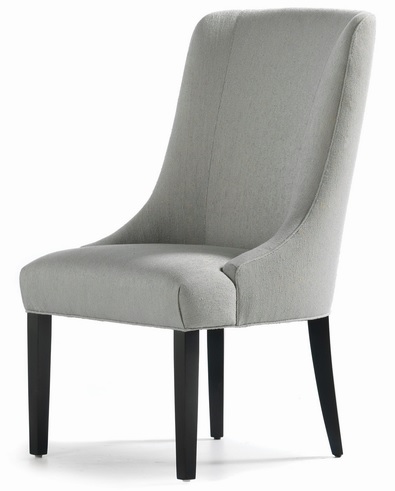
With an elegant, scoop-armed chair chosen...


...my client and I were captivated by a lovely geometric pattern that, while it doesn't explicitly reference the ocean, recalls waves or even tangles of kelp or seaweed. To further customize this chair and make is something truly unique and beautiful, we are putting this fabric only on the outside back...


...while the inside back and the seat will be upholstered in this rich aquatic colored velvet which has been specially treated to resist stains.


The fabric is on its way to the manufacturer in North Carolina and we should have our custom chairs in another several weeks!

I love creating customized furniture for clients. We can customize case goods like buffets by choosing our color or wood stain and whether there are fabric, leather, raffia, or mirrored panels. And of course we can dress furniture in nearly any fabric we wish, often with welting and nailhead options as well. There is nothing "off-the-rack" about it. It really is like having couture clothing designed for your chairs!

If you'd like to furnish your house with unique pieces of furniture created to your own taste and style, give me a call.

Happy designing!

Monday, February 27, 2017

What Is Button Tufting?

There are some funny terms in interior design, and I believe the term "tufting" falls into that category. The word can produce a quizzical look on faces, but the concept is quite simple. Tufting refers to depressions at regular intervals on a piece of fabric or leather (such as a cushion or on a piece of upholstered furniture) by passing a thread through it. This can be left as thread, but most often this technique is seen as button tufting. The most famous example of this is on the classic Chesterfield sofa, previously featured here.


The iconic Chesterfield sofa features button tufting arranged in a diamond pattern which imbues it with a very sophisticated and traditional look. But if a button tufted sofa is arranged not in a diamond pattern but in a linear pattern, the effect is quite different. As you can see by the example below, what we end up with is a more contemporary feeling along the lines of a Mid-Century Modern piece of furniture.


Tufting can be also be used on headboards to add further softness and luxury to a bedroom...


...or on benches...


...or on chairs...


...and of course, on pillows and cushions!


Happy designing!