I am so excited to have found a new lighting company that is creating some truly gorgeous light fixtures. Brightbound, headquartered here in Northern California, is showing some simple yet luxe styles. Mouth blown glass pieces of various colors, sizes, and opacity are custom-made in Brooklyn, and then sent here to be assembled using hand-knotted cord available in many different hues. The results are stunning. I can't wait to show these to a client! As you can see, they look good at a kitchen island, over a dining table, in a living room, in a bathroom, or even in a bedroom!
If you would like to use a Brightbound fixture in a bathroom, dining room, living room, or kitchen project, just give me a call!
Happy designing!
Showing posts with label light fixture. Show all posts
Monday, June 9, 2025
Monday, October 21, 2024
History of Furniture: The Arco Lamp
In my History of Furniture series, I usually write about time periods, movements, and eras in regard to interior design with an occasional foray into exterior architecture. But there have been exceptions when I examine a single piece of furniture, and delightfully, this is one of those times.
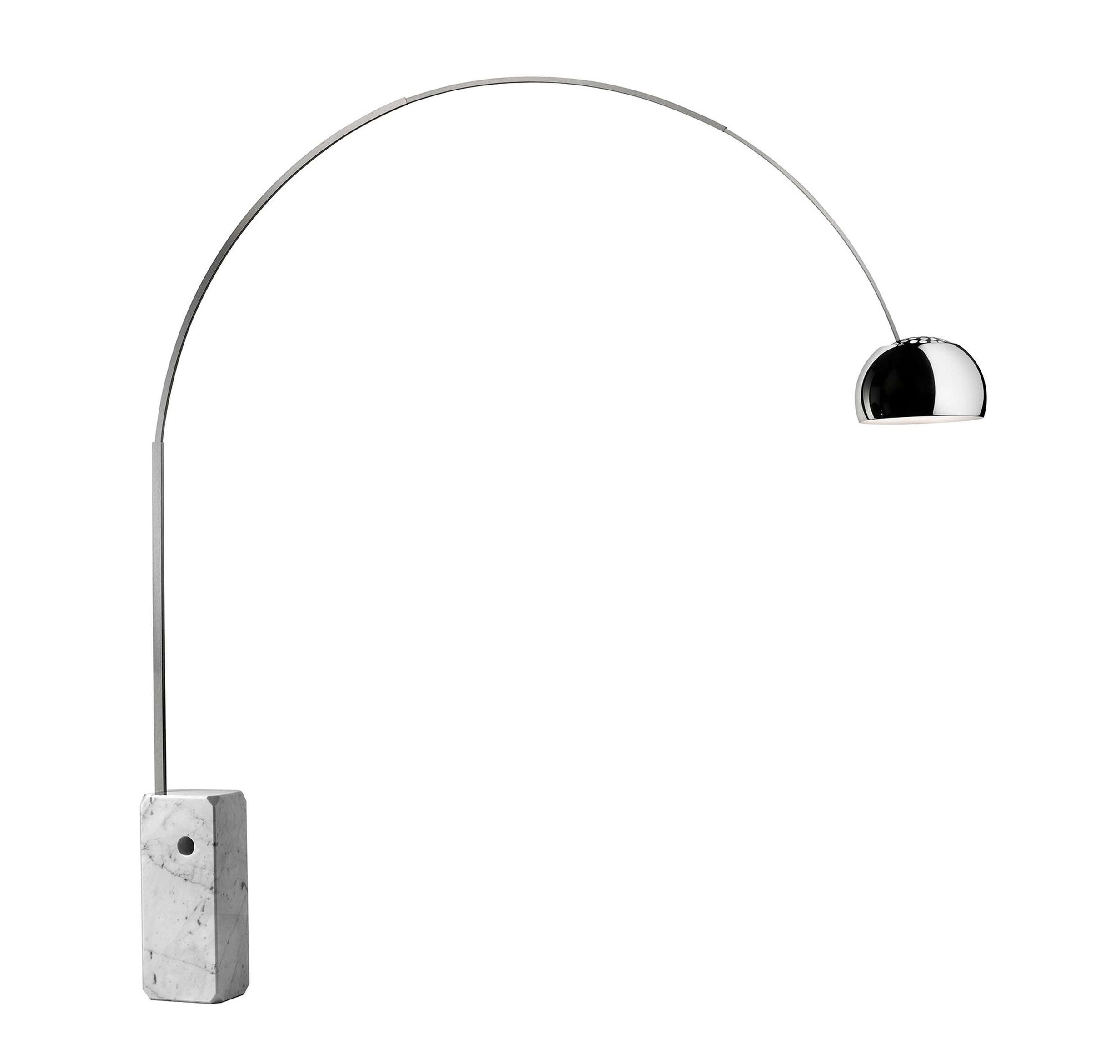
A classic and very important piece of furniture was designed in 1962 by Italian brothers designed by brothers Pier Giacomo and Achille Castiglioni for lighting manufacturer Flos. It is called the Arco lamp and has been a staple of interiors through Mid-Century Modern, the 70s and 80s, and even now. Remarkably, it has been in constant production by Flos since its birth in 1962.
The Achille Castiglioni Foundation website describes this spectacularly elegant fixture:
Floor lamp with direct light, it fulfills the need for direct lighting on a table without having the constraint of a fixed light point on the ceiling. The base of the lamp is made up of a parallelepiped of white marble weighing approximately 65 kg, the corners are rounded, equipped with a hole made in the center of gravity, useful both for fixing the vertical stem that supports the actual arch and for easy movement of the lamp (for example by inserting a simple broom handle).
The arched stem is made up of three sectors in stainless steel profile with a U-section capable of allowing, by sliding one inside the other, telescopic advancement and the hidden passage of the wires. This gives the arch more widths, with the reflector being positioned at three different heights.
The dome is made up of two pieces: a fixed one in the shape of a perforated cap to facilitate the cooling of the lamp holder (100 watt bulb in opaline glass), the other a mobile aluminum ring, resting on the first, so that it can be rectified in position, depending on the height of the third sector of the arch.
This technical description is a good exmaple of something being more than the sum of its parts. There is a reason this fixture has sold millions. There is a timeless beauty and simplicity in this light that cannot be denied.
The Arco light can be bought from Flos and through Design Within Reach.
Happy designing!
A classic and very important piece of furniture was designed in 1962 by Italian brothers designed by brothers Pier Giacomo and Achille Castiglioni for lighting manufacturer Flos. It is called the Arco lamp and has been a staple of interiors through Mid-Century Modern, the 70s and 80s, and even now. Remarkably, it has been in constant production by Flos since its birth in 1962.
The Achille Castiglioni Foundation website describes this spectacularly elegant fixture:
Floor lamp with direct light, it fulfills the need for direct lighting on a table without having the constraint of a fixed light point on the ceiling. The base of the lamp is made up of a parallelepiped of white marble weighing approximately 65 kg, the corners are rounded, equipped with a hole made in the center of gravity, useful both for fixing the vertical stem that supports the actual arch and for easy movement of the lamp (for example by inserting a simple broom handle).
The arched stem is made up of three sectors in stainless steel profile with a U-section capable of allowing, by sliding one inside the other, telescopic advancement and the hidden passage of the wires. This gives the arch more widths, with the reflector being positioned at three different heights.
The dome is made up of two pieces: a fixed one in the shape of a perforated cap to facilitate the cooling of the lamp holder (100 watt bulb in opaline glass), the other a mobile aluminum ring, resting on the first, so that it can be rectified in position, depending on the height of the third sector of the arch.
This technical description is a good exmaple of something being more than the sum of its parts. There is a reason this fixture has sold millions. There is a timeless beauty and simplicity in this light that cannot be denied.
Happy designing!
Monday, September 21, 2020
The Future of Lighting Is Now
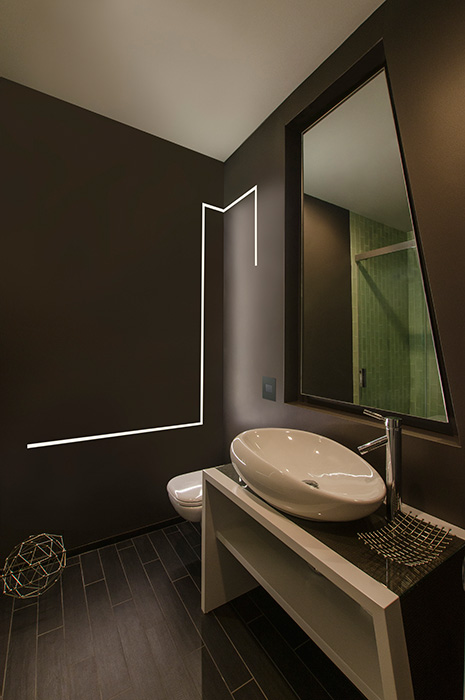
I am beyond excited with the possibilities of the amazing fixtures Chicago-based PureEdge Lighting are creating. Their Tru Line series shouldn't even be called "fixtures" because they are installed into walls and ceilings, becoming part of the structure of the building itself. Lines of embedded LED lights can run across a ceiling and down a wall...
...or wrap around a corner. They can be used in places where traditional fixtures cannot.
Tru Line can offer illumination in crucial areas like stairways.
My imagination is already running, thinking of ways this product can be incorporated into a design. The possibilities seem nearly endless.
Happy designing!
...or wrap around a corner. They can be used in places where traditional fixtures cannot.
Tru Line can offer illumination in crucial areas like stairways.
My imagination is already running, thinking of ways this product can be incorporated into a design. The possibilities seem nearly endless.
Happy designing!
Monday, June 15, 2020
Stickbulb
We started this month looking at the history of white plaster lighting fixtures, and in contrast to the artisan-made tactility of those fixtures, let's look at a company integrating LED into extremely minimalist designs using slim rectangles of wood.
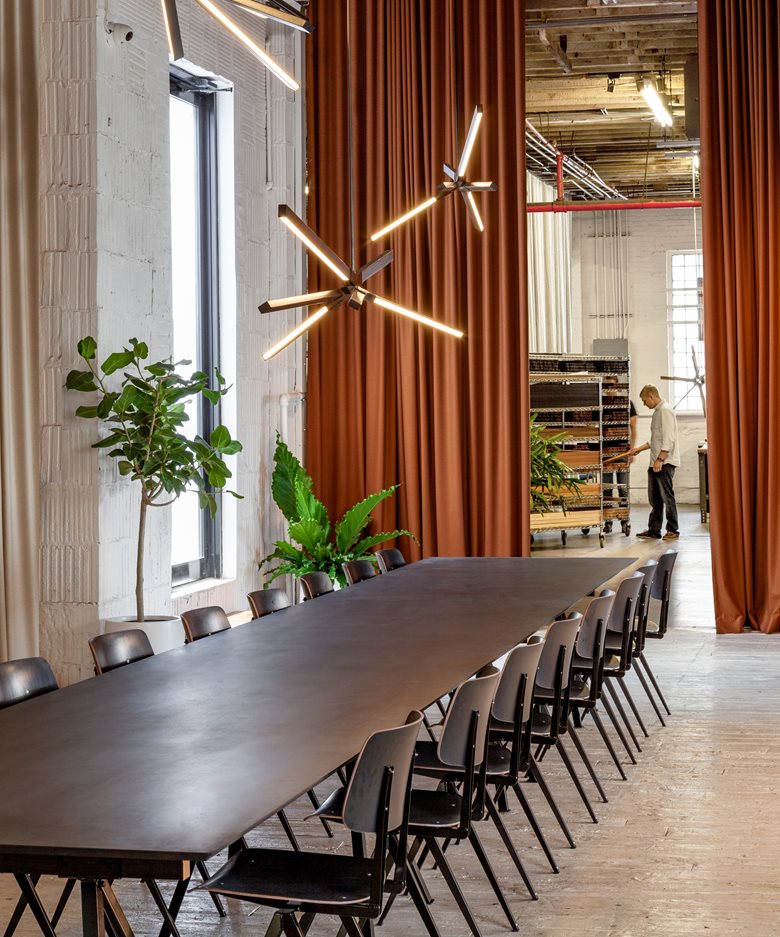
Stickbulb was formed in 2012 by Russell Greenberg and Christopher Beardsley. Inspired by a pile of long linear wooden cut-offs in their workshop, the designers challenged themselves to develop a truly sustainable lighting system. As a starting point, they only considered designs that could be manufactured locally and affordably within a five mile radius of their New York City office. They chose to use reclaimed and sustainably sourced woods as a primary building material, and sourced energy efficient LED technologies and components. The collection was designed with the least number of parts possible and with connections that make the pieces easy to separate for maintenance, recycling, or reuse. The result is a light-up erector set of interchangeable components that allows for unlimited customization and creativity.
They make a wonderful collection of pendants, chandeliers, sconces, and floor lamps. Take a look at the strong line of the pieces below.
Happy designing!
Stickbulb was formed in 2012 by Russell Greenberg and Christopher Beardsley. Inspired by a pile of long linear wooden cut-offs in their workshop, the designers challenged themselves to develop a truly sustainable lighting system. As a starting point, they only considered designs that could be manufactured locally and affordably within a five mile radius of their New York City office. They chose to use reclaimed and sustainably sourced woods as a primary building material, and sourced energy efficient LED technologies and components. The collection was designed with the least number of parts possible and with connections that make the pieces easy to separate for maintenance, recycling, or reuse. The result is a light-up erector set of interchangeable components that allows for unlimited customization and creativity.
They make a wonderful collection of pendants, chandeliers, sconces, and floor lamps. Take a look at the strong line of the pieces below.
Happy designing!
Monday, June 1, 2020
The Timelessness of White Plaster
Ever since the rise of social media platforms like Instagram and Pinterest, interior design ideas, colors, shapes, textures, and patterns rise and fall at a dizzying pace. Things that used to become popular in an organic way, that is by installation and use, are now artificially turned into "trends" that cycle through in a matter of months. Images race across the internet and things become passé even before the last person can hit SEND.
So I appreciate an interior design item that has been around and will be around...an item that is not appealing to the Insta-crowd. And this subtle material shows up discreetly in design schemes, adding interest and style without appealing to the lowest common denominator. White plaster has been used for many different applications (see the marvelous white plaster furniture of John Dickinson here) but when used on lighting fixtures, it turns into something very special.
In 1954, the modern master artist Alberto Giacometti created three plaster chandeliers for his friend, the art critic, patron, and publisher Tériade (Stratis Eleftheriades). The one seen below hung in Tériade's dining room in his apartment on rue de Rennes in Paris. The artist had used white plaster in his sculptural work for some time. Giacometti had begun designing plaster lighting in the late 1920s, a period of intense collaboration with Jean-Michel Frank. And this particular light sold at auction for £2,045,000.
Alberto created many works with his brother Diego who was an equally powerful and famous sculptor and designer. And in 1985, the Musée national Picasso-Paris commissioned Diego Giacometti, then in his 80s, to create a 50-piece collection of chairs, benches, lights and tables, designed exclusively for the Hôtel Salé (the historical site that houses the museum). He finished the commission just before his death in July 1985.
As I mentioned, the allure of such delicate, geometric white plaster light fixtures seems to transcend styles and trends.
Lighting designer Julie Neill has an entire line of white plaster fixtures: she created this light in homage to Diego Giacometti called, appropriately enough, the Diego Chandelier. The version here is a two-tier fixture but it also comes as a single tier.
Something very much like the Diego light can be spotted in the Paris apartment of Jean-Louis Deniot.
And this sitting room by Jeffrey Bilhuber sports what looks like the two-tiered version.
Interior designer Miles Redd designed a fixture in white plaster for Ballard.
There are lots of other versions of light fixtures in white plaster...
I love this cup fixture and lantern fixture from ALT For Living.
This white plaster Lotus chandelier from Tracey Garet for her company Apsara is both modern but organic enough to take its place in a traditional Chinoiserie dining room!
Here is a lovely, subtle chandelier in a beautifully bright dining room by Charlie Ferrer.
And even legendary interior designer Nicky Haslam has a white plaster lantern in his London home!
Happy designing!
So I appreciate an interior design item that has been around and will be around...an item that is not appealing to the Insta-crowd. And this subtle material shows up discreetly in design schemes, adding interest and style without appealing to the lowest common denominator. White plaster has been used for many different applications (see the marvelous white plaster furniture of John Dickinson here) but when used on lighting fixtures, it turns into something very special.
In 1954, the modern master artist Alberto Giacometti created three plaster chandeliers for his friend, the art critic, patron, and publisher Tériade (Stratis Eleftheriades). The one seen below hung in Tériade's dining room in his apartment on rue de Rennes in Paris. The artist had used white plaster in his sculptural work for some time. Giacometti had begun designing plaster lighting in the late 1920s, a period of intense collaboration with Jean-Michel Frank. And this particular light sold at auction for £2,045,000.
![]() |
| In this portrait of Alberto Giacometti in his studio, the chandelier can be seen hanging in the upper right. |
Alberto created many works with his brother Diego who was an equally powerful and famous sculptor and designer. And in 1985, the Musée national Picasso-Paris commissioned Diego Giacometti, then in his 80s, to create a 50-piece collection of chairs, benches, lights and tables, designed exclusively for the Hôtel Salé (the historical site that houses the museum). He finished the commission just before his death in July 1985.
As I mentioned, the allure of such delicate, geometric white plaster light fixtures seems to transcend styles and trends.
Lighting designer Julie Neill has an entire line of white plaster fixtures: she created this light in homage to Diego Giacometti called, appropriately enough, the Diego Chandelier. The version here is a two-tier fixture but it also comes as a single tier.
Something very much like the Diego light can be spotted in the Paris apartment of Jean-Louis Deniot.
And this sitting room by Jeffrey Bilhuber sports what looks like the two-tiered version.
Interior designer Miles Redd designed a fixture in white plaster for Ballard.
There are lots of other versions of light fixtures in white plaster...
I love this cup fixture and lantern fixture from ALT For Living.
This white plaster Lotus chandelier from Tracey Garet for her company Apsara is both modern but organic enough to take its place in a traditional Chinoiserie dining room!
Here is a lovely, subtle chandelier in a beautifully bright dining room by Charlie Ferrer.
And even legendary interior designer Nicky Haslam has a white plaster lantern in his London home!
Happy designing!
Subscribe to:
Posts (Atom)