Showing posts with label wool. Show all posts

Monday, May 4, 2020

To Carpet or Not To Carpet: That Is The Question

If "to carpet or not to carpet" really is your question, I hope I can provide some answers or at least some guidance.

First, let's talk about what carpeting is. I have often heard people use the words "carpet" and rug" interchangeably and while this may be attributed to regional dialects, within the design world a carpet is a floor covering that stretches from wall to wall while a rug is something smaller that floats within a space. We can talk about rugs in a future post, but for now, carpet is where we are!


So, if you want to explore the idea of carpeting, it's good to know where carpeting can and cannot go. Since the concept of carpet is something warm and soft underfoot, it is ideal for the private spaces of your home, such as bedrooms (where we are most always barefoot), perhaps family rooms (again, where we may be barefoot), and offices. However, carpet should not be used in kitchens (for the obvious reason of spilling and cleaning), and carpets should never be used in bathrooms (for the obvious reason of hygiene). And while it is often used on stairs as a runner--either tacked down or with elegant brass rail hardware--carpet is not a good choice for high traffic areas like entryways and hallways. Since these spaces get a lot more daily use, the carpet in these areas can wear faster and become stained much quicker. Hard surfaces are the better choice for these spots.


A carpeted bedroom however can give a wonderful sense of luxury and pleasure. There are so many types of carpet. How do you know what kind to invest in? Ask yourself how plush you want the carpet to be. There are two main types of carpet.

--Loop pile (this includes Berber, level loop, and multi-loop carpets)

Berber
Level loop
Multi-loop

--Cut pile (this is what used to be referred to as "shag" carpeting and includes velvet, Saxony, textured, and frieze carpets)

Saxony
Textured
Frieze

When loop pile carpets are made, the fibers come up from the bottom--or backing--of the carpet and then back down again, creating a closed loop. The loops on Berber carpets can be very tight, giving the appearance of something woven. Level loops offer a bit of cushion and multi-loop carpets can be a mixture of high and low loops, making the carpet appear to be "sculpted." Tighter loops like Berbers wear best as the fibers do not stick up for them to become crushed or matted. However this carpet style can feel a little bit industrial.


Cut pile carpeting is more sumptuous and can offer a plushness that is delightful. When the carpet fibers come up from the underside of the backing material, they are cut instead of returning into the backing. A Saxony carpet has fibers placed together in a dense arrangement and cut as evenly as possible. Some types of textured carpets have a construction where the fibers are twisted before they are cut giving them a more casual appearance and a longer wear life. You can look for the TPI or "twists per inch" on the carpet information which should tell you about its quality: generally carpets will have 3-6 twists per inch but frieze carpets can see up to 7 or 9 twists per inch.

Two other factors determine the quality of a carpet and should be examined when deciding: density and weight.

--Density refers to how many fibers are in a pile and how tight the fibers are; generally, denser carpets are more durable. Bend the carpet sample into a U-shape and see how much of the backing is visible. More backing means less quality.
--Weight is an indicator of density, as it is measured by square foot. The higher the weight, the more fiber per square foot, the more dense and durable the carpet. Again, this information should be shown on the back of the carpet sample when choosing and buying.

This leaves the material from which your carpet can be made. There are a lot of different materials, but they are basically broken down into natural or man-made fibers.

--Natural fibers include wool and silk which is blended with other fibers. Wool however is the only natural fiber that is fire-resistant because of the presence of lanolin. It also resists stains. is considered eco-friendly, and has an excellent wear life.

--Man-made fibers include:
a) Nylon--The most popular choice of man-made fibers but needs to be treated with a stain resistant product. It does have a long wear life and is good in higher traffic areas if you wish to use it.
b) Acrylic--Seen as an inexpensive alternative to wool, acrylic is stain resistant and easy to clean, fade resistant, and water-repellant but it is less durable than wool and can become fuzzy over time.
c) Olefin--Resistant to moisture, mold, and mildew with medium durability.
d) Polyester--Stain and fade resistant and durable but make sure you get a good quality carpet with maximum density and weight so it lasts a long time.

Things to consider when choosing a material include the foot traffic of your space, and whether children or pets (this means dirt and staining) are going to be on the carpet.


I hope this helped take the mystery out of carpet.
Happy designing!

Monday, December 5, 2016

A Flokati Will Keep You Warm

For the colder months here in the Northern Hemisphere, nothing keeps you warmer than all natural wool. And what could be more luxurious than feeling warm, thick wool pile under your feet instead of a cold wood or tile floor?

A flokati (flow-KAH-tee) is a type of rug that has been woven in Greece for thousands of years. Originally created by Vlach shepherds in the Pindus mountain range on the border of Greece and Albania, these rugs are made entirely of sheep wool, including the base. When the rug is being woven, long wool strands are inserted in between the weft fibers (the ones that run horizontally, or left to right). The rugs are then left in cold running water like rivers or waterfalls (or machine baths) where the long wool strands unravel and fluff out, while the backing gets much tighter, creating the classic, shag-rug look and feel of a flokati.

Today, these rugs are still handmade in Greece. In fact, in 1966 the Greek Ministries of Finance, Industry, and Commerce passed a law regarding flokatis that is reminiscent of the territorial claims for champagne (in order to be called champagne and not just a sparkling wine, it must be made in the Champagne region of France). The law specified that for a rug to be classified as a flokati, it must be hand woven in Greece and must be made of 100% wool (warp, weft, and pile). The total weight of the rug must be at least 1800 grams of wool per square meter. And the flokati must be subjected to the water friction process for the pile to unravel and fluff out.

Since they were popular in the United States in the 1970s, these rugs can have a slightly retro vibe to them. But as you can see below, they can look completely modern too!


Flokatis don't have to go on the floor either--they can be spread on chairs or on the backs of sofas...or even hung on walls like a tapestry to give a space texture.


Happy designing!

Monday, April 28, 2014

Wallpaper: Maya Romanoff

When Richard Romanoff left UC Berkeley for an adventure in India in 1969, he came back with a new name: Maya. That same year, he attended the now-legendary music festival Woodstock where he became enamored of tie-dye as a fabric technique. All this laid the foundation for his eponymous company that produces wallcoverings and textiles.


At first, Maya Romanoff produced, naturally, tie-dyed fabric and wallpaper. But over the years, the company branched out into wallcoverings of all sorts. They are now known as a luxury brand, creating incredible works of art for walls for the likes of The Four Seasons and venerable British institution Harrod's.

In conjunction with interior designer Amy Lau, the company issued anniversary versions of a tie-dyed pattern in 2009. Below is the Snowflake pattern...


...and the tie-dyed pattern they call "Half Plaid!" I like the humorous reference of the name since it does indeed seem like a very loose interpretation of only the warp and not the weft of a woven fabric!


Here is a view of the tie-dyed wallpaper in the Amy Lau/Maya Romanoff pop-up store in Bergdorf Goodman. Honestly, if I did not know it was tie-dyed, it would simply read as some kind of fascinating texture like cork.


Perhaps Maya Romanoff is best known for their Beadazzled line: wallpaper--in a wide array of colors--covered with tiny glass beads, giving the paper a magical, glamorous appearance. I have seen this product in person and it is indeed beautiful but it is difficult for a camera to pick up the depth and sheen of the glass beads. Trust me when I say that in person, it is breathtaking.


The company makes wallcoverings from a variety of other exotic materials including thin veneers of actual Mother of Pearl which are flexible and can wrap around corners! It is available in different configurations such as an overlapping circle pattern or even in a chevron!


If you like the crisp, classic look of bespoke men's suits, you could clad your walls in Maya Romanoff's Blanket line of wool fabric wallcovering, available with different stitching options!


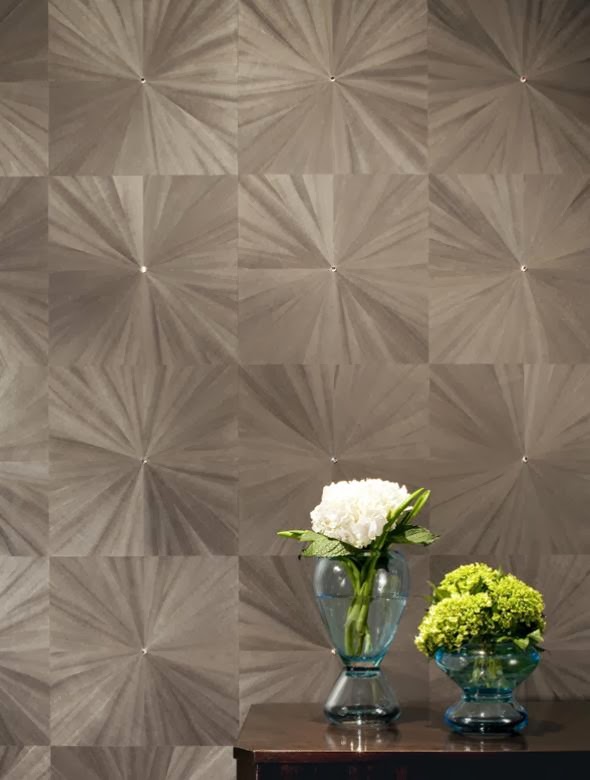
The Ajiro Sunburst line is made from wood veneer but it looks more like squares of ruched silk, gathered into a central point... which comes with an optional Swarovski crystal or pearl to embellish each panel (second image below)!


The company has introduced some new products recently and I really like the raised Croc pattern, and the wonderful visual texture of a line they call River Bed.


Unfortunately, Maya Romanoff passed away this year, on January 15th, 2014, of complications from Parkinson's. Thankfully, his visionary legacy continues with his company.

Maya Romanoff products are handmade by artists and craftspeople at the Romanoff factory in Ilinois.
http://www.mayaromanoff.com/

As I have said in past posts, when I dare to utter the word "wallpaper" to a client, I have been met with looks of horror, fueled by bad memories of 1960s or 70s wallpaper from childhood homes. But as you can see, Maya Romanoff makes a product that is amazingly chic, inventive, and artistic, which can enhance nearly any interior.

I'll be covering (pun intended) more wallpaper in future posts...stay tuned and happy designing!