This year marks the 60th anniversary of one of Mid-Century Modern's most enduring products, the iconic Artichoke Light. But to celebrate it, we need to back up seventy years to before the light was made.
On the Langelinie waterfront in Copenhagen, Denmark, a grand pavilion designed by Vilhelm Dahlerup was erected and housed a restaurant and café as well as the facilities for the Royal Danish Yacht Club. But after a few years, it became evident that a new, larger building was required and the original was demolished to make way for a new structure designed by Fritz Koch. It had a domed, central banqueting hall that now had room for 300 guests. But unfortunately, the Germans occupying Denmark blew it up in 1944 in retaliation for the Dutch Resistance movement. After the war, Copenhagen Municipality launched a competition for architects to submit plans for a new Langleinie Pavilion. Niels and Eva Koppel won for their sleek, modernist take on the new Langelinie Pavilion... a grouping of three squares with the central volume featuring a glass curtain wall. Construction began in 1956...
...and here is where our story really starts. The Koppels commissioned architect and designer Poul Henningsen to create a light fixture for the new pavilion that would provide good light coverage but that would look like a piece of sculpture when not illuminated. Henningsen had created a light in 1925 that featured concentric metal circles that directed light downward onto a dining table or desk, and he took this idea and riffed on it, adding many more baffles to direct light. Based on the organic, Golden Mean Fibonacci sequence, Henningsen created the PH Artichoke Pendant (sometimes called the Pine Cone Light) for the 1958 inauguration of the pavilion where the fixtures remain to this day.
This classic can be seen around the world in residential and commercial settings. It retains its sculptural sense even when lit.
The Artichoke Pendant is still manufactured by Louis Poulsen as it has been since 1958:
"The fixture has 72 leaves, positioned so as to provide totally glare-free light from any angle. To ensure a high level of quality, much of the production process is still carried out by hand. The renowned light fixture has kept its original copper finish, which to this date illuminates spaces with its warm and ambient lighting. With the brushed and polished steel as well as white painted metal models, further members have been added to the PH Artichoke family, highlighting its versatility and timeless sillouhette. In 2018, Louis Poulsen celebrates the design's 60th anniversary with a beautiful new brushed brass edition. This special edition, available exclusively through 2018, will be engraved with PH's signature - PH Artichoke - 1958-2018 - Anniversary Edition, and a unique number. From 2019, the PH Artichoke will be delivered without the anniversary engraving."
If you'd like to own this historic light fixture, contact me--I'd love to design a space for it.
Happy designing!
Showing posts with label Denmark. Show all posts
Monday, October 8, 2018
Monday, October 16, 2017
Snedker Studio's Marbled Wood Flooring
As part of Copenhagen's Snedker Studio, textile designer Pernille Snedker Hansen creates marvelous painted wood floors using the ancient handcrafted art of marbling (the technique used to create classic endpapers for books). By swirling paint onto a fluid surface and dipping planks onto the paint, the marbling design is transferred.
Her Refraction Series #1 fits together beautifully and can be configured in a bookmatched pattern...
...and Refraction #2 can be configured into a chevron pattern.
I think her Wave pattern might be my favorite. She says her aim with this technique is to invoke old-growth tree rings and this pattern feels wonderfully organic.
And for some curves, the Arch series creates a pleasing, rhythmic pattern.
Here's how she does it!
I would love to use these incredible, one-of-a-kind planks for a project. Anyone?
Happy designing!
Her Refraction Series #1 fits together beautifully and can be configured in a bookmatched pattern...
...and Refraction #2 can be configured into a chevron pattern.
I think her Wave pattern might be my favorite. She says her aim with this technique is to invoke old-growth tree rings and this pattern feels wonderfully organic.
And for some curves, the Arch series creates a pleasing, rhythmic pattern.
Here's how she does it!
I would love to use these incredible, one-of-a-kind planks for a project. Anyone?
Happy designing!
Monday, April 11, 2016
Ege Carpet Atelier
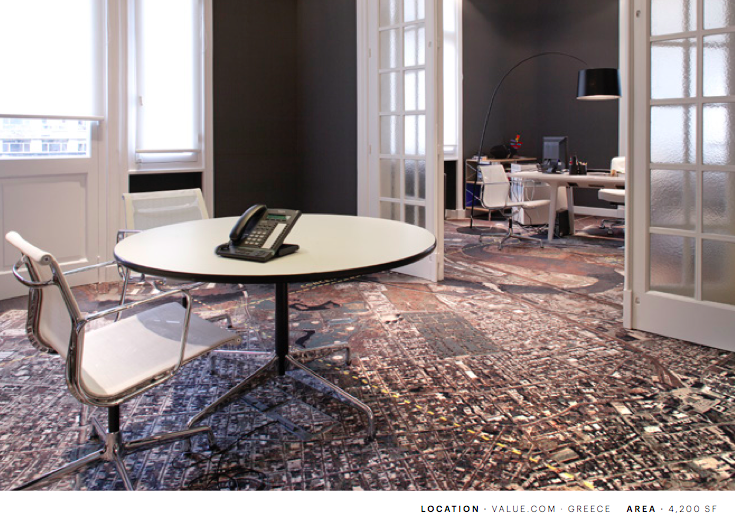
Ege Carpet, designed in New York and made in Denmark have been making floor coverings for 78 years now, so they know a thing or two about it. They even have a wonderful program called Atelier that allows you to design your own bespoke product. If you can imagine it, they can probably put it on a carpet or rug. Look at some of these marvelous examples below like the sand dunes or aerial map that add interest, whimsy...creating a custom rug makes a space truly memorable.
And French fashion designer Christian Lacroix created these amazing carpets for fashion museum Musée Galliera in Paris and art museum Musée Réattu in Arles.
It is vital to incorporate pattern, color, and interest into a room with furnishings but often a floor is overlooked. Even though these photos show carpets in commercial applications, they could work beautifully in any residential setting.
Are you considering adding a special touch to your floors? Give me a call!
Happy designing!
And French fashion designer Christian Lacroix created these amazing carpets for fashion museum Musée Galliera in Paris and art museum Musée Réattu in Arles.
It is vital to incorporate pattern, color, and interest into a room with furnishings but often a floor is overlooked. Even though these photos show carpets in commercial applications, they could work beautifully in any residential setting.
Are you considering adding a special touch to your floors? Give me a call!
Happy designing!
Monday, March 21, 2016
Mid-Century Modern March: The Danish Modern Dining Room
A staple of Mid-Century interiors is the Scandinavian design sensibility referred to as Danish Modern. Starting in the 1920's during the Bauhaus revolution (previously here) Denmark produced a wide range of modernist furniture pieces. The style migrated to the United States in the 40s and thrived throughout the 50s and 60s with talented proponents and designers like Arne Jacobsen and Hans Wegner. Seating and tables were minimal and sleek, generally made from light-colored woods. But nowhere was the Danish Modern style more at home than the dining room. In the 50s and 60s, credenzas, buffets, and sideboards (see here for previous definitions) on spindle or hairpin legs graced dining rooms large and small.
Happy designing!
![]() |
| Hairpin legs on a Danish Modern credenza |
Happy designing!
Subscribe to:
Posts (Atom)


