Showing posts with label Knoll. Show all posts

Monday, March 23, 2026

Know Your Sofas: The Florence Knoll Sofa

For this installation of Know Your Sofas, I introduce you to one Florence Knoll (1917 – 2019), a pioneering American architect, interior designer, and furniture designer who transformed the look and function of the modern workplace as well as residences around the world. A protégée of Bauhaus pioneers and design legends Ludwig Mies van der Rohe and Eliel Saarinen, she co-founded Knoll Associates with her husband Hans. Her approach integrated architecture, interiors, textiles, and furniture into cohesive, functional spaces. And she created one of the most iconic, simple--and most knocked off--pieces of furniture that appeared in nearly every Mid-Century home or office: the Florence Knoll sofa.


Knoll herself referred to her furniture as the “meat and potatoes” of design, by which she meant that her work was foundational, not flashy, designing furniture only when she “needed the piece of furniture for a job and it wasn’t there.” They were, “The fill-in pieces that no one else wants to do.” Yet this very philosophy is what made the sofa revolutionary. With its clean lines, tufted cushions, and sleek metal frame, the sofa brought a sense of order and structure to interior spaces that had often been cluttered and overly decorative. Here is an early sketch of what was to become her signature piece.


Designed in 1954 with an architect’s eye, the Florence Knoll Sofa is all about balance, proportion, and purpose. It provided a comfortable place to sit without disrupting the visual harmony of a room. Its geometric form was inspired by modernist principles, while its materials--often wool upholstery and chromed steel legs--spoke to both durability and modern sophistication. Its adaptability is one reason the Florence Knoll Sofa has endured. Equally at home in a corporate boardroom or a minimalist living room, it became a staple of modern interiors from the 1950s onward and helped define what modern furniture could be. It broke away from ornamentation and embraced clarity. It blurred the line between residential and commercial spaces, helping to usher in the idea of the “open plan” office. And perhaps most importantly, it showed that interior design deserved the same rigor and thoughtfulness as architecture--she was trained by Mies van der Rohe after all!

Image from the Knoll Archive
Florence Knoll seating designs installed in the office of Cowles Publications.
Image from the Knoll Archive
Florence Knoll sofa in a residential setting.
Image from the Knoll Archive

The Knoll sofa continues to be made by Knoll and is available from DWR. It looks marvelous in a sleek, Mid Century setting or in a Haussmannian apartment in Paris with ornate plasterwork!


Happy designing!

Monday, April 14, 2025

Know Your Chairs: The Bertoia Diamond Chair

This installation of Know Your Chairs focuses on a hallmark of mid-century design. Harry Bertoia's wire-framed Diamond chair emerged from the luxury of the time and space required for its creation.


Bertoia was born in Italy but moved to the United States at the age of 15 with his older brother, Oreste. He learned English and studied jewelry making from 1930 to 1936. But in 1937, something happened that would change his life and contribute to art and design in a meaningful way. He received a scholarship to study at the Cranbrook Academy of Art where he encountered Walter Gropius (founder of the legendary Bauhaus School in Germany, previously here), Ray and Charles Eames (influential pioneers of architecture and design, previously here), and Florence Knoll (architect and interior/furniture designer who, along with her husband Hans, started the revolutionary company Knoll Associates, now known simply as Knoll).

After moving from a student of painting to teaching jewelry and metal work, he was recruited to join Charles and Ray Eames in California to work on the development of their molded plywood products. But what happened next is a wonderful example of networking and simply putting yourself "out there" as the saying goes. The official Knoll site describes it well:

"On the suggestion of Herbert Matter, who had worked alongside Eames and Bertoia, Florence and Hans [Knoll] traveled to California and encouraged Bertoia to move east and set up his own metal shop in a corner of Knoll’s production facility. Having studied with Bertoia at Cranbrook, Florence was sure that he would produce something extraordinary if given the time and space to experiment.

Characteristic of the early environment at Knoll, Hans and Florence never demanded that Bertoia design furniture, but instead encouraged him to explore whatever he liked. They simply asked that if he arrived at something interesting, to show them. Needless to say, Harry Bertoia arrived at something outstanding. His iconic wire furniture collection, introduced in 1952, is recognized worldwide as one of the great achievements of 20th century furniture design."


The chair can be used without a seat pad for outdoor--or even indoor--lounging...


The pad provides some cushion and presents an opportunity to introduce color into a space.


The Diamond Chair is also offered with a full body pad!


The Diamond Chair is still in production and can be purchased from Knoll or Design Within Reach!

Take a look at the official Harry Bertoia website to see his marvelous paintings and sculptures as well.

Happy designing!

Monday, April 24, 2023

Know Your Chairs: The Womb Chair

For this installation of Know Your Chairs, let's look at another classic of Mid-Century Modern design: the Womb Chair. Created in 1946 by Finnish-American designer and architect Eero Saarinen (previously here), around the same time he was working on designs for the gateway Arch in St. Louis, he was approached by Florence Knoll who challenged him to make a new kind of chair: "I told Eero I was sick and tired of the one-dimensional lounge chair...long and narrow...I want a chair I can sit in sideways or any other way I want to sit in it...a chair that was like a basket of pillows...something I could really curl up in."

Saarinen set about reinventing the concept of a chair so that it was not comfortable from all the cushioning or padding, but from the actual shape of the chair itself. Wrapping foam around a fiberglass shell and setting it all on a set of splayed steel legs, the organic, welcoming Womb Chair was born. Speaking to the chair's name, Saarinen said, "It was designed on the theory that a great number of people have never really felt comfortable and secure since they left the womb. The chair is an attempt to rectify this maladjustment in our civilization. There seemed to be a need for a large and really comfortable chair to take the place of the old overstuffed chair. Today, more than ever before, we need to relax."


This classic of modernist design is still available from the original manufacturer and license holder, Knoll.

Happy designing!

Monday, December 12, 2016

Know Your Chairs: The Platner Chair

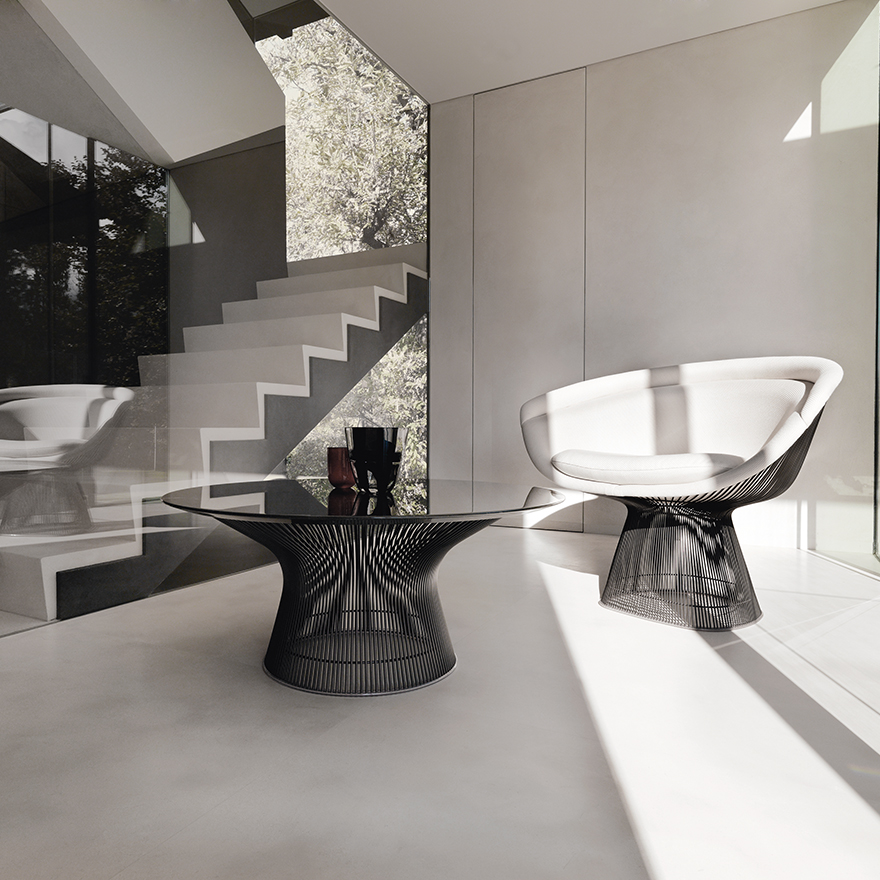
Warren Platner started out as an architect but he will forever be known as a furniture designer and interior designer. He was a member of Eero Saarinen’s office (previously here) from 1960 to 1965, participating in the designs for the Dulles International Airport in Washington, D.C., the Repertory Theatre at Lincoln Center, and John Deere World Headquarters. But it wasn't until 1966 when he unveiled through Knoll his classic Platner chair collection that he found his true calling. All the pieces--except the Platner Loveseat which is no longer made--have been in continuous production since their introduction and each sculptural base of these staples of modernist design is made up of hundreds of steel rods which take over one thousand welds to manufacture!


Warren Platner was inducted into Interior Design magazine’s hall of fame in 1985. Until falling ill, Platner was still active in his firm, working on projects. He died in 2006 at the age of 86.

The Platner Arm Chair--
can be bought from Knoll here


The Platner Easy Chair--
can be bought from Knoll here


The Platner Lounge Chair--
can be bought from Knoll here


Happy designing!

Monday, April 7, 2014

Know Your Chairs: The Barcelona

Ludwig Mies van der Rohe was a legendary architect and one of the founders of Modernism. But aside from designing the structure, he often designed the furniture and furnishings that were to go in his buildings as well. Such is the case with what has come to be one of, if not the most famous chair designs in history: the Barcelona Chair.


In 1929, Mies (as he was referred to...sounds like Meez) was tapped to design the German Pavilion at the International Expo which was being hosted in Barcelona, Spain. This pavilion was to exemplify the new Weimar Republic, and according to the Commissioner of the Expo, Georg von Schnitzler, to give "voice to the spirit of a new era." So Mies designed a glorious building of steel, glass, travertine, marble, and red onyx. The result was a breathtaking space, spare, low, and radically new and utterly modern. It was not to house any trade exhibits but was to remain empty. The building itself was seen as the exhibit.


Mies designed some equally spectacular, minimalist furniture to occupy this radically minimalist space. The Barcelona chair was composed of tilted planes affixed to gracefully curved steel X legs below. The original chairs, along with their accompanying ottomans, were made of tufted ivory colored pig skin but subsequent versions were made of leather. The classic color now seems to be black, but can be made in white, black, or brown leather to fit with various color palettes. Although there are many unlicensed knockoffs and "versions" whose proportions are not quite right, the venerable modernist furniture manufacturer Knoll owns the rights to the authentic Barcelona Chair. Visit their site, http://www.knoll.com/, to order.


Without any forward thought or regard, the pavilion was destroyed in 1930, almost immediately after the Expo closed. But thankfully the structure was rebuilt between 1983 and 1986, using extant original plans and photographs as a guide, and is permanently on display at an alternate site in Barcelona. Visit the official site below for information about location and how to visit.

http://www.miesbcn.com/

The Barcelona chair compliments nearly any décor scheme from ethnic and eclectic to, of course, modern, whether mid-century or miminalist. You might find the Barcelona to be a good fit for your space.

Happy designing!