
Formed in the late Victorian period (previously here), the movement known as Arts and Crafts came into being as a way to protest the new, and to some the menacing, Industrial Revolution. Roughly between 1880 and 1920, there arose a mistrust and dislike of machine-manufactured furniture and home goods. These objects were seen as too ornate simply for its own sake, soulless, tasteless, and removing humans from the natural world. There were dozens of high profile designers and architects, several of whom I will mention here, but they all felt what was lacking in the modern machine age was the touch of the craftsman, a sense of an object being made by hand out of an organic material like wood and stone.
It is understandable that the movement originated in Great Britain, the first part of the world to really see the proliferation of the Industrial Revolution. Major proponents of this movement include William Morris and Charles Rennie Mackintosh.
William Morris' Wiki entry exhaustively lists him as a "textile designer, poet, artist, novelist, architectural conservationist, printer, translator and socialist activist" and while all of that is true, he is most remembered for his textile and wallcovering designs. Influenced by the flat presentation of Japanese wood block prints and featuring natural, organic motifs, many of these original wallcoverings and fabrics are currently in production through Morris & Co. owned by the Sanderson Group.
 |
| William Morris, age 53 |


Compatriot and fellow Arts and Crafts figure Charles Rennie Mackintosh, previously here in a Famous Homes post, created his own visual vernacular with his wife, the artist Margaret Macdonald Mackintosh. Also inspired by Japanese wood blocks and the honesty of handmade crafts, Mackintosh worked with even simpler shapes and forms that look more like cloisonné. Look at these rose designs made for the Mackintosh's masterpiece, Hill House, created for publishing magnate Walter Blackie in Helensburg, Scotland.
 |
| Charles Rennie Mackintosh |


It took a little while but Arts and Crafts eventually made its way to North America and held sway from roughly 1910 to 1925 or so. There were many different Arts and Crafts societies that sprang up around the United States, all dedicated to simplicity of form and design along with integrity of construction. Major figures included Gustav Stickley who made furniture that featured mortise and tenon construction reminiscent of traditional Japanese joinery, and Elbert Hubbard who created the Roycroft community of craftsmen in upstate New York. These legendary brands are again in production and can be purchased through Stickley.com. This style of furniture is often referred to as Mission Style but in actuality, Stickley rejected that name, claiming it to be misleading. The name refers to the Spanish missions of California and can be traced back to a very simple, chunky, near-Shaker chair made by A.J. Forbes around 1894 for San Francisco's Swedenborgian Church. New York furniture manufacturer and retailer Joseph P. McHugh copied these chairs and created a coordinating line of furnishings which resembled the pieces coming from the Arts and Crafts movement at the time. Thus the term Mission was born.
%2520Stickley%2520sideboard%25209005.02.jpg)


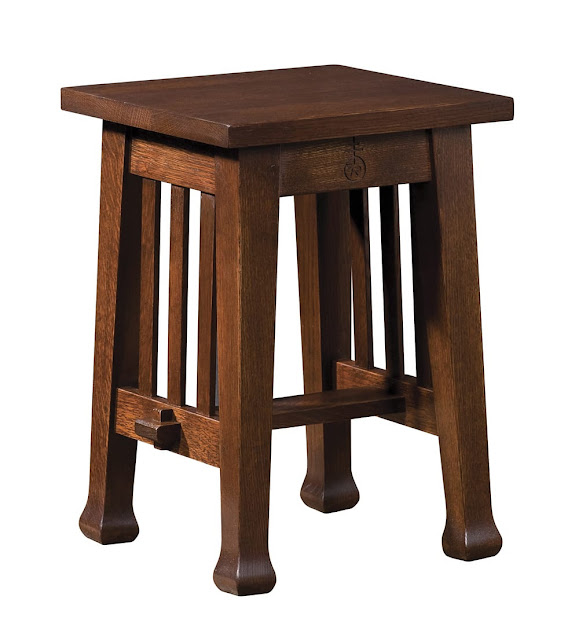
On the West Coast, Arts and Crafts manifested with the work of architects Julia Morgan and brothers Greene and Greene as American Craftsman (an offshoot of this is Frank Lloyd Wright's Prairie Style which we will examine in a future post of History of Furniture, as it deserves its own section). They each created buildings and interiors that changed the way people lived. Indeed, Greene and Greene's contributions led to the evolution of what is still referred to as the California Bungalow style which is seen everywhere in cities like Berkeley, Venice, and Pasadena.
 |
| Julia Morgan, St. John’s Presbyterian Church, Berkeley, Calif., 1908–16. Julia Morgan Collection, Environmental Design Archives, University of California, Berkeley |
Greene and Greene's masterpiece is the Gamble House in Pasadena, California. Built for David B. Gamble, son of the Procter & Gamble founder James Gamble, the home is a National Historic Landmark, a California Historical Landmark, and open to the public for tours and events. Tour tickets can be purchased at Gamblehouse.org.


There was also a great interest in pottery and metal work in the Arts and Crafts movement, as evidenced by the iconic mica-shade copper lamp, and many pottery companies like Grueby, Newcomb College, Rookwood, Roseville, and Weller.


