Monday, April 25, 2022

Know Your Chairs: The Throne Chair by Carlo Bugatti

For this continuing series of Know Your Chairs, I want to share a very special creation. Known as The Throne Chair, this incredible--and incredibly rare--piece of furniture was designed by Carlo Bugatti.


If his name sounds familiar, his son Ettore went on to create the esteemed Bugatti automobile, and other son Rembrandt Bugatti became a renowned sculptor. Carlo was born in 1856 in Milan which, at that time, was not part of Italy but part of the Kingdom of Lombardy (the Kingdom officially became part of Italy in 1866). He studied both at the Brera Academy in Milan and the legendary Académie des Beaux Arts in Paris. Starting in 1880, he began to manufacture furniture, working in Milan and Paris. And around the turn of the century he seemed to hit his stride, creating stunning, one-of-a-kind pieces. But nothing quite beats his Throne Chair.
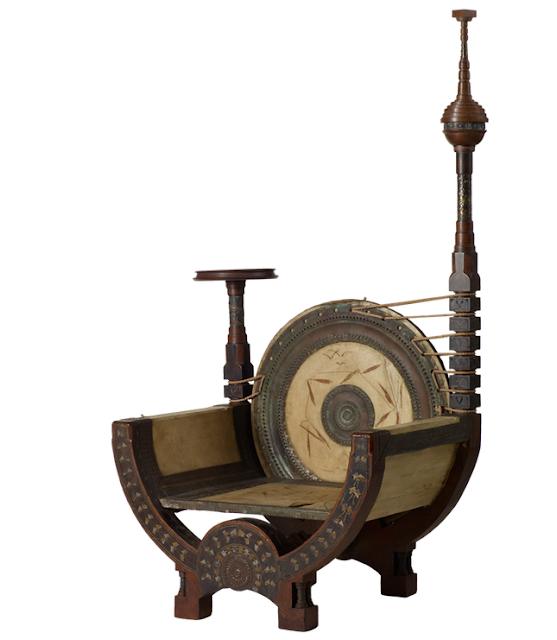


The asymmetrical Throne Chair feels a little Moroccan, West African, maybe Mongolian, with a bit of Egyptian thrown in, perhaps a little Gothic as well, all seen through an Art Nouveau lens. It was, after all, created smack dab in the middle of the Art Nouveau movement in Europe during which a fascination with all things "Orientalist" blossomed. This trend covered any area that was considered "exotic" to Western Europe like Egypt, Turkey, all the way to Japan. And the Throne Chair includes materials and craftsmanship that represent those areas: wood inlaid with bone and metal, copper, rope...and the round shield seat back features a painted vellum insert on brass.

Of course there is no current Bugatti furniture studio, no one "holds the rights" to any of his pieces. We only have what reamins of his creations. Bugatti himself kept no production records so it is impossible to tell how many pieces he created, much less how many Throne Chairs exist. Some estimates put his creations at less than 1,000 pieces of furniture in total, if that. In fact, a Bugatti Throne Chair last sold at auction for $30,000 several years ago...and I suspect the next time it comes up, it will sell for much more than that.

Happy designing!

Monday, April 11, 2022

Fiorito Interior Design Press Update, March 2022

I am proud to share that Fiorito Interior Design was featured on Houzz in an article by interiors journalist Jo Simmons entitled "Small Indulgences to Enhance Everyday Life." A photo of the English-French Manor House-Style kitchen I recently posted here is mentioned under a category extolling the pleasure of having fresh cut flowers in one's home. The yellow tulips in the blue and white kitchen certainly bring a bright delight to the space.


Thanks Houzz and Jo for featuring my work.
Photo by Bernardo Grijalva.

Happy designing!

Monday, March 28, 2022

An English-French Manor-Style Remodel by Fiorito Interior Design

It is sometimes a surprise what beauty can lurk under the surface of a room. A client with a 1970s kitchen and eat-in area cut up by an unwieldy peninsula was desperate for it to reflect her love of all things English-and-French-Manor-Home.

Working closely with my client, we removed the peninsula in favor of a lovely free-standing island that we painted a shade of French Blue. This is topped with Old World sink hardware (note the ceramic HOT and COLD medallions on the faucets!) and a gorgeous marble counter with a very special edge profile that evokes an antique French Boulangerie counter from the 1910s. Pendants with patinaed metal shades over the island further the charming Old World feel. Handmade white and blue tiles laid in a quilted diamond pattern cover the backsplash, and the remainder of the cabinetry at the perimeter is in a warm cream tone.

The eat-in area near the fireplace got a cozy treatment with custom seat cushions and window seat bench cushions in a classic blue-and-white Toile de Jouy matching the island stools.

The nearby living room got a similar treatment. We removed dark wood paneling and dark carpeting in favor of a light sky blue wall and lighter wood flooring. A new rug with the appearance of an heirloom, a new grand-scaled sofa, and some of my client’s precious antiques helped take the room from 70s rec room to English Sitting Room.


All photos by Bernardo Grijalva.

Happy designing!

Monday, March 14, 2022

Know Your Sofas: The Camaleonda Sofa

Let's face it, there were a ton of super-cool sofas designed and manufactured by super-cool furniture designers in the 1960s and 1970s. The Togo sofa by Michel Ducaroy (here), the Terrazza sofa by de Sede and Ubald Klug (here), the Élysée Sofa by Pierre Paulin (here), and the Serpentine sofa by Vladimir Kagan (here). And to this illustrious list in our series Know Your Sofas, I am delighted to add the equally super-cool Camaleonda sofa by Mario Bellini.


Born in 1935, Mario Bellini's amazingly varied and prolific design career started in 1963. Among many other thihngs he was, and you might want to sit down for this, chief product designer at Olvetti from 1963 to 1991, designed furnishings for B&B Italia and Cassina and Natuzzi, hi-fi systems, headphones and electric organs for Yamaha, lamps for Artemide, Erco and Flos, office furniture for Vitra, and was an auto deisgn consultant for Renault. And he has twenty-five of his designs in the permanent design collection of the New York MoMA. Wow. As of this writing, Bellini is 87 and still designing at his studio Mario Bellini Architects.

But back to his Camaleonda sofa...designed for B&B Italia in 1970.  In a 2020 interview with Architectural Digest, Bellini said, "I crossed two words: camaleonte, or chameleon, an extraordinary animal capable of adapting to its environment, and onda, or wave." This portmanteau is a perfect word for modular seating that can be arranged in many different ways to suit a specific room or environment. Here it is in an original B&B Italia advertisement in 1971.

Photo: Bruno Falchi and Liderno Salvador

The sofa is held together with an ingenious system of cables and hooks. And I love how the upholstery ends up looking like it is draped rather than tightly tacked down.


Here it is in the Malibu home of Beastie Boy Mike D. 

Photo by Trevor Tondro

And here it is in the amazing Brooklyn townhouse of Athena Calderone as featured in architectural Digest in 2018.

Photo by Gieves Anderson

Although the sofa went out of production in 1979 and originals auction off for more than a pretty penny, B&B Italia, the original manufacturers, have brought it back, now featuring recycled and recyclable materials.


Happy designing!

Monday, February 28, 2022

History of Furniture: The Conversation Pit

For this installment, let's look at something that is not so much an actual piece of individual furniture as much as it is a structure: The Conversation Pit.

Although sunken seating has roots far back in history, particularly in Asian countries, interior design lore suggests that the first real conversation pit as we know it today was created by Bruce Goff, an American architect, for a home he designed in 1927. Conversation pits became something of a signature in his home designs but it wasn't until the 1950s that the idea caught fire and spread, showing up in the 60s, 70s, even into the 80s!

Perhaps one of the best known examples of a conversation pit is in the Miller House, the mid-century masterpiece designed by Eero Saarinen with interiors by the incomparable Alexander Girard. It was Girard who suggested the conversation pit so as not to clutter the space with furniture pieces that would have impeded the view and interrupted the lines of Saarinen's architecture.


Another spectacular example of a conversation pit, on a grand scale, is another Saarinen design: the TWA Terminal at JFK which is now the fabulously retro TWA Hotel!


Conversation pits could be found in ordinary residential designs as well!


Eventually, like any element from pretty much any era, conversation pits started to look dated and fell out of favor. But word is they are making a comeback in interior architecture and design. Here is a current, superb example by architect Craig Steely who embedded a marvelous sunken pit into the concrete foundation of a home in the hills of the Santa Cruz Mountains. Steely says the pit "is filled with 144 sq. ft. of B&B Italia’s 'Tufty time' sofa components." In deep purple. Delightful.


Happy designing!

Monday, February 14, 2022

A Salute To Bedrooms... For Valentine's Day 2022

Since today is Valentine's Day, I thought I would re-share a popular post from the past: a salute to sensuality featuring some luxurious, fun, luscious boudoirs.

One of the most basic ways to create an inviting bedroom retreat is to simply make the bed itself seem inviting. A padded and tufted headboard, as seen in the two photos below, sets the stage for a bed that appears sprawling, substantial...a comfortable place to spread out, a tranquil spot to relax on, a soft sensuous spot to roll around in...

A bed with an attractive base and headboard signals a sense of place and purpose.
In the first photo, the bed seems like a cushy cloud nestled on a plinth of warm, rich leather. Second image: the soft blue headboard and footboard by Jay Jeffers announces itself in this superbly relaxed yet sophisticated room.

http://jeffersdesigngroup.com/

Layering soft, sumptuous textures is another way to add a decadent sense to a bedroom. In the tactile room below, designed by Eric Kuster, we see hair-on-hide panels on the anchor wall, and a soft faux fur throw plays well with velvets and satins.

http://www.erickuster.com/

Speaking of fabrics, another way to soften a bedroom is to use fabric panels on the walls, a technique I have successfully used for clients. You can use drapery panels as a floor-to-ceiling headboard, like the first image. Or you can run panels along an entire wall, like Elizabeth Gordon did in the second image below. It's also good for dampening sound (wink wink).

http://www.elizabeth-gordon.com/

A dark color palette in a bedroom says moody, exotic, and romantic.
The first image below by designer Smith Boyd features a delicious palette of browns, taupes, and greys along with textures like leather. The wood-grain striped wallpaper creates a natural, slightly wilder feeling that is tipped a little to the masculine side. The feeling of the dark purple Arabesque wallpaper in the next image is carried through by the Rococo mirrors and night tables... it feels like a fantasia on Mozart's "Abduction From The Seraglio!"

http://smithboydinteriors.com/

And think about dramatic, steamy, over-sized photos for an addition of extra sass and whimsy.
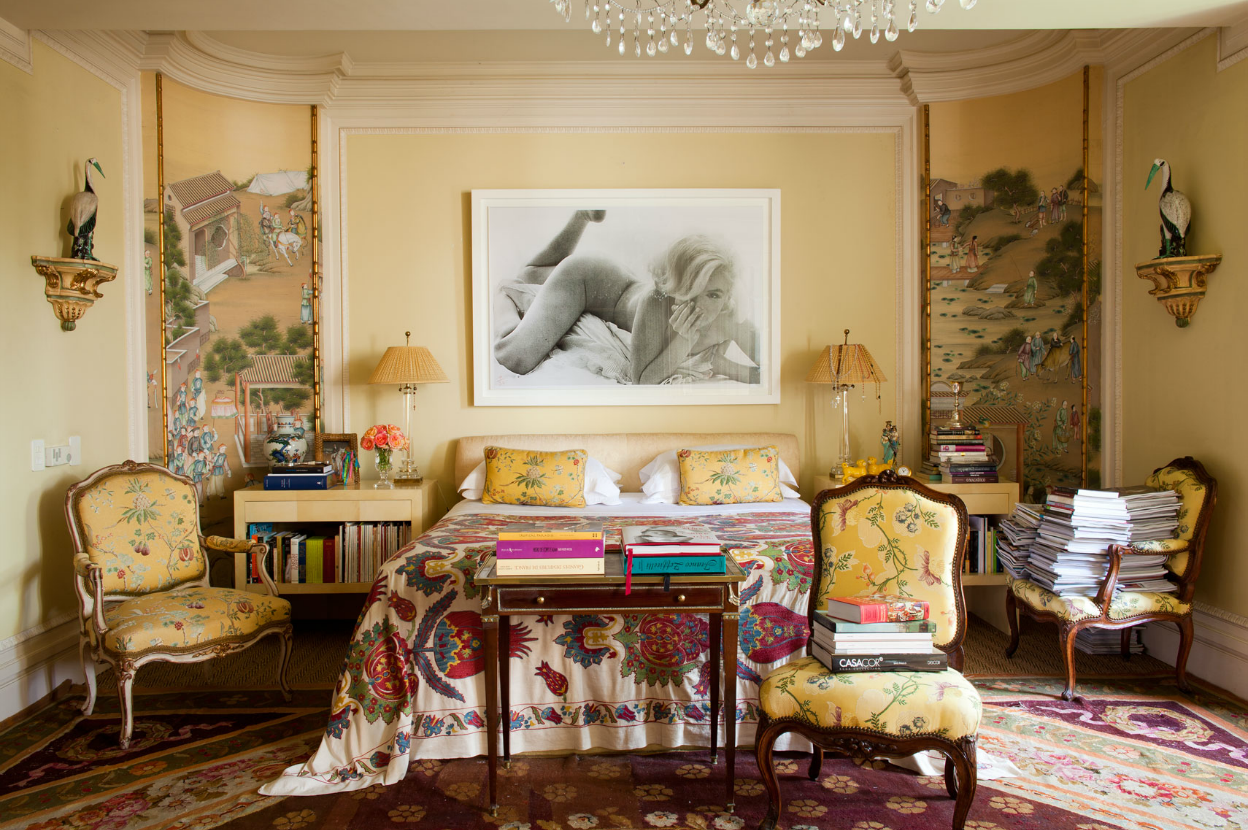
In the first photo, Amanda Nisbet's wild room for the Kip's Bay Showhouse uses a photo of pink glossed lips by Marilyn Minter. Another Marilyn, this one Monroe, presides over the bedroom of Brazilian architect Jorge Elias and his wife Lucila in the second image. I love how the lightness, curves, and playfulness of the photo (and its subject) contrast with as well as compliment the Chinoiserie feel.

And finally, I must report that I have tried to give equal time but I can't find an image of a bedroom that uses sexy images of men, which seems a little unlikely... there have to be some expertly designed bedrooms out there with a painting of a male torso or even a stylized Tom of Finland image. If any of my readers come across such a thing, let me know!

http://amandanisbetdesign.com/
Above photo by Trevor Tondro

http://www.jorgeelias.com.br/
Above photo by Roger Davies

And notice how, in all of these images, extra pillows offer more visual comfort as well as more opportunities to introduce color, texture, and pattern. I hope I have inspired you to think about ways to enhance your bedroom, and to make it even more of a special "destination."

Happy Valentine's Day and happy designing!

Monday, January 31, 2022

Porcelain Tiles Mimic Shou Sugi Ban

Italian tile manufacturer Casalgrande Padana have created a wonderful porcelain plank tile that mimics the look of the centuries-old Japanese technique of Shou Sugi Ban, which means burnt cedar beam in Japanese. Originating in the 1700s, the method where cedar planks are charred and then sealed with natural oils, making them a unique material for building, is also known as Yakisugi.

 
 And Casalgranda Padana captures the rusticity and marvelous darkened wood grain in a porcelain tile. Available in 9mm thickness, the planks are made in a single standard size of 8" x 48".


The planks come in six different colorways but the ones that look most realistic are black and brown...


I can see some great uses for this product, adding warmth and an organic sense to any space whether on a floor or wall!

Happy designing!

Monday, January 17, 2022

Vaulted vs. Cathedral Ceilings

I last posted about ceiling styles way back in 2014 here, and since then I have heard people speak of the difference between vaulted and cathedral ceilings, so I thought I'd take this opportunity to talk about these two additional ceiling styles and what they look like.

Even though the terms re used interchangeably, a vaulted ceiling and a cathedral ceiling are different.

Instead of being flat, like most ceilings in residences, a cathedral ceiling rises from the ceiling, mirroring the external roof line, to meet at the center, typically at a central ridge beam.

A cathedral ceiling can be simple...


...or it can feature tongue and groove siding...


...or it can even feature beams. The ceiling, both inside and out, in the image below shows a cathedral ceiling in what appears to be a classic Eichler home.


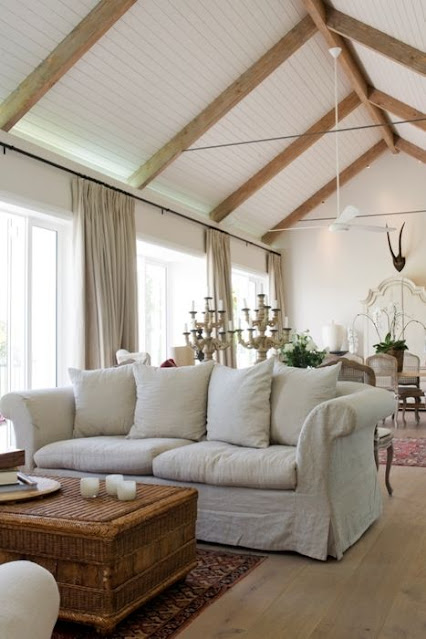
And here is a ceiling with wooden beams which lend a more rustic sense.


A cathedral ceiling can even sport trusses which are exposed cross beams that hold up the ceiling framing.


A hallmark of a cathedral ceiling is its symmetry. By contrast, a vaulted ceiling does not have to follow the roof line and can be contoured to many other shapes like the barrel vaulted ceiling I wrote about in my original ceiling post. The two sides do not have to be the same pitch or size.


As I previously mentioned, a vaulted ceiling can be barrel shaped...


...or it can be what is called "groin vaulted," a style seen in Romanesque churches. The unique shape is made by intersecting two barrel ceilings at right angles.


A vaulted ceiling can even take the shape of a dome.


Happy designing!