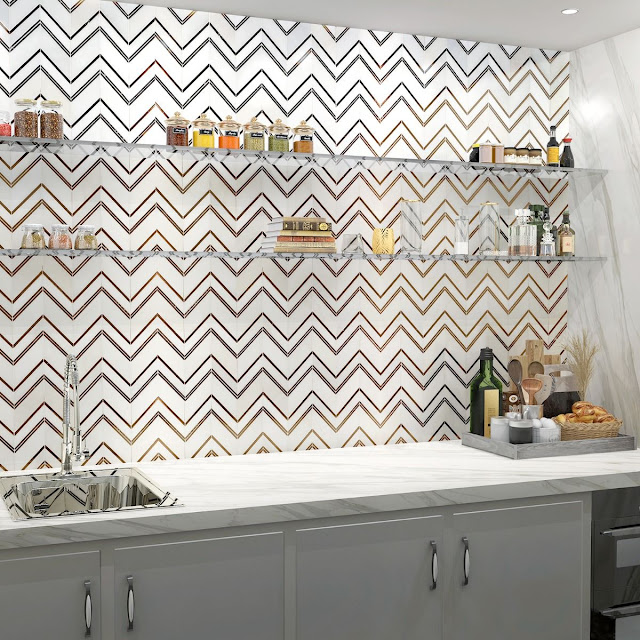
Showing posts with label tile. Show all posts

Monday, February 23, 2026

Choosing A Kitchen Backsplash: From Classic Tile to Unexpected Materials

The kitchen backsplash is no longer just a practical feature—it’s a style statement. Gone are the days of a skimpy four to six inch run of material above the counter. Whether you're contemplating a cosmetic refresh or a full-on kitchen remodel, choosing the right backsplash can completely transform the look and feel of the space. With so many materials available from timeless tile to bold concrete or sleek metals, there’s something for every style and budget.

1. Classic Tile: Endless Styles and Patterns
Tile is the most traditional and versatile option for a backsplash. Whether it’s classic subway tile, intricate mosaic patterns, or hand-painted ceramics, tile offers endless customization. The most popular choice for a tile backsplash is porcelain since it is such a durable, maintenance-free material. But you can also look at tiles of other materials such as glass, metal, or stone. Mixing a gloss and matte version of a single tile can look intriguing for the subtle play of light, but for more drama, you can mix different materials for a completely unique style. Using grout colors that either blend or contrast depending on the material and what kind of feeling you want to create offers another chance for self-expression.

Black subway tile with white grout in kitchen by Corey Damen Jenkins
Small stone mosaic backsplash in kitchen by Fiorito Interior Design
Glass subway tiles in kitchen by Fiorito Interior Design

2. Glass: Sleek, Modern, and Reflective
Glass backsplashes offer a sleek, seamless look and reflect light beautifully, making your kitchen feel brighter and more open. You can choose from clear, frosted, or back-painted glass in any color. A full-height glass slab backsplash (instead of just a strip) creates a bold, contemporary effect. Reverse painting (called eglomisé) offers an array of design possibilities.

Glass sheet backsplash by Steffen Welsch Architects
Glass sheet backsplash by Griffin Enright Architects
Hand-painted eglomise backsplash by Billet Collins

3. Natural Stone: Rich Texture and Elegance
Marble, travertine, granite, and slate backsplashes bring natural texture and a sense of luxury. Each stone is unique, so you get a one-of-a-kind design. For a high-end look, I like to use the same material for the backsplash that was used for the counter top material. It makes the space feel more expansive. If however you would like to use a different material for the splash, I always let one of the materials be the star of the show. If you want to use a highly patterned backsplash, then a quieter counter top with little to no movement allows the splash to shine without creating a fight between materials.

Slab splash and counter in kitchen by Cari Giannoulias
Bookmatched stone slabs in kitchen by Everage Design

4. Quartz: Durable and Low-Maintenance
Quartz backsplashes are non-porous, easy to clean, and just like the stone options shown above, can match or contrast with quartz countertops. They offer a seamless, polished look without the maintenance of natural stone. Make sure to buy a reputable, well-known brand that has a high quartz to binder ratio for structural integrity.

Empira White quartz by Caesarstone
Primordia quartz by Caesarstone

5. Stainless Steel: Industrial Meets Chic
Stainless steel is heat- and stain-resistant, easy to clean, and offers a cool, industrial vibe. It’s especially popular in chef-style kitchens. Go beyond plain panels—consider pressed patterns or a brushed finish to add depth.

Stainless steel backsplash in kitchen by Cary Bernstein Architect

6. Other Metals: Brass, Copper, and Tin
Metallic backsplashes can add warmth, glam, or vintage charm. Brass and copper age beautifully, while tin offers an ornate, old-world aesthetic.

Brass backsplash
Copper backsplash by Halman Thompson
Pressed tin backsplash

7. Concrete: Raw, Edgy, and Modern
Concrete brings a raw, urban feel to the kitchen. It can be cast in panels or troweled directly onto walls for a seamless finish. So your kitchen doesn't feel too cold or sterile, you can combine with wood or warm tones to soften the industrial edge. (If the thought of real concrete is too much, there are porcelain tiles and quartz materials that accurately mimic the look and color of concrete!)

Concrete backsplash
Waxed and sealed concrete backsplash

8. Wood: Warm and Unexpected
Wood as a backsplash is a very unconventional choice but offers incredible warmth and texture. Reclaimed wood offers a great, organic and rustic look, or try slatted panels for a sleek Mid-Century or Scandinavian style. Keep in mind however that wood is a natural and highly porous material so use around a wet area means your wood must be sealed, preferably with a marine-grade varnish to keep it stain-free. With the right sealant, this material can be surprisingly durable. Additionally, there are porcelain tiles that mimic the look of plank wood and slatted wood that will provide the same look without the worry.

Wood backsplash and live edge countertop
Slatted wood backsplash

I like to think that choosing a kitchen backsplash is about more than just protection—it’s a design decision that can define your kitchen's character. Whether you're going for classic elegance, modern minimalism, or something totally unique, there’s a material out there that’s perfect for your vision. If you'd like to explore these and even more options, give me a call!

Happy designing!

Monday, September 29, 2025

How To Freshen Up Subway Tile

In light of one of my recent posts about types of backsplash materials seen here, let's take a deeper dive and look at one of the most enduring choices. I am sure everyone is familiar with the traditional subway tile. Most often seen in white, sometimes in a gloss finish, this tile can look right at home in certain designs (especially vintage bathrooms) but can be a bit overused these days. The standard installation is to create what is called a "running bond" layout, where the tiles are laid horizontal and the grout lines line up with the middle of the tile below and above it.


If you still like the look of subway tiles but want a new perspective, you can try the following alternate tile layouts!

Instead of a running bond (or half offset), you can opt for a third offset, which is where the grout line of the tile above and below falls about a third of the width of the tile.


But if you don't want any offset, you can create a much sleeker, modern look by using a horizontal stack bond where all the grout lines and tiles are lined up.

Tile by MSI

by RWB Designs

For a twist on this layout, you can turn the tiles so they run vertically!
by Kristen and Joe Cole via AD
Tiles by WOW Tile

And for a twist on the twist, you can combine this vertical layout but use a half or a third offset!


Happy designing!

Monday, July 7, 2025

Tile AND Wood: Why Not Both?

If you can't make up your mind between a tile you love and the warmth of wood, why not opt for both?

by Jeff Schlarb

by Kingston Lafferty Design

by Benjamin Wood


If you'd like to explore some creative designs for your own floors, give me a call!
Happy designing!

Monday, October 9, 2023

Sibling Patterns: Herringbone and Chevron

In the world of interiors, there can be so many names for so many different types of materials and patterns which can lead to confusion. A pair of patterns that, much like siblings who look alike, can be mistaken for one another are the herringbone and chevron. But there is one easy way to tell them apart.

Both patterns depend on strong diagonal lines. In the case of tile, shown in the photos below, or wood plank flooring, the planks or rectangular tiles will be placed at a diagonal. But it is how the ends are finished that determines which pattern it will be.

A herringbone pattern leaves the tile or plank as it is and simply lays them next to each other, without any cutting or adjustments. The staggered layout is reminiscent of a zipper's teeth...

Herringbone floor in bathroom by Fiorito Interior Design

By contrast, a chevron pattern is basically the same thing but with the ends cut at an angle so the join becomes a straight line instead of a staggered/overlapping intersection, like a herringbone.


Happy designing!

Monday, June 6, 2022

New Ravenna + Gracie = Gorgeousness

I just came across a collaboration between Exmore, Va.-based mosaic tile manufacturer New Ravenna and venerable wallcovering manufacturer Gracie (since 1898!). New Ravenna is creating glass mosaic panels based on Gracie wallcovering patterns and the results are amazing. Together, they have created five different offerings, each in two colorways.

Blythedunes, a hand-cut jewel glass mosaic shown in Lapis Lazuli, Iolite, and Covellite, with Sea Glass™ Absolute White, is part of the Gracie collection for New Ravenna.


Here it is shown in jewel Agate, Quartz, Amber, Alexandrite, Tiger’s Eye, Sardonyx, Garnet, Ruby, Carnelian, Covellite, Rhodolite, Olivine, Schist, Tortoise Shell, and Obsidian with Sea Glass™ Tanzanite. It is clearly handmade in bespoke sizes.


The French Deco pattern feels vaguely Asian, shown in jewel Absolute White and honed Dawn Mirror. It is also availabel in a more naturalistic colorway using Peridot with Sea Glass™ Absolute White.


Linda's Garden , named for an ancient frescoed Roman villa Linda Gracie admired on her travels to Italy uses jewel Agate, Amber, Citrine, Peridot, Alexandrite, Jade, Schist, Lavastone, Tourmaline, Labradorite, Zircon, Jasper, Champagne, Opal, and Moonstone with Sea Glass™ Serpentine. A warmer colorway uses Citrine, Quartz, Agate, Amber, Tiger’s Eye, and Tortoise Shell, and Sea Glass™ Ruby.


Wave and Blossom, a pattern that feels even more Deco than the French Deco above, uses some pretty lixe colors and materials: Tortoise Shell, Amber, Tiger’s Eye, Jasper, Obsidian, 24K Gold, Dawn Mirror, Moonstone, Alabaster, Champagne, and Rhodolite with honed 24K Gold. The cooler colorway uses Lavastone, Mica, Pewter, Amber, Champagne, Marcasite, and Opal with Sea Glass™ Absolute White.


Finally, a pattern based on the classic Japanese wave design by Hokusai features  realistic and sepia-toned colorways with Marcasite, Zircon, Mica, Pewter, Opal, and Moonstone with Sea Glass™ Moonstone and Absolute White.


These stunning mosaic panels deserve pride of place in a grand walk-in shower or surrounding a luxurious soaking tub. I can't wait to install one for a client...maybe it could be you?

Happy designing!