The architect, artist, and designer Charles Rennie Mackintosh is credited with helping to creating a genre of art and design known as the Glasgow School (a streamlined version of the concurrent Art Nouveau style, previously here), and his exemplary masterpiece, Hill House, is the subject of this month's installment of Famous Homes.
Located in Helensburg, Scotland--about 25 miles north-west of Glasgow--Hill House started as a plot of land purchased in 1902 by publishing magnate Walter Blackie. He intended to have a home built for his family and Blackie's friend Talwin Morris recommended architect Charles Rennie Mackintosh to create it. After seeing other homes he designed, Blackie hired Mackintosh. It seems it was a perfect match as Blackie's style direction for the house--no bricks and plaster or wood beam construction, and no red-tiled roof, but grey rough cast walls, and a slate roof instead--dovetailed neatly with Mackintosh evolving work within the Glasgow School. And in 1904, Mackintosh delivered just that.
All of the interiors were designed by Mackintosh as well, along with his wife, the artist Margaret Macdonald Mackintosh. Between them, they created a unique, bright white interior that supported the Mackintoshes belief that a minimalistic exterior should shelter an extraordinary interior. Textiles, rugs, furniture, fittings, and lighting fixtures were designed by the Mackintoshes as well as art work. Margaret Macdonald Mackintosh's gesso panel Sleeping Princess resides here along with some lovely embroidered textile hangings in a bedroom.
Along with highly stylized florals, the rectilinear design of the interior is emblematic of Mackintosh, especially the use of perforated squares seen at the top of the classic ladder-back chair he designed specifically for this house, and which is currently available through license-holder Cassina here.
To clad the exterior of Hill House, Mackintosh selected portland cement harl, then a newly introduced product, for the surface finish but this was found to be less durable than traditional lime harl and by 2017 it was discovered to be in a precarious, soggy condition, putting the integrity of the whole building at risk of sever water damage. But the National Trust have built a very ambitious structure around the house to protect it. Their website describes it:
Mackintosh was a revolutionary designer, but the materials and techniques at the cutting edge of architectural design in 1900 haven’t withstood a century of the west of Scotland’s harsh, wet weather conditions.
The external render of the property has not proved watertight and the walls have gradually become saturated and are crumbling, with water now threatening the interiors.
If we don’t act soon, the house will be irreparably damaged and we’ll lose its iconic architecture and unique interiors forever.
We’re embarking on a 10-year conservation programme, which will allow continued public access to the house, but also offer views of the Hill House that have never been seen before, even by Mackintosh himself. Stage one opened to visitors in early June 2019, with a protective steel frame structure covered in chainmail mesh, featuring walkways around and over the top of the house. This structure, along with a new visitor centre, will deliver a unique heritage visitor experience.
You can visit the Hill House in Scotland and see The Box as well as eat some delicious Mackintosh inspired treats at the cafe. See the website for details.
Happy designing!
Monday, July 27, 2020
Monday, July 13, 2020
Flexible Trim
I just discovered a great product for exterior and interior window and door trim that is bendable and flexible! Flex-Trim, based in North Carolina for the east coast and Utah for us folks here in the west coast, makes an exciting product that saves money and time.
Their Flex Trim™ is made from a unique polymer resin blend, easily allowing the product to follow a curve or radius.
Their premium product ZzzzFLEX™ is made from an elastomer composite which is extremely strong, durable, and stainable.
Ultra-Flex is a syntactic polyurethane compound with a cellular composition structure similar to wood. One of the main advantages of this material is that it 40-50% lighter than other flexible moulding formulations, yet retains the necessary strength and durability. It comes PRE-PRIMED for superior painting and staining and is “back sanded” for better glue adhesion.
I'm inspired to put curves and arches everywhere now!
Happy designing!
Their Flex Trim™ is made from a unique polymer resin blend, easily allowing the product to follow a curve or radius.
Their premium product ZzzzFLEX™ is made from an elastomer composite which is extremely strong, durable, and stainable.
Ultra-Flex is a syntactic polyurethane compound with a cellular composition structure similar to wood. One of the main advantages of this material is that it 40-50% lighter than other flexible moulding formulations, yet retains the necessary strength and durability. It comes PRE-PRIMED for superior painting and staining and is “back sanded” for better glue adhesion.
I'm inspired to put curves and arches everywhere now!
Happy designing!
Monday, June 29, 2020
History of Furniture: Duncan Phyfe
Let's look back at a truly timeless genre of furniture for this installment of the History of Furniture.
Duncan Fife was born in Scotland in 1768 where he served as a cabinetmaker's apprentice but immigrated with his family to Albany, New York in 1784. After changing the spelling of his name to Phyfe, he opened his own business in 1794 and became a famous furniture maker. Known during his lifetime as the "United States Rage", he made Neoclassical furniture for the social and mercantile elite of New York, Philadelphia, and the American South where he was particularly popular.
While he may not have developed a style of furniture, he refined and elevated Neoclassical pieces, bringing them to the United States, and leaving a lasting impression of what fine furniture looks like. His pieces echo through what we consider "antique furniture" to be today.
A hallmark of his furniture was the lyre motif which you can see below on a chair splat, the base of a game table, and the sides of a bench.
Another feature of Phyfe furniture is the curved X-shape on the legs and backs of the curule chair, a design that dates back to ancient Rome.
Here is an ancient Roman coin showing Emperor Tiberius seated on a curule seat!
Happy designing!
Duncan Fife was born in Scotland in 1768 where he served as a cabinetmaker's apprentice but immigrated with his family to Albany, New York in 1784. After changing the spelling of his name to Phyfe, he opened his own business in 1794 and became a famous furniture maker. Known during his lifetime as the "United States Rage", he made Neoclassical furniture for the social and mercantile elite of New York, Philadelphia, and the American South where he was particularly popular.
While he may not have developed a style of furniture, he refined and elevated Neoclassical pieces, bringing them to the United States, and leaving a lasting impression of what fine furniture looks like. His pieces echo through what we consider "antique furniture" to be today.
A hallmark of his furniture was the lyre motif which you can see below on a chair splat, the base of a game table, and the sides of a bench.
Another feature of Phyfe furniture is the curved X-shape on the legs and backs of the curule chair, a design that dates back to ancient Rome.
Here is an ancient Roman coin showing Emperor Tiberius seated on a curule seat!
Happy designing!
Monday, June 15, 2020
Stickbulb
We started this month looking at the history of white plaster lighting fixtures, and in contrast to the artisan-made tactility of those fixtures, let's look at a company integrating LED into extremely minimalist designs using slim rectangles of wood.
Stickbulb was formed in 2012 by Russell Greenberg and Christopher Beardsley. Inspired by a pile of long linear wooden cut-offs in their workshop, the designers challenged themselves to develop a truly sustainable lighting system. As a starting point, they only considered designs that could be manufactured locally and affordably within a five mile radius of their New York City office. They chose to use reclaimed and sustainably sourced woods as a primary building material, and sourced energy efficient LED technologies and components. The collection was designed with the least number of parts possible and with connections that make the pieces easy to separate for maintenance, recycling, or reuse. The result is a light-up erector set of interchangeable components that allows for unlimited customization and creativity.
They make a wonderful collection of pendants, chandeliers, sconces, and floor lamps. Take a look at the strong line of the pieces below.
Happy designing!
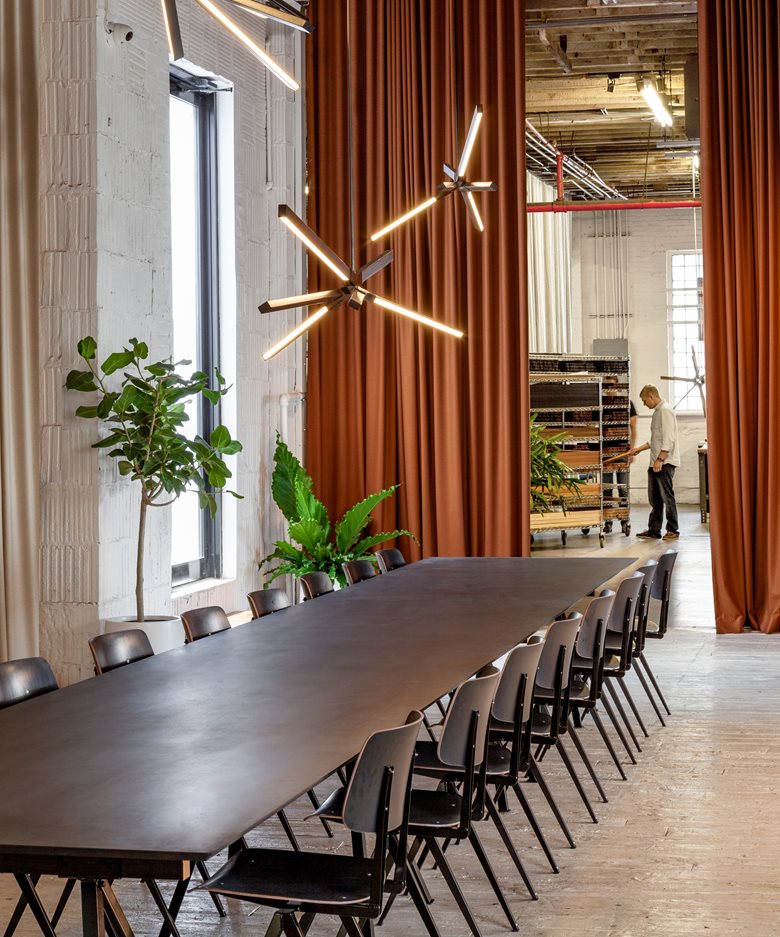
Stickbulb was formed in 2012 by Russell Greenberg and Christopher Beardsley. Inspired by a pile of long linear wooden cut-offs in their workshop, the designers challenged themselves to develop a truly sustainable lighting system. As a starting point, they only considered designs that could be manufactured locally and affordably within a five mile radius of their New York City office. They chose to use reclaimed and sustainably sourced woods as a primary building material, and sourced energy efficient LED technologies and components. The collection was designed with the least number of parts possible and with connections that make the pieces easy to separate for maintenance, recycling, or reuse. The result is a light-up erector set of interchangeable components that allows for unlimited customization and creativity.
They make a wonderful collection of pendants, chandeliers, sconces, and floor lamps. Take a look at the strong line of the pieces below.
Happy designing!
Monday, June 1, 2020
The Timelessness of White Plaster
Ever since the rise of social media platforms like Instagram and Pinterest, interior design ideas, colors, shapes, textures, and patterns rise and fall at a dizzying pace. Things that used to become popular in an organic way, that is by installation and use, are now artificially turned into "trends" that cycle through in a matter of months. Images race across the internet and things become passé even before the last person can hit SEND.
So I appreciate an interior design item that has been around and will be around...an item that is not appealing to the Insta-crowd. And this subtle material shows up discreetly in design schemes, adding interest and style without appealing to the lowest common denominator. White plaster has been used for many different applications (see the marvelous white plaster furniture of John Dickinson here) but when used on lighting fixtures, it turns into something very special.
In 1954, the modern master artist Alberto Giacometti created three plaster chandeliers for his friend, the art critic, patron, and publisher Tériade (Stratis Eleftheriades). The one seen below hung in Tériade's dining room in his apartment on rue de Rennes in Paris. The artist had used white plaster in his sculptural work for some time. Giacometti had begun designing plaster lighting in the late 1920s, a period of intense collaboration with Jean-Michel Frank. And this particular light sold at auction for £2,045,000.
Alberto created many works with his brother Diego who was an equally powerful and famous sculptor and designer. And in 1985, the Musée national Picasso-Paris commissioned Diego Giacometti, then in his 80s, to create a 50-piece collection of chairs, benches, lights and tables, designed exclusively for the Hôtel Salé (the historical site that houses the museum). He finished the commission just before his death in July 1985.
As I mentioned, the allure of such delicate, geometric white plaster light fixtures seems to transcend styles and trends.
Lighting designer Julie Neill has an entire line of white plaster fixtures: she created this light in homage to Diego Giacometti called, appropriately enough, the Diego Chandelier. The version here is a two-tier fixture but it also comes as a single tier.
Something very much like the Diego light can be spotted in the Paris apartment of Jean-Louis Deniot.
And this sitting room by Jeffrey Bilhuber sports what looks like the two-tiered version.
Interior designer Miles Redd designed a fixture in white plaster for Ballard.
There are lots of other versions of light fixtures in white plaster...
I love this cup fixture and lantern fixture from ALT For Living.
This white plaster Lotus chandelier from Tracey Garet for her company Apsara is both modern but organic enough to take its place in a traditional Chinoiserie dining room!
Here is a lovely, subtle chandelier in a beautifully bright dining room by Charlie Ferrer.
And even legendary interior designer Nicky Haslam has a white plaster lantern in his London home!
Happy designing!
So I appreciate an interior design item that has been around and will be around...an item that is not appealing to the Insta-crowd. And this subtle material shows up discreetly in design schemes, adding interest and style without appealing to the lowest common denominator. White plaster has been used for many different applications (see the marvelous white plaster furniture of John Dickinson here) but when used on lighting fixtures, it turns into something very special.
In 1954, the modern master artist Alberto Giacometti created three plaster chandeliers for his friend, the art critic, patron, and publisher Tériade (Stratis Eleftheriades). The one seen below hung in Tériade's dining room in his apartment on rue de Rennes in Paris. The artist had used white plaster in his sculptural work for some time. Giacometti had begun designing plaster lighting in the late 1920s, a period of intense collaboration with Jean-Michel Frank. And this particular light sold at auction for £2,045,000.
![]() |
| In this portrait of Alberto Giacometti in his studio, the chandelier can be seen hanging in the upper right. |
Alberto created many works with his brother Diego who was an equally powerful and famous sculptor and designer. And in 1985, the Musée national Picasso-Paris commissioned Diego Giacometti, then in his 80s, to create a 50-piece collection of chairs, benches, lights and tables, designed exclusively for the Hôtel Salé (the historical site that houses the museum). He finished the commission just before his death in July 1985.
As I mentioned, the allure of such delicate, geometric white plaster light fixtures seems to transcend styles and trends.
Lighting designer Julie Neill has an entire line of white plaster fixtures: she created this light in homage to Diego Giacometti called, appropriately enough, the Diego Chandelier. The version here is a two-tier fixture but it also comes as a single tier.
Something very much like the Diego light can be spotted in the Paris apartment of Jean-Louis Deniot.
And this sitting room by Jeffrey Bilhuber sports what looks like the two-tiered version.
Interior designer Miles Redd designed a fixture in white plaster for Ballard.
There are lots of other versions of light fixtures in white plaster...
I love this cup fixture and lantern fixture from ALT For Living.
This white plaster Lotus chandelier from Tracey Garet for her company Apsara is both modern but organic enough to take its place in a traditional Chinoiserie dining room!
Here is a lovely, subtle chandelier in a beautifully bright dining room by Charlie Ferrer.
And even legendary interior designer Nicky Haslam has a white plaster lantern in his London home!
Happy designing!
Subscribe to:
Posts (Atom)


