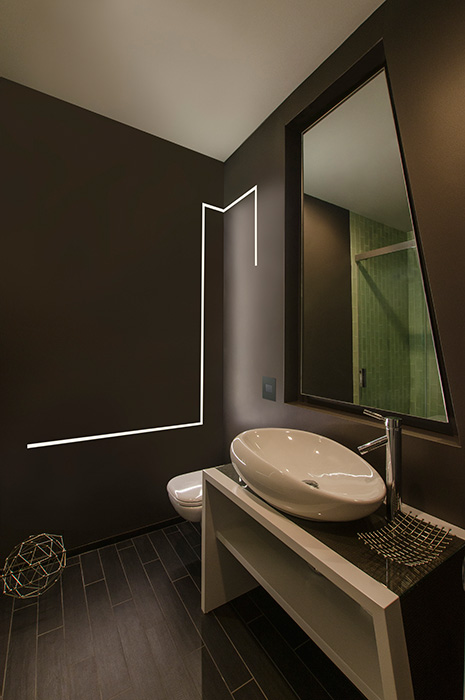
Each space I am hired to work on is individual, unique, and has its own personality. But there is one element that is consistent in every single space I design and that element is: light. It is the invisible element in the room since many people only consider furniture or furnishings, or finish materials such as tile, wood, or paint when thinking of a room. Yet lighting is such a vital part of each and every space.
Lighting greatly effects mood. I am sure we have all had the frustrating experience of being in a room with insufficient light when we are trying to read or work on a task which requires us to see well. And by the same token, I am sure we have all been in a room that was simply too bright when we wanted to relax. Too much light or not enough can create a subliminal annoyance that manifests in a dislike of the room itself. But don't hate your kitchen or living room for bad lighting. There are easy ways to fix this problem.
Whether you are building from scratch, starting a down-to-the-studs remodel, or just planning on furnishing an existing space, below are some tips and thoughts for working with lighting.
First, we want to think of lighting as being flexible. We want to be able to choose bright light for any task we might want to work on, but we also want to be able to control that light for when we wish to watch a movie on a nice new flat screen or spend a nice, intimate evening visiting with friends. In order to achieve this, we can layer our lighting.
There are three main types of lighting:
1) Ambient
This is light that completely illuminates a room. Think of this as the base coat of paint on a wall--you want good coverage, to spread the light out as much as you can. Well placed recessed ceiling lights do a good job with this layer. In the photo below, you can that the recessed trough lights create an even blanket of light for the center of the living room.
2) Task
This is lighting that allows us, as the name implies, to complete a certain task. Sconce lights on either side of a bathroom mirror cast light ONTO our faces, allowing us to shave or put on make-up without any annoying shadows. A table lamp or reading lamp next to a chair allows us to read without eye strain. Under cabinet lighting in a kitchen allows us to use sharp knives safely.
3) Accent
As I wrote at the beginning of this post, each room has its own unique personality and accent lighting allows certain traits to be highlighted. The swing arm lamps in the Robert Couturier-designed library below are a lovely element to limn the shelves of books. Strategically placed spot lights can illuminate art, whether it is two or three dimensional. And lighting under a bathroom vanity toe kick or hidden in a soffit can define the edges of a room. Accent lighting can also bring some sparkle and drama to a space.
Accent lighting can also highlight architectural details such as cove or tray ceilings. Wall washers (recessed lighting positioned to send a beam of light cascading down a wall) can call out the texture of stone or wood wall details.
Successful spaces incorporate all three layers of light. In the living room, and the Candice Olsen-designed kitchen below, see if you can identify the three layers at work in each room.
If you are remodeling or simply refurnishing a space, remember to include multiple sources of light in your layering. Ambient layer: If you have the opportunity to add recessed ceiling lights, by all means do so. If you can't recess into the ceiling, unobtrusive surface mounted spots can be just as effective. Task layer: Use several table lamps instead of one torchiere in the corner. Accent layer: Include a decorative light here and there for some interest. And remember that small up-lights can be positioned behind furniture to brighten dark corners.
Happy designing!