I am always searching for unique lighting options for clients, and Hubbardton Forge has just released a new collection that fits the bill. Called Snaps, the configurable design features differing lengths of leather strapping (in brown, black, or white!) punctuated by round LED lights housed in alabaster, all held together with riveted snaps! As you can see below, it looks great in many settings and provides a great sculptural focal point.
I am excited to use the Snaps Collection in a project! Contact me if you want to include Snaps in your remodeled space.
Happy designing!
Showing posts with label leather. Show all posts
Monday, February 10, 2025
Monday, April 8, 2024
The Vanity Fair XC Armchair by Fornasetti and Poltrona Frau
Since this month is scheduled for a "Know Your Chairs" post (see the post later this month featuring the classic Brentwood chair by William Haines), I thought it was appropriate to share a new chair created by Fornasetti and venerable Italian furniture manufacturer Poltrona Frau.
This chair, dubbed the Vanity Fair XC chair sports an iconic design by Piero Fornasetti which is digitally printed on leather. This limited edition run of 50 chairs went on sale solely through the Poltrona Frau site on February 15th, but starting this April 10th, it will also be available in select Poltrona Frau brick and mortar stores.
The Fornasetti site describes the collaboration:
"Poltrona Frau's timeless design and exceptional craftsmanship meet Fornasetti's surreal Soli e Nuvole illustrations in this exclusive limited-edition of 50 Vanity Fair XC armchairs.
The iconic Vanity Fair XC armchair, a celebrated symbol of Italian design, encounters Fornasetti's mesmerizing pattern, a stunning composition of the sun and moon rising over swirling clouds, digitally-printed in meticulous detail on Pelle Frau® Impact Less leather.
For the first time, Poltrona Frau employs a digital printing technique that recalls silkscreen printing, reproducing Fornasetti's intricate hand-drawn patterns on leather, ensuring unparalleled detail and a unique tactile sensation.
Each of the 50 pieces is meticulously hand-crafted in Italy, individually numbered and accompanied by a signed certificate of authenticity."
Happy designing!
Monday, May 31, 2021
Legends of Design: Charlotte Perriand
In this continuing series of Legends of Design, let's look at an underrated figure of 20th century Modernism, Charlotte Perriand.
She was born in 1903 in Paris to a tailor and seamstress. After showing exceptional artistic talent in her youth, she attended the École de L'Union Centrale des Arts Décoratifs in 1920 to study furniture design. In 1927, only two years after graduating, Perriand renovated her apartment at Place Saint Sulpice in Paris into a room with a built-in wall bar made of aluminum, glass and chrome. For this design, she created her first piece of iconic furniture: the Siège Pivotant or Swivel Seat.

She recreated this entire room for the 1927 Salon d'Automne, and christened it the Bar sous le Toit or Bar In The Attic. And it of course featured the same Swivel Seat.
This small revolving armchair is characterized by a polished trivalent chrome plated enamel steel frame, and a unique tubular back rest of padded leather. It fit right in with the Modernist room of light-reflecting aluminum, nickel-plated surfaces, and glass shelves.
In 2019 and 2020, the Fondation Louis Vuitton hosted a marvelous retrospective of Perriand's life and work entitled Charlotte Perriand: Inventing A New World. The Fondation noted, "She was an exceptional personality, a woman committed to leading a veritable evolution, or perhaps more aptly, a revolution. Her keen observation and vision of the world and its cultural and artistic expressions place her at the heart of a new order that introduced new relationships between the arts themselves – from architecture and painting to sculpture – as well as between the world’s most diverse cultures, from Asia (Japan, Vietnam and other countries) to Latin America, notably Brazil. Her work resonated with changes in the social and political order, the evolution of the role of women and changes in attitudes towards urban living. She embodied a transition from 19th century traditions towards the contemporary model of the 20th century, scarred by the cataclysms unleashed by totalitarian regimes and world wars, followed by both physical and moral reconstruction."

In a bit of kismet, the famed architect and furniture designer Le Corbusier visited the Salon a month later and saw her Bar sous le Toit. Suitably impressed, he offered Perriand a job and for the next decade, she, with Le Corbusier and Corbusier's cousin Pierre Jeanneret, created some of the most iconic Modernist furniture pieces ever. I covered these in another post here, but they are: the LC-1 chair with its sling back (first photo below), the LC-2 and LC-3 cube chairs (in the second photo below, you can see why the LC-2 is called the Petit Confort chair and the LC-3 is called the Grand Confort chair!, and the third photo shows the Grand in situ), and finally the LC-4 chaise longue (photos four and five), which when taken off its base and placed directly onto the floor, can rock!.
She went on to create other classic and influential designs including the 1953 Maison du Mexique bookcase, seen below in different color iterations.
Happy designing!
Labels:
architect,
chair,
Charlotte Perriand,
France,
furniture design,
LC-1,
LC-2,
LC-3,
LC-4,
Le Corbusier,
leather,
legends of design,
Maison du Mexique bookcase,
Paris,
Siège Pivotant,
steel
Monday, October 29, 2018
Amberg Studio Creates Digitally Printed Leather
English leather craftsman Bill Amberg of The Bill Amberg Studio commissioned artists and designers to create patterns to be digitally printed onto leather hides. This new technology offers exciting possibilities in the world of leather upholstery but also other applications as well: leather floor tiles, wallcoverings, and fashion items like bags and shoes!
Avant garde furniture designer Faye Toogood opted for an abstract pattern reminiscent of cave drawings...
...while L.A.-based interior and product designer Natasha Baradaran went a different route with a traditional floral lace pattern.
Design icon Tom Dixon created a pattern that mimics crinkled aluminum foil! This trompe-l'œil effect will surely delight anyone who first sees the pattern and then feels the soft smoothness of the leather!
And interior designer Alexandra Champalimaud imagined a set of hand drawn concentric circles in soft, comforting colors. They recall growth rings of trees.
Happy designing!
Monday, May 9, 2016
A "Modern Medieval" Dining Room by Fiorito Interior Design
My clients for this project wanted to erase from their newly purchased home the style choices of the previous owners. I was lucky they were eager to make their own impression, because that meant they were open to a lot of unique and special design elements. So we decided to turn the dining room into more of a statement space with elegant wood paneling, a grand carved wooden dining table, and a sense that a feast was about to take place. I thought of it as Modern Medieval!
The custom-made guest dining chairs are covered in a tapestry-like material of paisley and leopard while the custom-made host chairs, bigger and more luxuriously scaled, are covered in a soft olive green leather. Hanging above is a modern lighting fixture with clean lines but whose overall sense recalls ancient round candelabras from castles of yore. Below it all is a rug in camel and gold with an organic pattern of branches and leaves. Torch-like wall sconces, a mirrored buffet with hefty iron rings, and custom draperies in a gold-green harlequin texture finish the look. And the most special element of all: at night during dinner parties, the metallic gold ceiling reflects the chandelier and sconces, giving the room a glamorous, warm glow.
If you have a dining room that needs that special something extra, give me a call!
Happy designing!
The custom-made guest dining chairs are covered in a tapestry-like material of paisley and leopard while the custom-made host chairs, bigger and more luxuriously scaled, are covered in a soft olive green leather. Hanging above is a modern lighting fixture with clean lines but whose overall sense recalls ancient round candelabras from castles of yore. Below it all is a rug in camel and gold with an organic pattern of branches and leaves. Torch-like wall sconces, a mirrored buffet with hefty iron rings, and custom draperies in a gold-green harlequin texture finish the look. And the most special element of all: at night during dinner parties, the metallic gold ceiling reflects the chandelier and sconces, giving the room a glamorous, warm glow.
All photos by Bernardo Grijalva
If you have a dining room that needs that special something extra, give me a call!
Happy designing!
Labels:
buffet,
chandelier,
dining chair,
dining room,
dining table,
Fiorito Interior Design,
gold,
host chair,
Jeff Fiorito,
leather,
Medieval Modern,
metallic,
rug,
sconce,
table,
tapestry fabric,
wallcovering,
wood
Monday, November 3, 2014
History of Furniture: Le Corbusier
For this installment of History of Furniture, let's look at another staple of modernism: furnishings by Le Corbusier.
Charles-Édouard Jeanneret-Gris was a Swiss architect, designer, urban planner, artist, and writer who participated in the birth of Modernism as an artistic and civil movement. In 1920, early in his career, he adopted the pseudonym Le Corbusier (a version of his mother's father's name). Starting in 1928, Le Corbusier collaborated with Charlotte Perriand, another architect he invited to join his design studio, to create a series of chairs and lounges that are still being used today.
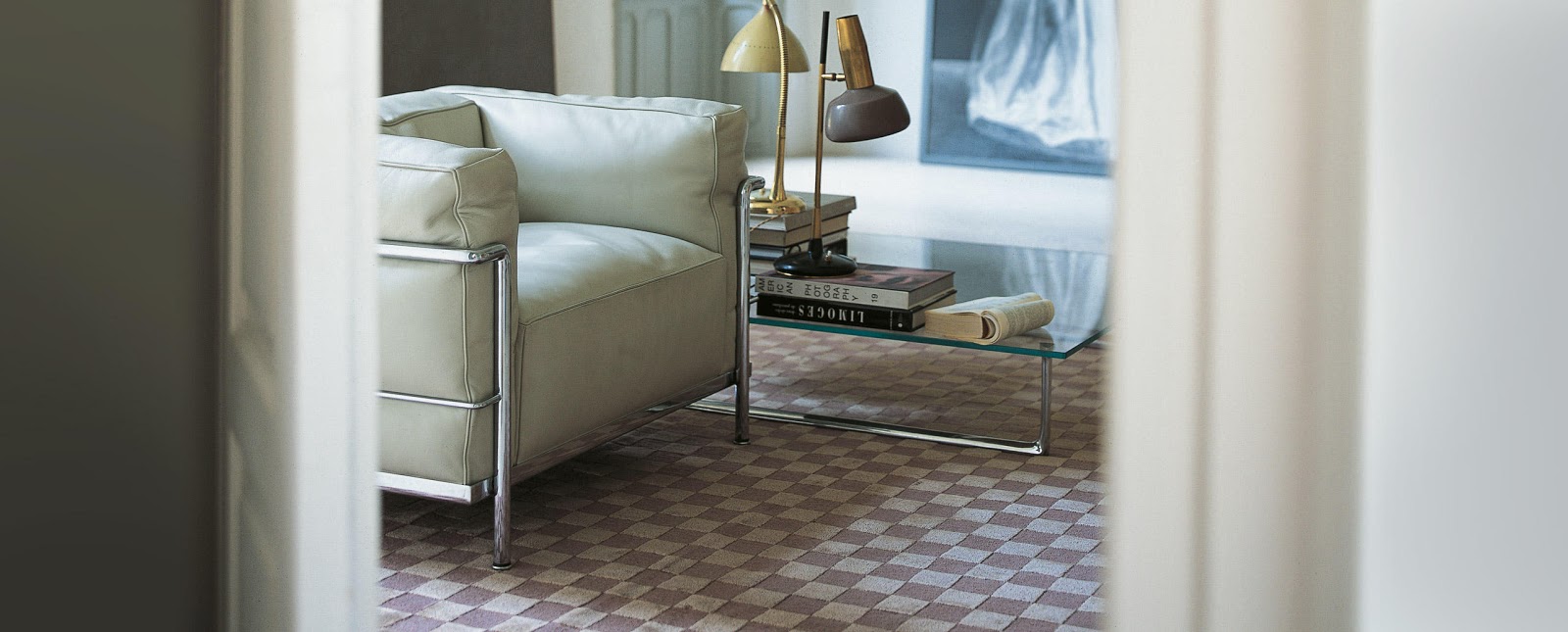
The first chair to be produced was the LC-1, consisting of a frame of steel tubing with tightly wrapped leather panels for the seat, seat back, and arm rests. Black or white leather was common but the chair is now available in options like hair-on-hide, seen below. (Note: this chair is often confused with the Marcel Breuer Wassily chair which was covered here in a History of Furniture post about Bauhaus and De Stijl.)
This was followed by the iconic LC-2 and LC-3 chairs whose designs were based on the idea of a cube. The LC-2 is smaller but the LC-3 is scaled a little larger, with ever-so-slightly lower arms.
The frame is made of--you guessed it--chrome on steel tubing. The only company that holds the license for Le Corbusier's designs, Cassina, now make these pieces with powder coated tubing in different colors.
And finally, the LC-4 lounge chair is a modernist masterpiece, taking its place alongside Mies van der Rohe's legendary day bed, previously seen here.
Le Corbusier designed many influential and famous buildings, structures, and homes. He became a French citizen in 1930 and died on August 27, 1965 while swimming in the Mediterranean Sea.
These timeless pieces he gifted us will add a bit of architectural interest to any space. They are available through Cassina:
http://cassina.com/en
Happy designing!
Subscribe to:
Posts (Atom)