Showing posts with label window treatment. Show all posts

Monday, July 25, 2016

When In Rome!: Five Types Of Roman Shades

If you're thinking of window treatments for your windows, there are so many options, with a myriad of not only drapery styles but also shade styles. As with anything in interior design, there is a whole encyclopedia of terms, forms, and details within the world of shades themselves. Let's take a look at a few of the more common types of Roman shades in particular.

Flat--Consisting of a piece of flat fabric without any pleats, folds, or channels, this type of Roman shade is good for windows where you will not be raising or lowering the shade often. The fact that it does not have any pleats means that the fabric does not fold up neatly or quickly when raised. But a flat Roman shade still provides light control and privacy while bringing color and pattern to a room. And this style in particular lends itself to prints since there are no channels or pleats to interrupt a pattern repeat.


Plain or Pleated--This style is much like a flat Roman but with seams every eight to ten inches to help ease the shade in raising or lowering. As you can imagine, a tight pattern repeat would be interrupted by the seaming. As with any genre of knowledge, nomenclature can vary and I have seen this referred to as a Rear Tucked Roman shade. The Pleated name also can refer to a different type of shade, one we will see a few points down.


Relaxed or European--Here we have another variation of the flat shade but with a drooping center bar at bottom which gives the shade a casual, country appeal. But done with the right fabric, it could also read as extremely elegant.


Hobbled or Soft Fold (I have also seen this style referred to as Teardrop)--This style of Roman shade is made of ripples of soft folds that fall on top of one another, giving the shade dimension and softness. I would advise judicious use of this style as it can look overblown or gaudy depending on material and location.


Knife or Ribbed (I have also seen this style referred to as Slatted)--For this Roman shade, dowels are sewn into pockets every eight to ten inches or so. They can be attached at the rear of the shade so the front has a seam, in which case it is called a Knife or Knife Edge Roman shade. If the dowel pockets are in the front (with seam in the rear), this is generally called a Ribbed Roman shade.

Knife Edge with dowel pockets in rear
Ribbed with dowel pockets in front

Happy designing!

Monday, June 8, 2015

Ten Basic Drapery Pleats

There's nothing like custom drapery to finish a space, to soften the bare hard edges of window casings, and to add extra color, pattern, and texture to a room. But there are so many ways to finish draperies, and so many options to consider. Of course some of these decisions will be driven by your individual style preferences and what kind of look we are trying to create. Below are ten basic ways to finish the top of a drapery panel; there are even more esoteric flourishes and variations on these ten, but for now, they will get us started.

1) Pinch Pleat
I think this is probably the one most all of us are familiar with. The classic pinch pleat is just that: the fabric is pinched together a few inches below the top and stitched together so the fabric falls in waves from each pinch. This style can come in two finger pleats (first image), classic three finger pleats (second image), all the way up to five finger pleats.


2) Euro Pinch Pleat
This style is also sometimes referred to as Parisian or French Pleats. Instead of the pinch being stitched a few inches down, it is stitched at the top. The result is similar to a classic Pinch Pleat but the waves fall from the very top. As you can see, there is also the option for two, three, or more pleats.


3) Pencil Pleat
Instead of fingers like in the previous pleat styles, these panels have continuous pleats all along the top of the panel.


4) Inverted Pleat
Imagine pleating a piece of fabric but facing out the reverse side. This creates a nice, structured, almost architectural drapery panel.


5) Goblet Pleat
This pleat style is so named because of its rsemblance to a drinking goblet. The rounded shape is achieved by inserting cardboard or tissue paper into the hollow for the goblet to keep its shape.


6) Ripplefold
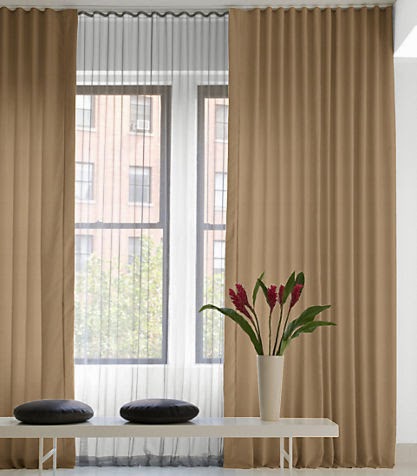
Although the second pleat on this list is called the Euro Pinch Pleat, the Ripplefold is by far the more European styled drapery. Its clean lines are elegant, modern but timeless, and can go with any type of interior. It is quickly becoming the choice here in the States. Ripplefold panels installed on a hidden or flush track at the ceiling line are truly lovely (it makes a lower ceiling look taller) and I have done several sets for clients.


7) Grommet
This extremely casual style is rather rustic and useful in family rooms, game rooms, cabins or boat houses.


8) Rod Pocket
This style can be found on off-the-shelf drapery panels at retail stores and tends to look messy. Because the top of the panel is not truly finished, the fabric unfortunately does not hang uniformly.


9) Tab Top
Again, a very casual style good for breakfast rooms, garden rooms, or outdoor loges. The inherent trouble with a tab top though is the difficulty in pulling the panels open or closed since the fabric tends not to slide freely on the rod.


10) Tie Top
Possibly the most casual style of all, a tie top can look good in spaces that are emulating a kind of Bohemian/Parisian cafe look but just like a tab top, the panels do not slide freely.


Like I said at the start of this post, there are variations on what we see here, but these basic ten are used most in drapery fabrication.

If you have some bare windows or want a new look for your home, let's create some gorgeous custom window treatments made especially for you.

Happy designing!

Monday, April 20, 2015

Exotic Delia Shades

Hot on the heels of last week's post about the differences between shutters, blinds, and shades, I present to you the wonderful company Delia Shades. Founded by Delia Helig in 2006, her eponymous Manhattan-based company creates shades in varying degrees of light filtering material (Delia shades can filter up to 95% of UV radiation). They are made of environmentally friendly, Greenguard-certified fabric that is lead-free, flame-resistant, bacteria- and fungus-resistant, and yet able to be cleaned with a gentle detergent solution. And as you can see, they come in an array of patterns ranging from Moorish patterns to Indian Jalli screens to African designs to Japanese Katagami. Custom client designs can also be manufactured! Candice Olson used the Latticework pattern to great effect in the first room below.


These designs make a marvelous base for a window treatment which should still include fabric drapes to soften the window casing and also add another opportunity to layer texture and color into the room.

Delia Shades:
http://www.deliashades.com/

If you have windows you don't know what to do with, give me a call. Perhaps we can come up with some amazing, unique window treatments created especially for you.
Happy designing!

Monday, April 13, 2015

Shutters, Blinds, Shades: What's The Difference?

The world of window coverings is enormous. I know, it may seem silly to the lay person ("Oh come on Jeff, a world of window coverings?") but there are almost as many different ways to dress a window as there are windows. And consequently there are many different names and terms that can get confused or used interchangeably.

Let's take a look at three common window coverings that are often lumped together--shutters, blinds, and shades--and discover what they are, and how they differ.

SHUTTERS
Shutters are generally louvered coverings for a window or door. They can be fixed or able to open up, away from the window or door.


Often one will hear shutters called Plantation shutters since they were used extensively in Colonial islands like Jamaica. They are quite practical in tropical areas since they provide shade from glaring sun but the louvers can be tilted, usually on a central rod, to allow air to circulate. in interiors, they can signal an exotic, lush design scheme.


But the problem with shutters--and a complaint I hear most from clients who may have inherited shutters as window coverings from a previous owner--is that they can be overwhelming and make a space feel gloomy. When used on a large expanse, they tend to feel heavy, clunky...


In this application, it is simply a missed opportunity to layer window coverings which can introduce more color and texture into the space (we will see examples of this later in the post). And unlike most shades, blinds, or even draperies, shutters are fixed to the entire window. They cannot be stacked back or moved off the glass to allow more light or view. Whether they are built to sit inside the casing, or must be boxed and mounted outside the casing, they are bulky and cumbersome to open. Honestly, I have only ever had clients remove shutters, not install them, not only for the aforementioned reasons, but because the look is now quite dated.

BLINDS
Blinds offer a bit more flexibility. A blind is a series of slats made of metal, wood, or a composite material. They can be pulled up tight against the top of the casing, allowing for a fairly unimpeded view and like shutters, the slats can also be tilted to control light. It might just be me, but blinds make me flash on classic noir films from the 1930s and 40s.


And blinds can still have a cool, urban feeling. They play well in city lofts...


...but wood or composite versions can look nice anywhere.


An optional decorative feature on blinds is the addition of fabric "tape" which can come in any color or pattern.


The look can have a rich, Old World feel.


SHADES
A shade is generally a solid material that raises and lowers in front of the window. The typical shade most of us grew up with is the spring roller shade, which is a tube at the top of the casing on which the material rolls when open. Because of this, it is preferable for the roller mechanism to be hidden behind a fascia of some kind.


Now shades come with a top down/bottom up feature that allows for more precise control, not only for light but for privacy as well. As you can see in the image below, this privacy control is very useful in a bathroom!


Bamboo shades are perfect for introducing additional color and texture, and a warm, organic feel into a space. They are marvelous when layered under fabric drapes. This layering gives rooms a more finished look since the fabric drapery offers a softening element for the space.


And finally, a very popular variety of shade is the soft Roman shade. This is a flat piece of fabric or material (bamboo can be used as well) which pleats up into itself when raised. The advantage to this shade is that it can act like a drapery (coming in ANY choice of fabric), but have the functionality of a blind. For this reason, they are useful in kitchens where one does not want loose drapery fabric near either a water or a heat source. They can be tucked up out of the way, or lay flat against the glass when down.


And there we have three popular window covering options. As I said at the top of this post, the world of window coverings is wide and vast. Stay tuned for upcoming posts about draperies and the many ways they can be created.

Happy designing!