Showing posts with label legend. Show all posts

Monday, September 21, 2026

Legends of Design: Jean-Michel Frank

For this installation of Legends of Design, we look at an incredibly influential designer whose name is often spoken with reverence.

Jean-Michel Frank | Photo by Rogi André
CNAC/MNAM/Dist. RMN–Grand Palais Art Resource

Jean-Michel Frank, working primarily in Paris during the 1920s and ’30s, built a reputation on what might seem like a contradiction: quiet rooms that still feel deeply luxurious. Often associated with Art Deco, his work stripped away the ornament and excess typical of that movement, leaving behind spaces that felt calm, edited, and incredibly refined. He wasn’t formally trained, which probably contributed to his work feeling so instinctive—less about rules, more about perception and proportion. In fact, he believed that "perfect taste" was a blueprint for a soulless room. During his career, he collaborated with an impressive array of designers and artists such as Diego and Alberto Giacometti, Salvador Dalí, Emilio Terry, and Christian Berard. And he counted Elsa Schiaparelli, the surrealist fashion designer (whose house has been successfully resurrected by Daniel Roseberry) as a close friend.

Frank is often described as a minimalist, but that word doesn't tell the full story. Yes, his spaces were restrained—pared down to essential forms, softened palettes, and an almost architectural sense of proportion. But layered into that restraint was an unexpected richness. What really set Frank apart was his obsession with materials. He had a marvelous ability to combine both humble and rare finishes and elevate them through context; he was clearly ahead of his time with this talent. Straw marquetry, plaster, and sandblasted oak might sit alongside shagreen, parchment, rock crystal, or mica—each chosen not for hierarchy, but for how it contributed to the overall composition. There’s a lesson here that still resonates: good design comes down to the care and intent with which materials are selected and brought together.

His interiors were intentionally spare (thus his "minimalist" label), but not cold. Frank understood that emptiness, when done well, creates presence. Rooms were often reduced to their essential elements—strong silhouettes, neutral palettes, and tactile surfaces—allowing art, light, and proportion to do the heavy lifting. It’s the kind of restraint that feels especially relevant now, as we continue to move away from over-designed spaces toward something more grounded and enduring. In 1936, while working with this idea of pared-down elegance, he designed what became the Parsons table. Today it feels almost everywhere—so simple it’s easy to take for granted—but his original concept was more nuanced: a clean, almost skeletal form meant to be wrapped in something unexpected and luxurious, like ivory, and the afore-mentioned mica, or shagreen.

Another aspect of his work that feels surprisingly current is how seamlessly he blended eras. Frank frequently paired modern, simplified forms with references to 18th-century French design, creating interiors that felt both timeless and quietly forward-thinking. "I believe that a less severe principle can be found — the mixing of styles," Frank wrote in 1935, "The noble frames that came to us from the past can receive today’s creations [paintings]. The house that we build now can welcome ancient things of beauty." His signature look was termed as "luxe pauvre," literally "poor luxury" in French. That mix—old and new, refined and raw—is something we return to again and again in contemporary design. And it is an approach I strive for in my own design practice.

A distant cousin of the famed diarist Anne Frank, he fled France around 1940. As both a Jew and an out gay man at that time, he was wise to escape the coming Nazi occupation. He ended up working and traveling in South America and the United States--his last project was the 5th Avenue apartment for Nelson and Mary Rockefeller. A frail and slight man who suffered from depression and ill health his entire life, he killed himself by overdosing on barbiturates in 1941, at the too-young age of 46. I wonder if he knew how his work would ripple out, how influential he would become, and how he would take his place in the pantheon of legendary designers.


In the photos above, we see Frank's design for banking heir Templeton Crocker's living room in his San Francisco penthouse. The walls are covered with parchment squares. The fireplace is faced with mica in gilt bronze inlays. Seating is upholstered in ivory Moroccan leather, and table lamps are made of rose quartz and obsidian chunks, all arranged on a chocolate brown carpet.


This image is of Crocker's sunroom which occupied the upper floor in the 6,000 square foot San Francisco penthouse with views overlooking The City.


Above is a view of the salon in Nelson Rockefeller's New York City apartment designed by Jean-Michel Frank, showing a mix of eras, a custom Aubusson carpet, and prominently featuring artworks--by Fernand Léger, Joan Miró, Pablo Picasso, Giorgio de Chirico, Alberto Giacometti, and Henri Matisse's mural over the fireplace--all from Rockefeller's staggering collection.

The Comité Jean-Michel Frank has been initiated by the artist’s family to promote the work and legacy of the designer. The site has a list of some wonderful publications about Frank. And French furniture manufacturer ECART holds the rights to many Frank-designed pieces, so you can own your very own bit of design history.

Happy designing!

Monday, May 6, 2024

Legends of Design: Kelly Wearstler

Can one be a Legend of Design and still be alive? For this installation of Legends of Design, I say "yes."


Kelly Wearstler began her design journey after a stint working in motion picture art departments in Hollywood by opening up her eponymous studio in 1995. She soon met her future husband, Brad Korzen who hired her to design his own home as well as several properties owned by his real estate group, Kor Realty Group. She has since developed into a force in the industry. Known for her clothes and high heels as much as her interiors, Wearstler has mined several design styles, working in once-popular vernaculars and pretty much single-handedly bringing them back into the consciousness of the design community. Mid-Century Modern gave way to Hollywood Regency (previously mentioned here), beautifully profiled in her second book, Domicilium Decoratus: Hillcrest Estate, Beverly Hills, California.


This was my first complete exposure to Wearstler's work and I was dazzled. It is a profile of her own home, the Hillcrest Estate in Beverly Hills. The decor inside is full-on Hollywood Regency with a deft mix of antiques, vintage, and modern with touches of exotica.


Wearstler, maybe more than any other current interior designer, truly revels in what she does. One can tell by her creations that she truly loves textures, shapes, color, space, pattern...all the basic elements that make up an interior design...and the marvelous frisson that can result from their unexpected combinations. Look at the love and care with which she assembled her Hillcrest Estate above, curating a maximalist experience that is jaw-dropping.

Wearstler has designed an incredible number of hotels starting with the Avalon Beverly Hills in 1999 as well as a long list of restaurants; visit her website to see photos of these projects as there are too many to include here in this post. As she has moved from project to project, she has expanded her visual vocabulary and now includes silhouettes and colors of the Memphis/Ettore Sottsass movement (previously here) as well as the rounded sturdy organic shapes of Brutalism. Let's look at her Malibu beach house to see an example of these styles. She eschews the tired blue-and-white beach house theme for a sun-bleached approach with not a blue to be found. The simplicity of the design itself allows nature outside to be the star.


Wearstler has also designed homes for many celebrities and non-celebrities...so, because I just can't resist, I leave you with some views of a home she designed for a couple on Mercer Island In Washington. Again, on display is her commitment to natural stone, textures, unexpected colors, and materials. Just phenomenal.


Happy designing!

Monday, May 8, 2023

Legends of Design: Dorothy Draper

Who was the first interior designer in the United States? An intriguing question indeed, since there seems to be two answers...

In a previous post here, I wrote about a woman named Elsie de Wolfe who is considered to be the mother of Interior Design as a profession. Born in 1865 (although her Wiki page wonders if she was born in 1859), de Wolfe had many society friends who admired her work in her own home and asked for her services to brighten and refresh their own spaces. But it wasn't until 1905 that de Wolfe became known as a true, professional interior designer when famed New York City architect Stanford White was designing The Colony Club, a women's socialite club on Madison Avenue started by suffragettes, and brought de Wolfe in to design the interior spaces. Based on that success, she opened up her design studio on 5th Avenue.

However, a few years later, another driving force in Interior Design arrived in the form of one Dorothy Draper. She was born into the wealthy Tuckerman family in Tuxedo Park, NY in 1889 who divided time between three homes--a mansion in Tuxedo Park, a Manhattan townhouse, and a summer cottage in Newport, Rhode Island, as well as traveling to Europe for summers. Her class and milieu certainly formed her taste and in a 2006 New York Times article about Draper, Donald Albrecht, the curator of architecture and design at the Museum of the City of New York, said her "background not only provided Draper with a valuable network of clients and an innate sense of entitlement and authority, but also offered her a first-hand acquaintance with the historical styles that she would freely interpret and transform."


Dorothy married George Draper in 1912 and began decorating a series of homes they bought and sold. Much like de Wolfe, her socialite friends saw and admired what she was creating and sought her out to design their own homes. And in 1925, she opened up what is considered the first official Interior Design business in the United States, the Architectural Clearing House. Four years and many successful renovations later, she changed the name of the firm to Dorothy Draper and Company.

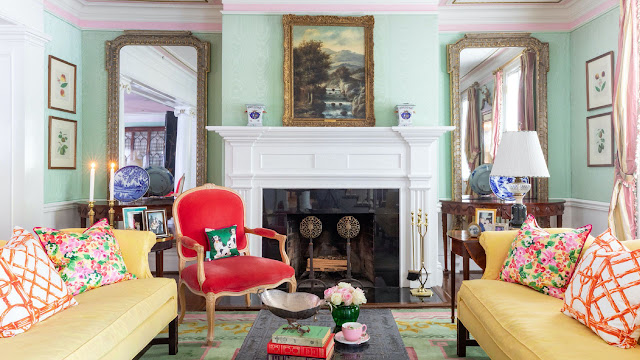
She championed a very specific aesthetic that was a blend of elements from Louis XIV, the wild ornamentation of Rococo, and a bit of neoclassicism from Louis XVI with contemporaneous elements and silhouettes from the 1920s. Her favorite color palette of red, green, powder blue, and yellow was offset by her penchant for cabbage-rose chintz, bamboo trellis and cabana stripe prints, palm frond wallcoverings, and black & white checked flooring. Her maximalist style came to be known as "Modern Baroque," or "Hollywood Regency" which can be seen in films from the 1920s all the way up to the 1950s. Her style can also be directly traced to the work of current designers like Kelly Wearstler and Johnathan Adler.

Draper's most famous project remains The Greenbrier, a massive resort in West Virginia dating from 1858 (!), that still prominently features her design sensibility. Draper was retained in 1946 to refresh and redecorate the resort, mingling her Modern Baroque flair with a Federalist style appropriate to the area. And while there have been changes over the years, the facility has not abandoned the original candy-colored schemes and details. Dorothy Draper is there in bright, full spirit. You can stay at The Greenbrier and see Draper's iconic work for yourself. Visit their site for information.
All following photos from The Greenbrier.


In 1964, Dorothy Draper sold her company to designer Carleton Varney who had worked closely with Draper for four years. He faithfully continued the legacy and style of Draper until his death in 2022 but Dorothy Draper and Company is still in operation.


Happy designing!