Showing posts with label cushion. Show all posts

Monday, July 12, 2021

Know Your Sofas: Back and Seat Options

While we have covered specific sofas in past installments of Know Your Sofas, today we are going to cover some design elements of a sofa and their names.


The advantage of working with me to furnish your home is that I can customize all aspects of a sofa to get the exact look we want. And one of the things that makes a sofa a sofa is its width. While this size can be adjusted, so can the depth and height.


Depth is an important factor as it is going to contribute to your overall comfort when seated. Petite and shorter people usually have better luck with a sofa that has an overall depth of around 36" which, after subtracting the structure of the back of the sofa as well as the thickness of the cushion, should give you a seat depth of around 24" or so. Taller families--or those who wish to have a lot of room to tuck one's legs on the sofa to curl up--will do well with a deeper overall depth of perhaps 40" or even 42". However, make sure the scale of such a deeper sofa fits with the room. You don't want to shoe horn a deep sofa into a space that can't take it.


A standard height of a sofa is usually around 36"--I have found that any higher feels like it blocks the flow of the room. There are lower sofas, usually of a modern design, but clients complain that it feels like they are going to tumble backward if it is too low.

The back of a sofa can also come in a few different iterations. One can have loose cushions...
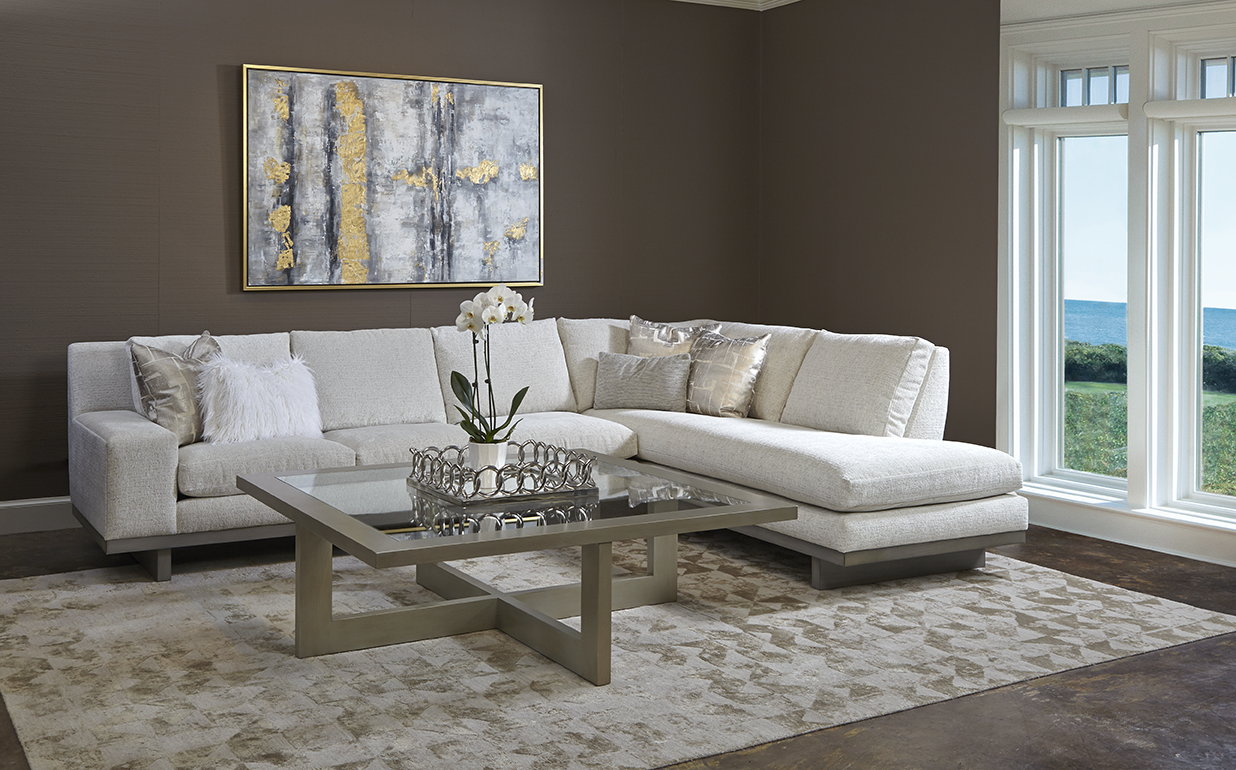

...or if you don't like the fact that the cushions can come off and move around (people with kids often do not like that option since the cushions always seem to end up in a pile on the floor after playtime), one can have what is called a "tight back," seen below.


If you do opt for back cushions, whether loose or fixed (stitched into place), there are options here too! A back cushion can be a square- or T-cushion.


And of course a seat can get a square or T treatment as well!


The right sofa can ground a room and set the stage for a welcoming feeling of comfort.


If you'd like a new sofa, we can make all of these decisions and more (legs, wood finish, nailheads, fabrics, welting, throw pillows) to get you the right sofa for your comfort and style.

Happy designing!

Monday, February 27, 2017

What Is Button Tufting?

There are some funny terms in interior design, and I believe the term "tufting" falls into that category. The word can produce a quizzical look on faces, but the concept is quite simple. Tufting refers to depressions at regular intervals on a piece of fabric or leather (such as a cushion or on a piece of upholstered furniture) by passing a thread through it. This can be left as thread, but most often this technique is seen as button tufting. The most famous example of this is on the classic Chesterfield sofa, previously featured here.


The iconic Chesterfield sofa features button tufting arranged in a diamond pattern which imbues it with a very sophisticated and traditional look. But if a button tufted sofa is arranged not in a diamond pattern but in a linear pattern, the effect is quite different. As you can see by the example below, what we end up with is a more contemporary feeling along the lines of a Mid-Century Modern piece of furniture.


Tufting can be also be used on headboards to add further softness and luxury to a bedroom...


...or on benches...


...or on chairs...


...and of course, on pillows and cushions!


Happy designing!

Monday, January 11, 2016

A Cushion Is A Cushion Is A Cushion

Right? Well, not really. As usual, in interior design, there are so many terms and styles for things that seem like they should be simple. Take the humble cushion. If you've ever noticed the construction of a cushion you might have seen the following shapes.

The most common cushion or pillow type must be the "knife edge" cushion. One look at this style and it is easy to see why it has that name. A knife edge cushion can have just a simple seam where the fabric is sewn together, as seen below.


Or a knife edge cushion can have what is called a welt. Also commonly called a cord--or sometimes referred to as "piping"--a welt is a piece of rolled fabric that trims the edge of the pillow. A self welt is one that is made out of the same material as the cushion or pillow.


But look how fun a pillow can be with a contrasting welt. If done with light and dark colors, the effect can be very striking, looking like a bold outline.


A knife edge cushion can be a little plain so to add some elegance to a pillow, try a Turkish corner where the material is pinch pleated into a discreet fold. The overall look is softer and more luxurious.


Another common cushion and pillow style is the box edge. Instead of sewing two pieces of material together to form a seam, a box cushion has side panels that give it a top, a bottom, and four sides, just like a box.


A flanged cushion is one whose edge extends beyond the seam, as seen here. The flange can be of the same or different material.


Sometimes the material used for the flange can be gathered into a kind of ruffled look that lends a feminine or country appearance.


Pillows can also be trimmed or edged with a variety of fringes, tassels, and pom-poms.


A bolster pillow is mostly used for decorative purposes. It is usually seen at the ends of a sofa, or as part of a pillow arrangement on a bed. The example below in silvery velvet is a bolster with a darker welt and a button tufted end.


When you go cushion shopping, keep an eye out for these styles.
Happy designing!