Showing posts with label carpet. Show all posts

Monday, August 10, 2020

Leopard, Jaguar, or Cheetah?: The Enduring Classical Appeal of Big Cat Prints

There are few things more polarizing in the world of interior design than animal prints. There are those who love them because they love the animals themselves while others hate them for unfortunate associations with gaudy, Las Vegas-style decor and tacky clothing. If I've learned one thing in my years in interior design, it's that people can have strong mental and emotional associations with the most unexpected things.

But for me--someone who has studied interiors for the better part of his life and has been exposed to millions of images, ideas, and designs--I feel differently. While I do love the big cats featured here in this post, I have always had Classical associations with the use of these patterns. Just like the old adage "Every room should have something red in it," these rooms live by the adage "Every Neo-Classical room should have something leopard in it." Just look at the spectacular surroundings of each of these spots of leopard (pun intended). Used in this way, leopard brings an air of sophistication, a kind of Continental savoir faire that speaks to the idea of the layering of history in a room.

A leopard carpet in the library of Pierre Sauvage's Paris apartment
Leopard pillows in the Paris apartment of Marco Scarani and Jamie Creel
Leopard stair runner in a home by Miles Redd
Leopard carpet and upholstered stool in the entry of Alina Cho's midtown Manhattan apartment
Leopard stools in a sitting room by Alessandra Branca

In order to clarify, when you are looking at these patterns, you might see one that looks familiar but with some slight variations. If you see leopard spots but with a few more little speckles and spots in the center of the rosette, you are looking at the fur of the magnificent jaguar.

Arne Jacobsen Egg chair upholstered in jaguar in Emma Jane Pilkington's apartment

Now, here's the thing: there is yet another big cat with fur that is similar in pattern to a leopard and that is the endangered cheetah. Where the leopard and jaguar have black or dark rosettes with a brown center and sometimes additional smaller spots in the center, the cheetah simply has spots.

The bedroom in designer Stephen Shubel's San Francisco loft features a cheetah carpet
Cheetah chairs in a wonderfully eclectic sitting room Olivier Gagnere

Of course I do not condone the use of real fur for any purposes. These big cat prints look wonderful in crushed velvet, woven into wool carpets, or even printed on linen. There is no need to slaughter one of these animals to enjoy the beauty of their natural markings.

Happy designing!

Monday, May 4, 2020

To Carpet or Not To Carpet: That Is The Question

If "to carpet or not to carpet" really is your question, I hope I can provide some answers or at least some guidance.

First, let's talk about what carpeting is. I have often heard people use the words "carpet" and rug" interchangeably and while this may be attributed to regional dialects, within the design world a carpet is a floor covering that stretches from wall to wall while a rug is something smaller that floats within a space. We can talk about rugs in a future post, but for now, carpet is where we are!


So, if you want to explore the idea of carpeting, it's good to know where carpeting can and cannot go. Since the concept of carpet is something warm and soft underfoot, it is ideal for the private spaces of your home, such as bedrooms (where we are most always barefoot), perhaps family rooms (again, where we may be barefoot), and offices. However, carpet should not be used in kitchens (for the obvious reason of spilling and cleaning), and carpets should never be used in bathrooms (for the obvious reason of hygiene). And while it is often used on stairs as a runner--either tacked down or with elegant brass rail hardware--carpet is not a good choice for high traffic areas like entryways and hallways. Since these spaces get a lot more daily use, the carpet in these areas can wear faster and become stained much quicker. Hard surfaces are the better choice for these spots.


A carpeted bedroom however can give a wonderful sense of luxury and pleasure. There are so many types of carpet. How do you know what kind to invest in? Ask yourself how plush you want the carpet to be. There are two main types of carpet.

--Loop pile (this includes Berber, level loop, and multi-loop carpets)

Berber
Level loop
Multi-loop

--Cut pile (this is what used to be referred to as "shag" carpeting and includes velvet, Saxony, textured, and frieze carpets)

Saxony
Textured
Frieze

When loop pile carpets are made, the fibers come up from the bottom--or backing--of the carpet and then back down again, creating a closed loop. The loops on Berber carpets can be very tight, giving the appearance of something woven. Level loops offer a bit of cushion and multi-loop carpets can be a mixture of high and low loops, making the carpet appear to be "sculpted." Tighter loops like Berbers wear best as the fibers do not stick up for them to become crushed or matted. However this carpet style can feel a little bit industrial.


Cut pile carpeting is more sumptuous and can offer a plushness that is delightful. When the carpet fibers come up from the underside of the backing material, they are cut instead of returning into the backing. A Saxony carpet has fibers placed together in a dense arrangement and cut as evenly as possible. Some types of textured carpets have a construction where the fibers are twisted before they are cut giving them a more casual appearance and a longer wear life. You can look for the TPI or "twists per inch" on the carpet information which should tell you about its quality: generally carpets will have 3-6 twists per inch but frieze carpets can see up to 7 or 9 twists per inch.

Two other factors determine the quality of a carpet and should be examined when deciding: density and weight.

--Density refers to how many fibers are in a pile and how tight the fibers are; generally, denser carpets are more durable. Bend the carpet sample into a U-shape and see how much of the backing is visible. More backing means less quality.
--Weight is an indicator of density, as it is measured by square foot. The higher the weight, the more fiber per square foot, the more dense and durable the carpet. Again, this information should be shown on the back of the carpet sample when choosing and buying.

This leaves the material from which your carpet can be made. There are a lot of different materials, but they are basically broken down into natural or man-made fibers.

--Natural fibers include wool and silk which is blended with other fibers. Wool however is the only natural fiber that is fire-resistant because of the presence of lanolin. It also resists stains. is considered eco-friendly, and has an excellent wear life.

--Man-made fibers include:
a) Nylon--The most popular choice of man-made fibers but needs to be treated with a stain resistant product. It does have a long wear life and is good in higher traffic areas if you wish to use it.
b) Acrylic--Seen as an inexpensive alternative to wool, acrylic is stain resistant and easy to clean, fade resistant, and water-repellant but it is less durable than wool and can become fuzzy over time.
c) Olefin--Resistant to moisture, mold, and mildew with medium durability.
d) Polyester--Stain and fade resistant and durable but make sure you get a good quality carpet with maximum density and weight so it lasts a long time.

Things to consider when choosing a material include the foot traffic of your space, and whether children or pets (this means dirt and staining) are going to be on the carpet.


I hope this helped take the mystery out of carpet.
Happy designing!

Monday, August 29, 2016

4 Types of Natural Fiber Rugs

As I've said many times here on the Fiorito Interior Design blog, each aspect of interior design brings with it an unexpected amount of information, options, nomenclature, and choices...more than a lay person could have imagined. So let's dive into a little subset of flooring information: rugs and carpets can come in many different materials, and sometimes the most overlooked category is that of natural fiber rugs. We've all seen them, but do we really understand what they are made of?

1) I think the most common term we've all probably heard is "sisal." But what is a sisal rug? Woven from the stiff fibers of the Agave sisalana, a type of agave plant that looks a little like a palm, a sisal rug is one of the toughest materials out there, suitable for higher traffic areas.


Sisal comes in a variety of organic, neutral colors and naturally resists allergens. Look how the sisal rugs installed in a home by Michael Abraham Architects below lend a textural element to the room without becoming a pattern. When used as area rugs, the edges can be bound with tape in any color to coordinate with an existing color palette. Sisal is however fairly rough to the touch, so be careful when installing in areas where one will tend to be barefoot...and because it is a completely natural fiber, it will absorb water so be very careful of spills!


2) Jute is a material we have all used at one time or another in the form of twine, rope, Hessian cloth, and some sacks which hold, for example, rice or coffee beans. It is made from the bark of the white jute plant (Corchorus capsularis) and tossa jute (C. olitorius).


As a woven rug material, it is softer than sisal with a feel closer to cotton and for that reason is better in lower traffic areas of the home. It tends to be thicker than sisal, so the profile of the rug can be substantial. And like sisal, it is a natural material that will quickly and eagerly absorb liquids.


3) Seagrass, as its name implies, grows under the sea. Rugs are made from a variety of grasses and not from one specific type.


There's a very thick seagrass that can be woven into a rattan-like material and made into tables, chairs, and ottomans but rugs are made from a type more suitable for the function. These fibers are extremely tough and cannot be dyed so seagrass rugs often have a greenish cast to them.


4) Coir (pronounced COY-er) is an astonishing material. It is a yarn made from fibers of the discarded husks of coconuts! Brown coir is made from mature coconuts while the white variety is made from green husks of unripe coconuts.


Coir can be woven into a pile for bristly door mats but can also be made into yarn for rugs similar to sisal, jute, and seagrass, with a texture like that of a Berber carpet.


The advantage of these materials is that, when grown judiciously, they are all sustainable, coming from plants that renew quite quickly, or in the case or coir, coming from the cast off of a plant, leaving the living tree untouched.

Happy designing!

Monday, April 11, 2016

Ege Carpet Atelier

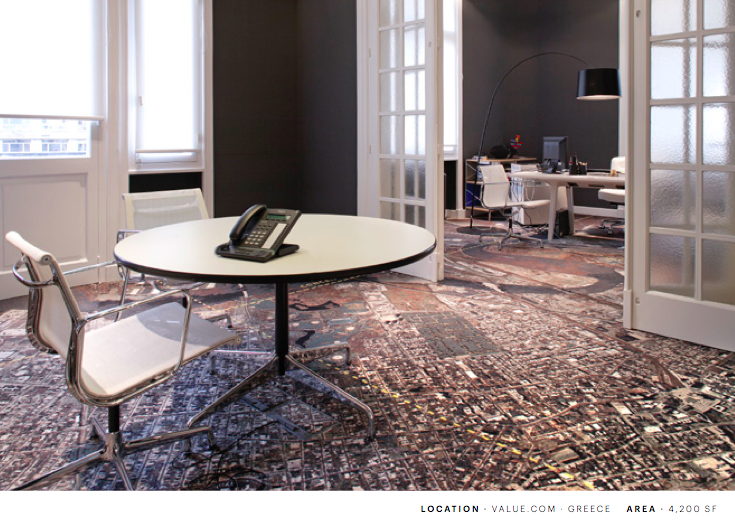
Ege Carpet, designed in New York and made in Denmark have been making floor coverings for 78 years now, so they know a thing or two about it. They even have a wonderful program called Atelier that allows you to design your own bespoke product. If you can imagine it, they can probably put it on a carpet or rug. Look at some of these marvelous examples below like the sand dunes or aerial map that add interest, whimsy...creating a custom rug makes a space truly memorable.


And French fashion designer Christian Lacroix created these amazing carpets for fashion museum Musée Galliera in Paris and art museum Musée Réattu in Arles.


It is vital to incorporate pattern, color, and interest into a room with furnishings but often a floor is overlooked. Even though these photos show carpets in commercial applications, they could work beautifully in any residential setting.
Are you considering adding a special touch to your floors? Give me a call!
Happy designing!

Monday, September 7, 2015

Tibetan Tiger Rugs

Years ago, I worked for a store that sold hand loomed Tiger Rugs from Tibet. I bought them directly from the importer who would go to Tibet and although I told myself to grab one for myself while I could, I never did and now I regret it. These gorgeous hand knotted rugs are associated with ancient adherents of Tibetan Buddhism who meditated on tiger pelts. It is believed that meditating on a tiger rug will protect the meditator from negative influences (both seen and unseen), thus enhancing the power of one's meditation practice.

The best kind are the cut out rugs, in the shape of an actual pelt. But there are rectangular tiger rugs where the body of the tiger is within the ground of the rug itself.

A tiger rug on the loom in Nepal. Photo by Dieter Wanczura at Artelino. Click photo for details.

Using these rugs in an interior application can lend an eclectic, worldly sense to any room. Here we see a cut out Tibetan tiger rug in the entryway of the former home of interior designer Frank de Biasi and his partner, designer Gene Meyer.


Tibetan tiger rugs don't necessarily have to be used on the floor. They can be draped over chairs or sofas, or used as wall hangings!

Happy designing!