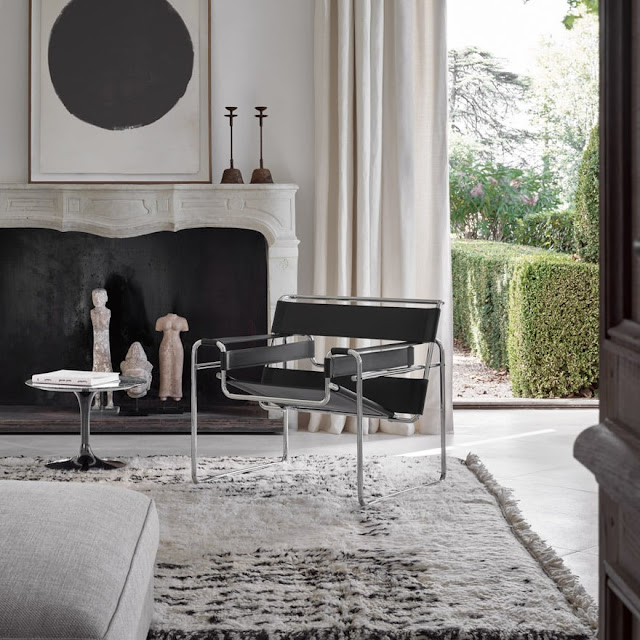
After the opulence, glitter, and excess of the holiday season passes, my mind usually turns to more simple forms and styles. After the shiny ornaments are put away, we are left with bare branches and grey skies. With this in mind, this installation of History of Furniture focuses on two simple, sleek styles from the early part of the 20th century known as Bauhaus, or International Style, and its counterpart De Stijl (deh STEEL).
The Bauhaus School was founded by architect Walter Gropius in Weimar, Germany in 1919. The Bauhaus Manifesto touted the unity of all arts, and emphasized the idea that artists are actually craftsmen. "Salon art" is a "world that must build again," according to the manifesto. "Let us then create a new guild of craftsmen without the class distinctions that raise an arrogant barrier between craftsman and artist! Together let us desire, conceive, and create the new structure of the future..." Gropius proclaimed that "we want an architecture adapted to our world of machines, radios and fast cars." The Bauhaus school was heavily influenced by Modernism. The long list of teachers and students who graduated from the school forged a new, abstract, spartan sensibility that went on to influence generations and decades to come. The movement's influence can still be felt, especially with the return in popularity of Mid-Century Modern design.
Concurrently in The Netherlands, a similar idea was brewing in a movement called De Stijl, or "the Style," founded in 1917, in which total abstraction and a simplification to basic shapes and colors was promoted. Although the two movements are referred to under their respective names and produced work that is identifiable as belonging to one movement or another, there was enough crossover and similarity to warrant my presenting them together for this post. In fact, Dutch painter and De Stijl founder Theo van Doesburg moved to Weimar to teach at the Bauhaus.
The Bauhaus style announced itself in the main structure when the school moved from Weimar to Dessau. The no-nonsense concrete, steel, and glass elements set off the Bauhaus font beautifully.
The furniture, rugs, and pottery that came out of the school were equally as severe, startling, and ultimately functional as the building itself. Take a look.
The famous Bauhaus child's cradle designed by Peter Keler was a traditional idea distilled down to only what was necessary for its function. Keler used a theory of color and shape developed by one of his teachers, the painter Wassily Kandinsky, to fashion the piece from a square, a circle, and a triangle.
Below we can see the classic lamp designed by Bauhaus follower Wilhelm Wagenfeld. Next to it are some multi-colored Bauhaus nesting tables. As always with Bauhaus, form (and style) follows function.
One of the most famous Bauhaus designers (both a student
and later a teacher) created one of the most famous chairs in history: the Wassily Chair by Marcel Breuer. It was revolutionary at the time because the German steel manufacturer Mannesmann had recently perfected a way of producing steel tubing without any seams, making the bend of the steel frame possible. The taut black leather gives it a very architectural look.
Breuer also created one of the most copied chairs of the 20th century, the Cesca Chair, made of steel tubing and a woven cane back and seat. My parents had these chairs at our dining table when I was growing up.
Meanwhile in The Netherlands, De Stijl designer Gerrit Reitveld was almost single-handedly changing the way the Dutch saw furniture. He had a close artistic friendship with the artist Piet Mondrian whose rigid canvases of squares and rectangles served as inspiration and fodder for Reitveld's own ideas about the nature of design, and the importance of horizontal and vertical planes.
His most famous chair, the Red and Blue Chair, held to the De Stijl self-imposed restriction of using only primary colors along with black or white.
He created many other pieces, all adhering to the same properties and ideas he developed. Below we can see a buffet, a side table, his iconic Zig-Zag chair, and finally, his masterpiece, the Berlin Chair.
We can see echoes of Bauhaus and De Stijl in subsequent design movements like Mid-Century Modernism in the 1950s, clear through to the 1980s with the Memphis Style, both of which we will be examining in future posts.
In the meantime, happy designing!