For the colder months here in the Northern Hemisphere, nothing keeps you warmer than all natural wool. And what could be more luxurious than feeling warm, thick wool pile under your feet instead of a cold wood or tile floor?
A flokati (flow-KAH-tee) is a type of rug that has been woven in Greece for thousands of years. Originally created by Vlach shepherds in the Pindus mountain range on the border of Greece and Albania, these rugs are made entirely of sheep wool, including the base. When the rug is being woven, long wool strands are inserted in between the weft fibers (the ones that run horizontally, or left to right). The rugs are then left in cold running water like rivers or waterfalls (or machine baths) where the long wool strands unravel and fluff out, while the backing gets much tighter, creating the classic, shag-rug look and feel of a flokati.
Today, these rugs are still handmade in Greece. In fact, in 1966 the Greek Ministries of Finance, Industry, and Commerce passed a law regarding flokatis that is reminiscent of the territorial claims for champagne (in order to be called champagne and not just a sparkling wine, it must be made in the Champagne region of France). The law specified that for a rug to be classified as a flokati, it must be hand woven in Greece and must be made of 100% wool (warp, weft, and pile). The total weight of the rug must be at least 1800 grams of wool per square meter. And the flokati must be subjected to the water friction process for the pile to unravel and fluff out.
Since they were popular in the United States in the 1970s, these rugs can have a slightly retro vibe to them. But as you can see below, they can look completely modern too!
Flokatis don't have to go on the floor either--they can be spread on chairs or on the backs of sofas...or even hung on walls like a tapestry to give a space texture.
Happy designing!
Showing posts with label Greek. Show all posts
Monday, December 5, 2016
Monday, January 13, 2014
Know Your Chairs: The Klismos
We have the ancient Greeks to thank for the marvelous design of the klismos chair. Coming from the ancient Greek word klinein which means "to lean," this elegant chair can be seen depicted on vases and pottery from Greek antiquity.
Klismos chairs were originally made of wood with seats of cane or of woven leather. The swooping delicate line of the chair comes from its saber legs which curve out. The back rest continues the curve upward but in the opposite direction, giving the silhouette of the chair a beautiful "S" curve. A low, concave panel supported the sitter's back. While there are really no extant klismos chairs to speak of, we can find plenty of imagery showing its shape and construction not only from the Greeks but also from the Romans who emulated nearly every aspect of Greek culture.
The chair was quite popular during the classical Greek period but fell out of usage by the Hellenistic period. Some theorize this is because the chair's delicate saber legs contributed to instability, causing the piece to splay out and break. One would think that with a design flaw that serious, the chair would never have been widely used to begin with. I feel the decline of the chair simply has to do with changing tastes of style and fashion. Whatever the reason, it seems that the shape is too exotic and alluring to resist and the chair saw a huge rise in popularity in the late 1700s when all of Europe was interested in Neo-Classicism. Greek and Roman sites were being excavated, pottery was being unearthed and images of the klismos chair were discovered!
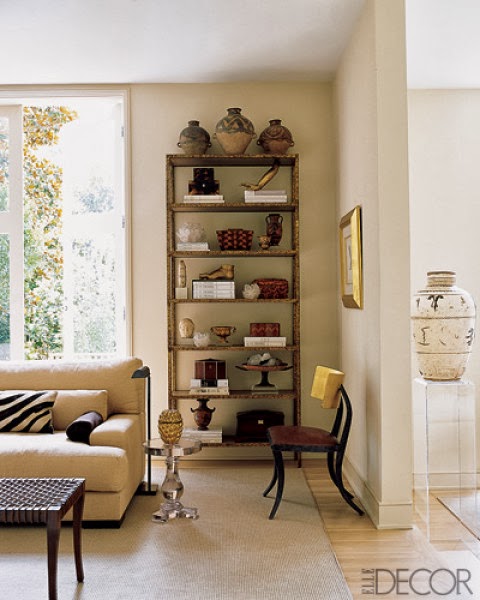
The klismos came back into favor in the late 1930s--look at T. H. Robsjohn-Gibbings' very faithful 1937 reconstruction above--and continues to be widely used today. Due to its simple lines and streamlined shape, the klismos can fit in with practically any décor scheme, from traditional to modern.
I came across this Bernhardt Gustav chair, which is a klismos chair in polished chrome, at a furniture showroom recently and I am beyond eager to use it for a client.
And if my client-to-be does not like chrome, I can get them one in a warm toned gold brass! Designer Will Wick used this De Sousa Hughes klismos chair, below, in a library to great effect!
It can even be found in acrylic...
The klismos chair is timeless and extremely versatile. Its presence is lyrical and sculptural. Maybe you could use one--or several--in your home!
Happy designing!
Subscribe to:
Posts (Atom)