Monday, May 22, 2023

Happy World Interiors Day 2023!

I will be celebrating World Interiors Day this Saturday, May 27, 2023, which is an event sponsored by IFI (The International Federation of Interior Architects/ Designers).


This year's theme is "Sustainability, Design & Beauty." And the IFI website says of the theme:

IFI invites you to explore “Sustainability, Design & Beauty” and to share with your colleagues and the world what this theme means to you as a design advocate and enthusiast. Let’s demonstrate how we deliver supportable beauty and vitality to the spaces and environments in our unique contexts and communities.

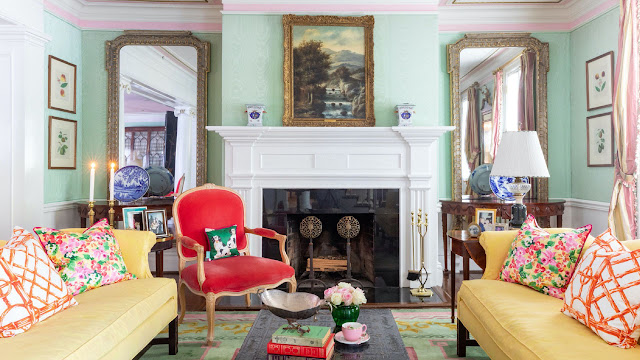
Working with an interior designer can greatly improve the experience of your home, how you live in it, and ultimately the value of your space. Life is so much better if you love where you live!

Interior designers can help with:
* Floor plans
* Space planning
* Color palette
* Paint selection
* Lighting selection and design
* Furniture and furnishings selection
* Art selection and placement
* Bath and kitchen remodels

In my own practice, I can help with any or all of these steps. If you have unlimited time and patience, you could tackle some of these yourself, but why bother when an educated, knowledgeable professional can save you time and heartache (and heartburn). But most importantly, an interior designer can save you money by helping you to avoid mistakes that would be costly to amend, fix, or do over, which is especially true with kitchen and bathroom remodels. It is not as easy as it looks on HGTV! Trust me.

I am an advocate for my clients, introducing them to products and materials that they might not otherwise know of. I can help to expand design sensibilities into new, exciting areas. And I can bring to the project advantageous relationships with vendors, suppliers, and tradespeople that clients normally would not have.

If you have been a fan of design but have never worked with an interior designer before, or if you have been thinking of perhaps working with an interior designer on a possible project in your home, or if you have started a project on your own but can't quite seem to finish it, I encourage you to contact me. I can help to greatly enhance your home and your life in it with thoughtful design. My business motto is, "Shape your home, shape your surroundings, shape your life."

Click on my business logo to the right to see my website, my portfolio, and to contact me!
Happy designing!

Monday, May 8, 2023

Legends of Design: Dorothy Draper

Who was the first interior designer in the United States? An intriguing question indeed, since there seems to be two answers...

In a previous post here, I wrote about a woman named Elsie de Wolfe who is considered to be the mother of Interior Design as a profession. Born in 1865 (although her Wiki page wonders if she was born in 1859), de Wolfe had many society friends who admired her work in her own home and asked for her services to brighten and refresh their own spaces. But it wasn't until 1905 that de Wolfe became known as a true, professional interior designer when famed New York City architect Stanford White was designing The Colony Club, a women's socialite club on Madison Avenue started by suffragettes, and brought de Wolfe in to design the interior spaces. Based on that success, she opened up her design studio on 5th Avenue.

However, a few years later, another driving force in Interior Design arrived in the form of one Dorothy Draper. She was born into the wealthy Tuckerman family in Tuxedo Park, NY in 1889 who divided time between three homes--a mansion in Tuxedo Park, a Manhattan townhouse, and a summer cottage in Newport, Rhode Island, as well as traveling to Europe for summers. Her class and milieu certainly formed her taste and in a 2006 New York Times article about Draper, Donald Albrecht, the curator of architecture and design at the Museum of the City of New York, said her "background not only provided Draper with a valuable network of clients and an innate sense of entitlement and authority, but also offered her a first-hand acquaintance with the historical styles that she would freely interpret and transform."


Dorothy married George Draper in 1912 and began decorating a series of homes they bought and sold. Much like de Wolfe, her socialite friends saw and admired what she was creating and sought her out to design their own homes. And in 1925, she opened up what is considered the first official Interior Design business in the United States, the Architectural Clearing House. Four years and many successful renovations later, she changed the name of the firm to Dorothy Draper and Company.

She championed a very specific aesthetic that was a blend of elements from Louis XIV, the wild ornamentation of Rococo, and a bit of neoclassicism from Louis XVI with contemporaneous elements and silhouettes from the 1920s. Her favorite color palette of red, green, powder blue, and yellow was offset by her penchant for cabbage-rose chintz, bamboo trellis and cabana stripe prints, palm frond wallcoverings, and black & white checked flooring. Her maximalist style came to be known as "Modern Baroque," or "Hollywood Regency" which can be seen in films from the 1920s all the way up to the 1950s. Her style can also be directly traced to the work of current designers like Kelly Wearstler and Johnathan Adler.

Draper's most famous project remains The Greenbrier, a massive resort in West Virginia dating from 1858 (!), that still prominently features her design sensibility. Draper was retained in 1946 to refresh and redecorate the resort, mingling her Modern Baroque flair with a Federalist style appropriate to the area. And while there have been changes over the years, the facility has not abandoned the original candy-colored schemes and details. Dorothy Draper is there in bright, full spirit. You can stay at The Greenbrier and see Draper's iconic work for yourself. Visit their site for information.
All following photos from The Greenbrier.


In 1964, Dorothy Draper sold her company to designer Carleton Varney who had worked closely with Draper for four years. He faithfully continued the legacy and style of Draper until his death in 2022 but Dorothy Draper and Company is still in operation.


Happy designing!

Monday, April 24, 2023

Know Your Chairs: The Womb Chair

For this installation of Know Your Chairs, let's look at another classic of Mid-Century Modern design: the Womb Chair. Created in 1946 by Finnish-American designer and architect Eero Saarinen (previously here), around the same time he was working on designs for the gateway Arch in St. Louis, he was approached by Florence Knoll who challenged him to make a new kind of chair: "I told Eero I was sick and tired of the one-dimensional lounge chair...long and narrow...I want a chair I can sit in sideways or any other way I want to sit in it...a chair that was like a basket of pillows...something I could really curl up in."

Saarinen set about reinventing the concept of a chair so that it was not comfortable from all the cushioning or padding, but from the actual shape of the chair itself. Wrapping foam around a fiberglass shell and setting it all on a set of splayed steel legs, the organic, welcoming Womb Chair was born. Speaking to the chair's name, Saarinen said, "It was designed on the theory that a great number of people have never really felt comfortable and secure since they left the womb. The chair is an attempt to rectify this maladjustment in our civilization. There seemed to be a need for a large and really comfortable chair to take the place of the old overstuffed chair. Today, more than ever before, we need to relax."


This classic of modernist design is still available from the original manufacturer and license holder, Knoll.

Happy designing!

Monday, April 10, 2023

Dead Flat by Farrow & Ball

Launched just a few weeks ago, British paint manufacturer Farrow & Ball's new Dead Flat formula is quite striking. A paint with an ultra-matte finish, it boasts only a 2% sheen. This allows the eye to perceive the depth and richness of Farrow & Ball's unique pigments. But what's so new about that you might ask? Haven't F&B always made deep, unusual hues? Well yes, but they have formulated Dead Flat to be--are you sitting down?--completely washable and wipeable, behaving much like a high sheen paint! Truly remarkable.


Happy designing!

Monday, March 27, 2023

A Gold and Stone Bathroom by Fiorito Interior Design

You don't have to have a big celebrity mansion to have a beautifully appointed house finished with unique and special materials. When my clients bought an average condo kitted out with all the average builder-grade things that average builders stuff into spaces like that, they longed to make it theirs. Being collectors of colorful Fiesta tableware and lovers of extravagant stone, we set about infusing the space with a dose of their fun personality.

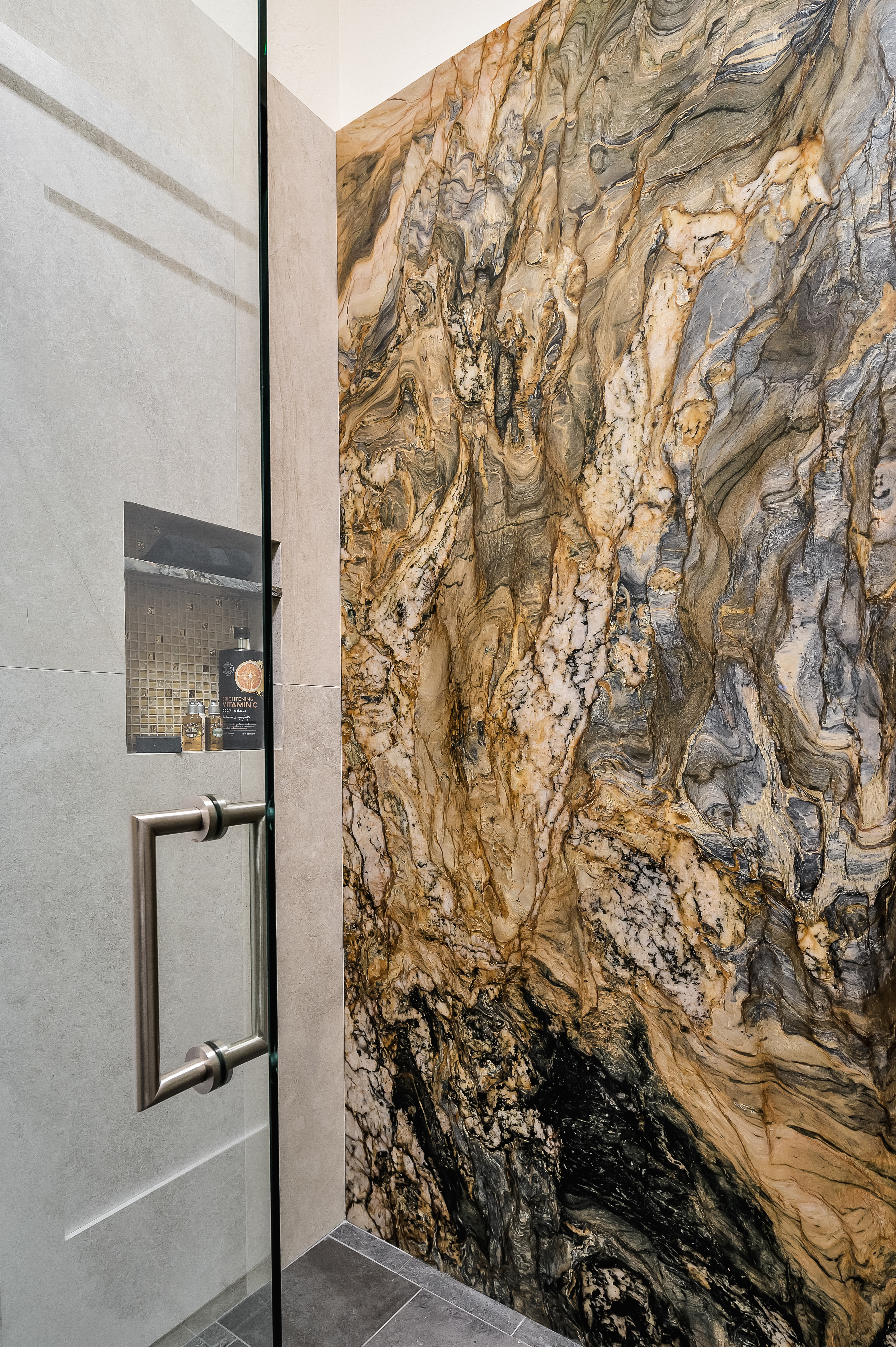
There wasn't a corner of the house that went untouched, but one of my favorite spaces turned out to be the primary bathroom. The scheme for this room took shape when we were at a slab warehouse shopping for material. We stumbled across a packet of a stunning quartzite called Fusion Wow Dark and immediately fell in love. We snatched up a pair of slabs for the counter as well as the back wall of the shower.


My clients were eager to be rid of a tub-shower alcove and create a spacious curbless shower, which meant a full piece of stone on the entire long wall would be stunning. But what should be put with it?

I found a neutral, sandstone-like tile for the return walls of the shower and brought it around the remaining walls of the space, capped with a coordinating chair rail. But my client's love of gold and all things sparkly led us to a wonderful mosaic. Composed of shifting hues of honey and gold, I envisioned the mosaic on the vanity wall and as a backing for the niche in the shower.


We chose a dark slate tile to ground the room, and designed a luxurious, glass French door shower enclosure. Little touches like a motion-detected toe kick night light at the vanity, oversized LED mirrors, and ultra-modern plumbing fixtures elevate this previously simple bathroom.

Photo by Bernardo Grijalva

And for a little perspective, here are some BEFORE and AFTER shots! As you can see, we ditched the mirrors that were just tacked to a piece of painted wood, the annoying drop-in sinks, and the dated tiled countertop.


If you wish to infuse some wow into your average space, give me a call. I'd love to help!

Happy designing!

Monday, March 13, 2023

Famous Homes: Georgia O'Keeffe's Abiquiú Home

Few famous homes have such an iconic connection between both location and inhabitant as the adobe structure in Abiquiú, New Mexico that legendary painter Georgia O'Keeffe called home.

After living just a few miles away at Ghost Ranch for several summers, she realized that the ranch was not suited for year-round living (especially in the colder winter months) and went in search of a permanent home. She found it in the small village of Abiquiú. The Georgia O'Keeffe Museum now owns both homes and the website has a succinct accounting:

Georgia O’Keeffe maintained two homes in Northern New Mexico. Her summer house, twelve miles from Abiquiú, sits on 12 acres at the edge of a 21,000-acre property called Ghost Ranch. When O’Keeffe purchased the parcel in 1940, the greater Ghost Ranch operated as a dude ranch—a destination for visitors and tourists...Though breathtakingly situated, O’Keeffe’s Ghost Ranch home was not suitable for her to live in year-round. O’Keeffe purchased a larger home, in the village of Abiquiú, for its well-irrigated garden and the comfort it offered in winter. While both houses are owned by the Georgia O’Keeffe Museum, only the Abiquiú Home and Studio is open for public tours.

The O’Keeffe Home and Studio reflects a blend of Native American and Spanish Colonial building styles, regional architectural traditions dating back centuries. The oldest rooms of the house were probably built in 1744. The house was expanded in the 19th century into a pueblo-style adobe (mud brick) hacienda, with rows of rooms organized around a common open space, or plazuela.

It was one of the courtyard walls of the home that first attracted O’Keeffe. She recalled: “As I climbed and walked about in the ruin I found a patio with a very pretty well house and bucket to draw up water. It was a good-sized patio with a long wall with a door on one side. That wall with a door in it was something I had to have.”

The 5,000-square-foot compound was in ruins in 1945 when she purchased the home from the Catholic Church. For the next four years, O’Keeffe supervised its restoration, which was carried out by her friend, Maria Chabot. O’Keeffe finally made Abiquiú her permanent home in 1949. The special character of the property, a quiet sanctuary from which to draw inspiration, perfectly suited O’Keeffe’s needs. O’Keeffe lived in the home from 1949 until 1984. She died in Santa Fe on March 6, 1986, at the age of 98. The O’Keeffe Home and Studio was designated a National Historic Landmark in 1998 and is now part of the Georgia O’Keeffe Museum.


There are several things that strike me about O'Keeffe's home and her personal style. She famously said when renovating the home that she did not want a Native American home, she did not want a Spanish Colonial home, she wanted "my home." Yet it is a blending of all those elements--the Native style straw-and-mud adobe texture outside and in as well as the spartan and functional design with open kiva fireplaces in corners that solidify the unique profile of this house. The near Zen-like interiors are a prefect foil for the type of pared-down sensibility of Modernism and Mid-Century Modern furniture styles. She preferred objects like Eero Saarinen's 1946 Womb Chair, his 1957 Tulip chair (previously here), the Eames' 1946 Molded Plywood Lounge Chair (previously here), and Alexander Calder mobiles. And it all works perfectly together.

A vintage view of the living room at Georgia O'Keefe's home with Saarinen's Womb Chair, at left.
A current view of the living room with the Womb Chair and ottoman.
The Eames-designed Molded Plywood Lounge Chair in red in the foreground.
A Le Corbusier-style lounge chair to the right of the fireplace with an O'Keefe sculpture on the hearth.


I just love this portrait of O'Keefe by photographer Christopher Springmann from 1974. He is a very talented portraitist because he got O'Keeffe to relax into a sweet sort of smile...


You can visit the Georgia O'Keeffe House in Abiquiú! Make reservations here. And then head to Santa Fe to view her work at the Georgia O'Keeffe Museum, tickets available here.

Happy designing!