Let's look back at a truly timeless genre of furniture for this installment of the History of Furniture.
Duncan Fife was born in Scotland in 1768 where he served as a cabinetmaker's apprentice but immigrated with his family to Albany, New York in 1784. After changing the spelling of his name to Phyfe, he opened his own business in 1794 and became a famous furniture maker. Known during his lifetime as the "United States Rage", he made Neoclassical furniture for the social and mercantile elite of New York, Philadelphia, and the American South where he was particularly popular.
While he may not have developed a style of furniture, he refined and elevated Neoclassical pieces, bringing them to the United States, and leaving a lasting impression of what fine furniture looks like. His pieces echo through what we consider "antique furniture" to be today.
A hallmark of his furniture was the lyre motif which you can see below on a chair splat, the base of a game table, and the sides of a bench.
Another feature of Phyfe furniture is the curved X-shape on the legs and backs of the curule chair, a design that dates back to ancient Rome.
Here is an ancient Roman coin showing Emperor Tiberius seated on a curule seat!
Happy designing!
Monday, June 29, 2020
Monday, June 15, 2020
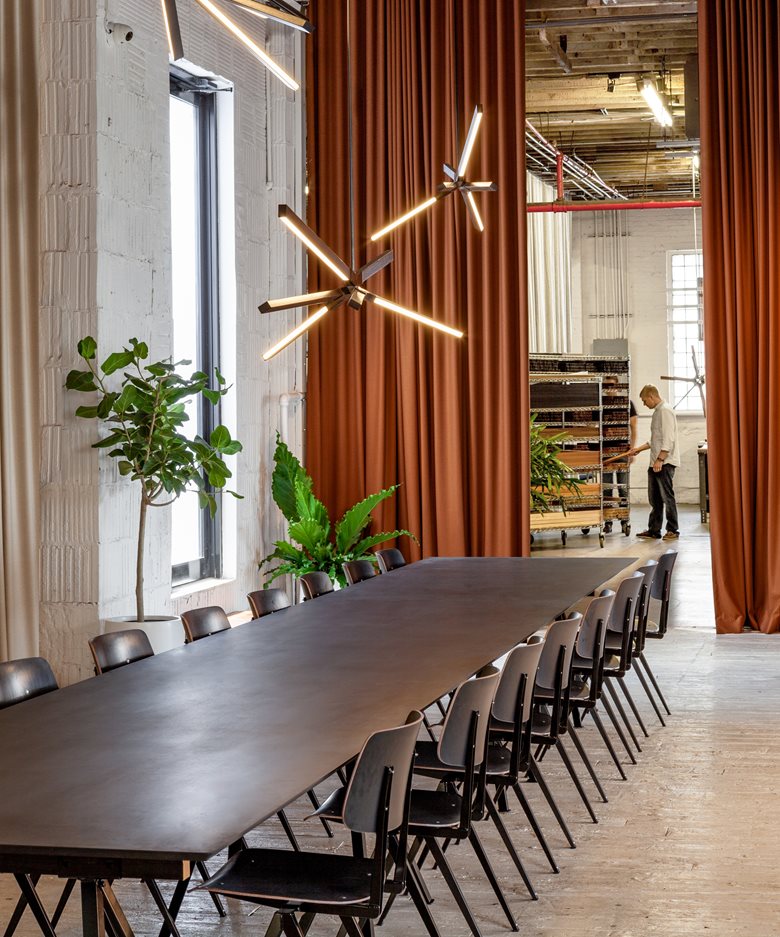
Stickbulb
We started this month looking at the history of white plaster lighting fixtures, and in contrast to the artisan-made tactility of those fixtures, let's look at a company integrating LED into extremely minimalist designs using slim rectangles of wood.
Stickbulb was formed in 2012 by Russell Greenberg and Christopher Beardsley. Inspired by a pile of long linear wooden cut-offs in their workshop, the designers challenged themselves to develop a truly sustainable lighting system. As a starting point, they only considered designs that could be manufactured locally and affordably within a five mile radius of their New York City office. They chose to use reclaimed and sustainably sourced woods as a primary building material, and sourced energy efficient LED technologies and components. The collection was designed with the least number of parts possible and with connections that make the pieces easy to separate for maintenance, recycling, or reuse. The result is a light-up erector set of interchangeable components that allows for unlimited customization and creativity.
They make a wonderful collection of pendants, chandeliers, sconces, and floor lamps. Take a look at the strong line of the pieces below.
Happy designing!
Monday, June 1, 2020
The Timelessness of White Plaster
Ever since the rise of social media platforms like Instagram and Pinterest, interior design ideas, colors, shapes, textures, and patterns rise and fall at a dizzying pace. Things that used to become popular in an organic way, that is by installation and use, are now artificially turned into "trends" that cycle through in a matter of months. Images race across the internet and things become passé even before the last person can hit SEND.
So I appreciate an interior design item that has been around and will be around...an item that is not appealing to the Insta-crowd. And this subtle material shows up discreetly in design schemes, adding interest and style without appealing to the lowest common denominator. White plaster has been used for many different applications (see the marvelous white plaster furniture of John Dickinson here) but when used on lighting fixtures, it turns into something very special.
In 1954, the modern master artist Alberto Giacometti created three plaster chandeliers for his friend, the art critic, patron, and publisher Tériade (Stratis Eleftheriades). The one seen below hung in Tériade's dining room in his apartment on rue de Rennes in Paris. The artist had used white plaster in his sculptural work for some time. Giacometti had begun designing plaster lighting in the late 1920s, a period of intense collaboration with Jean-Michel Frank. And this particular light sold at auction for £2,045,000.
Alberto created many works with his brother Diego who was an equally powerful and famous sculptor and designer. And in 1985, the Musée national Picasso-Paris commissioned Diego Giacometti, then in his 80s, to create a 50-piece collection of chairs, benches, lights and tables, designed exclusively for the Hôtel Salé (the historical site that houses the museum). He finished the commission just before his death in July 1985.
As I mentioned, the allure of such delicate, geometric white plaster light fixtures seems to transcend styles and trends.
Lighting designer Julie Neill has an entire line of white plaster fixtures: she created this light in homage to Diego Giacometti called, appropriately enough, the Diego Chandelier. The version here is a two-tier fixture but it also comes as a single tier.
Something very much like the Diego light can be spotted in the Paris apartment of Jean-Louis Deniot.
And this sitting room by Jeffrey Bilhuber sports what looks like the two-tiered version.
Interior designer Miles Redd designed a fixture in white plaster for Ballard.
There are lots of other versions of light fixtures in white plaster...
I love this cup fixture and lantern fixture from ALT For Living.
This white plaster Lotus chandelier from Tracey Garet for her company Apsara is both modern but organic enough to take its place in a traditional Chinoiserie dining room!
Here is a lovely, subtle chandelier in a beautifully bright dining room by Charlie Ferrer.
And even legendary interior designer Nicky Haslam has a white plaster lantern in his London home!
Happy designing!
So I appreciate an interior design item that has been around and will be around...an item that is not appealing to the Insta-crowd. And this subtle material shows up discreetly in design schemes, adding interest and style without appealing to the lowest common denominator. White plaster has been used for many different applications (see the marvelous white plaster furniture of John Dickinson here) but when used on lighting fixtures, it turns into something very special.
In 1954, the modern master artist Alberto Giacometti created three plaster chandeliers for his friend, the art critic, patron, and publisher Tériade (Stratis Eleftheriades). The one seen below hung in Tériade's dining room in his apartment on rue de Rennes in Paris. The artist had used white plaster in his sculptural work for some time. Giacometti had begun designing plaster lighting in the late 1920s, a period of intense collaboration with Jean-Michel Frank. And this particular light sold at auction for £2,045,000.
![]() |
| In this portrait of Alberto Giacometti in his studio, the chandelier can be seen hanging in the upper right. |
Alberto created many works with his brother Diego who was an equally powerful and famous sculptor and designer. And in 1985, the Musée national Picasso-Paris commissioned Diego Giacometti, then in his 80s, to create a 50-piece collection of chairs, benches, lights and tables, designed exclusively for the Hôtel Salé (the historical site that houses the museum). He finished the commission just before his death in July 1985.
As I mentioned, the allure of such delicate, geometric white plaster light fixtures seems to transcend styles and trends.
Lighting designer Julie Neill has an entire line of white plaster fixtures: she created this light in homage to Diego Giacometti called, appropriately enough, the Diego Chandelier. The version here is a two-tier fixture but it also comes as a single tier.
Something very much like the Diego light can be spotted in the Paris apartment of Jean-Louis Deniot.
And this sitting room by Jeffrey Bilhuber sports what looks like the two-tiered version.
Interior designer Miles Redd designed a fixture in white plaster for Ballard.
There are lots of other versions of light fixtures in white plaster...
I love this cup fixture and lantern fixture from ALT For Living.
This white plaster Lotus chandelier from Tracey Garet for her company Apsara is both modern but organic enough to take its place in a traditional Chinoiserie dining room!
Here is a lovely, subtle chandelier in a beautifully bright dining room by Charlie Ferrer.
And even legendary interior designer Nicky Haslam has a white plaster lantern in his London home!
Happy designing!
Monday, May 18, 2020
The Fun Room Sunroom by Fiorito Interior Design
The mission: turn an unused back patio into a space where mom and dad and kids can all play and enjoy being together. Dad is an avid video gamer, mom and dad love to play board games with friends and family, and the kids love to draw and play.
After the patio received a new enclosure and ceiling with recessed LED lights, my solution was to divide this long space into two zones, one for adults and one for kids, but unified with a sky blue and soothing green color palette and coordinating rugs.
To the right we have a comfortable sofa with poufs gathered around a specialty cocktail table that turns into a gaming table featuring a recessed well which corrals boards, game pieces, and dice (and a handy grooved lip for propping up game cards), and also has a hidden pop-up monitor that connects to game consoles or streams films/television.
I designed a shelving system to wrap around the back of a brick fireplace that includes narrow upper shelving to store board games, and plenty of other spots for fun things like working robotic models of R2D2 and BB8!
Over in the kids’ zone, a handy storage system with blue doors, a modular play table in a dark blue grey, and a sweet little tee pee lined with fur throws for playing, hiding, or napping gives this half of the room an organized way for kids to express themselves. Magnetic art holders on the wall display an ever-changing gallery of finger paintings and school crafts.
This back patio is now a fun room sunroom where the whole family can play!
All photos by Bernardo Grijalva
If you'd like to turn an unused area of your house into a special spot, give me a call!
Happy designing!
After the patio received a new enclosure and ceiling with recessed LED lights, my solution was to divide this long space into two zones, one for adults and one for kids, but unified with a sky blue and soothing green color palette and coordinating rugs.
To the right we have a comfortable sofa with poufs gathered around a specialty cocktail table that turns into a gaming table featuring a recessed well which corrals boards, game pieces, and dice (and a handy grooved lip for propping up game cards), and also has a hidden pop-up monitor that connects to game consoles or streams films/television.
I designed a shelving system to wrap around the back of a brick fireplace that includes narrow upper shelving to store board games, and plenty of other spots for fun things like working robotic models of R2D2 and BB8!
Over in the kids’ zone, a handy storage system with blue doors, a modular play table in a dark blue grey, and a sweet little tee pee lined with fur throws for playing, hiding, or napping gives this half of the room an organized way for kids to express themselves. Magnetic art holders on the wall display an ever-changing gallery of finger paintings and school crafts.
This back patio is now a fun room sunroom where the whole family can play!
![]() |
| The top of the specialty cocktail/game table comes off in sections... |
![]() |
| ...to reveal the navy velvet gaming surface beneath! |
![]() |
| Beneath the velvet gaming top is a flip up monitor for video games or movie watching! |
All photos by Bernardo Grijalva
If you'd like to turn an unused area of your house into a special spot, give me a call!
Happy designing!
Monday, May 11, 2020
Fiorito Interior Design Is Open!
Greetings clients past, current, and future!
While these last eight weeks have been an undeniably difficult time in our world, some things are still here, like the need for a comfortable, welcoming home in which to Shelter-In-Place. I've been hearing a lot of stories of people who are, for the first time, truly experiencing their homes and realizing they want it to be something cocooning, inspiring, and beautiful. Especially with the prospect of continuing extended periods at home (some models predict the virus' return in the fall), people are wanting to be engaged in their home in a more meaningful way.
And now that some restrictions are lifting and we are venturing out into the world once again, I am still here to help you achieve that goal while keeping aware of physical distance and our safety. None of us really knows what the next steps are, and retail--and especially our industry--is still making adjustments. But despite some supply chain delays, I am designing and successfully executing remodels and projects. It takes some creativity and patience as we all maneuver this new paradigm, but if you are yearning for an upgrade, facelift, or remodel of any space in your home, please contact me. I can help.
Stay safe and happy designing!
Monday, May 4, 2020
To Carpet or Not To Carpet: That Is The Question
If "to carpet or not to carpet" really is your question, I hope I can provide some answers or at least some guidance.
First, let's talk about what carpeting is. I have often heard people use the words "carpet" and rug" interchangeably and while this may be attributed to regional dialects, within the design world a carpet is a floor covering that stretches from wall to wall while a rug is something smaller that floats within a space. We can talk about rugs in a future post, but for now, carpet is where we are!
So, if you want to explore the idea of carpeting, it's good to know where carpeting can and cannot go. Since the concept of carpet is something warm and soft underfoot, it is ideal for the private spaces of your home, such as bedrooms (where we are most always barefoot), perhaps family rooms (again, where we may be barefoot), and offices. However, carpet should not be used in kitchens (for the obvious reason of spilling and cleaning), and carpets should never be used in bathrooms (for the obvious reason of hygiene). And while it is often used on stairs as a runner--either tacked down or with elegant brass rail hardware--carpet is not a good choice for high traffic areas like entryways and hallways. Since these spaces get a lot more daily use, the carpet in these areas can wear faster and become stained much quicker. Hard surfaces are the better choice for these spots.
A carpeted bedroom however can give a wonderful sense of luxury and pleasure. There are so many types of carpet. How do you know what kind to invest in? Ask yourself how plush you want the carpet to be. There are two main types of carpet.
--Loop pile (this includes Berber, level loop, and multi-loop carpets)
--Cut pile (this is what used to be referred to as "shag" carpeting and includes velvet, Saxony, textured, and frieze carpets)
When loop pile carpets are made, the fibers come up from the bottom--or backing--of the carpet and then back down again, creating a closed loop. The loops on Berber carpets can be very tight, giving the appearance of something woven. Level loops offer a bit of cushion and multi-loop carpets can be a mixture of high and low loops, making the carpet appear to be "sculpted." Tighter loops like Berbers wear best as the fibers do not stick up for them to become crushed or matted. However this carpet style can feel a little bit industrial.
Cut pile carpeting is more sumptuous and can offer a plushness that is delightful. When the carpet fibers come up from the underside of the backing material, they are cut instead of returning into the backing. A Saxony carpet has fibers placed together in a dense arrangement and cut as evenly as possible. Some types of textured carpets have a construction where the fibers are twisted before they are cut giving them a more casual appearance and a longer wear life. You can look for the TPI or "twists per inch" on the carpet information which should tell you about its quality: generally carpets will have 3-6 twists per inch but frieze carpets can see up to 7 or 9 twists per inch.
Two other factors determine the quality of a carpet and should be examined when deciding: density and weight.
--Density refers to how many fibers are in a pile and how tight the fibers are; generally, denser carpets are more durable. Bend the carpet sample into a U-shape and see how much of the backing is visible. More backing means less quality.
--Weight is an indicator of density, as it is measured by square foot. The higher the weight, the more fiber per square foot, the more dense and durable the carpet. Again, this information should be shown on the back of the carpet sample when choosing and buying.
This leaves the material from which your carpet can be made. There are a lot of different materials, but they are basically broken down into natural or man-made fibers.
--Natural fibers include wool and silk which is blended with other fibers. Wool however is the only natural fiber that is fire-resistant because of the presence of lanolin. It also resists stains. is considered eco-friendly, and has an excellent wear life.
--Man-made fibers include:
a) Nylon--The most popular choice of man-made fibers but needs to be treated with a stain resistant product. It does have a long wear life and is good in higher traffic areas if you wish to use it.
b) Acrylic--Seen as an inexpensive alternative to wool, acrylic is stain resistant and easy to clean, fade resistant, and water-repellant but it is less durable than wool and can become fuzzy over time.
c) Olefin--Resistant to moisture, mold, and mildew with medium durability.
d) Polyester--Stain and fade resistant and durable but make sure you get a good quality carpet with maximum density and weight so it lasts a long time.
Things to consider when choosing a material include the foot traffic of your space, and whether children or pets (this means dirt and staining) are going to be on the carpet.
I hope this helped take the mystery out of carpet.
Happy designing!
First, let's talk about what carpeting is. I have often heard people use the words "carpet" and rug" interchangeably and while this may be attributed to regional dialects, within the design world a carpet is a floor covering that stretches from wall to wall while a rug is something smaller that floats within a space. We can talk about rugs in a future post, but for now, carpet is where we are!
So, if you want to explore the idea of carpeting, it's good to know where carpeting can and cannot go. Since the concept of carpet is something warm and soft underfoot, it is ideal for the private spaces of your home, such as bedrooms (where we are most always barefoot), perhaps family rooms (again, where we may be barefoot), and offices. However, carpet should not be used in kitchens (for the obvious reason of spilling and cleaning), and carpets should never be used in bathrooms (for the obvious reason of hygiene). And while it is often used on stairs as a runner--either tacked down or with elegant brass rail hardware--carpet is not a good choice for high traffic areas like entryways and hallways. Since these spaces get a lot more daily use, the carpet in these areas can wear faster and become stained much quicker. Hard surfaces are the better choice for these spots.
A carpeted bedroom however can give a wonderful sense of luxury and pleasure. There are so many types of carpet. How do you know what kind to invest in? Ask yourself how plush you want the carpet to be. There are two main types of carpet.
--Loop pile (this includes Berber, level loop, and multi-loop carpets)
![]() |
| Berber |
![]() |
| Level loop |
![]() |
| Multi-loop |
--Cut pile (this is what used to be referred to as "shag" carpeting and includes velvet, Saxony, textured, and frieze carpets)
![]() |
| Saxony |
![]() |
| Textured |
![]() |
| Frieze |
When loop pile carpets are made, the fibers come up from the bottom--or backing--of the carpet and then back down again, creating a closed loop. The loops on Berber carpets can be very tight, giving the appearance of something woven. Level loops offer a bit of cushion and multi-loop carpets can be a mixture of high and low loops, making the carpet appear to be "sculpted." Tighter loops like Berbers wear best as the fibers do not stick up for them to become crushed or matted. However this carpet style can feel a little bit industrial.
Cut pile carpeting is more sumptuous and can offer a plushness that is delightful. When the carpet fibers come up from the underside of the backing material, they are cut instead of returning into the backing. A Saxony carpet has fibers placed together in a dense arrangement and cut as evenly as possible. Some types of textured carpets have a construction where the fibers are twisted before they are cut giving them a more casual appearance and a longer wear life. You can look for the TPI or "twists per inch" on the carpet information which should tell you about its quality: generally carpets will have 3-6 twists per inch but frieze carpets can see up to 7 or 9 twists per inch.
Two other factors determine the quality of a carpet and should be examined when deciding: density and weight.
--Density refers to how many fibers are in a pile and how tight the fibers are; generally, denser carpets are more durable. Bend the carpet sample into a U-shape and see how much of the backing is visible. More backing means less quality.
--Weight is an indicator of density, as it is measured by square foot. The higher the weight, the more fiber per square foot, the more dense and durable the carpet. Again, this information should be shown on the back of the carpet sample when choosing and buying.
This leaves the material from which your carpet can be made. There are a lot of different materials, but they are basically broken down into natural or man-made fibers.
--Natural fibers include wool and silk which is blended with other fibers. Wool however is the only natural fiber that is fire-resistant because of the presence of lanolin. It also resists stains. is considered eco-friendly, and has an excellent wear life.
--Man-made fibers include:
a) Nylon--The most popular choice of man-made fibers but needs to be treated with a stain resistant product. It does have a long wear life and is good in higher traffic areas if you wish to use it.
b) Acrylic--Seen as an inexpensive alternative to wool, acrylic is stain resistant and easy to clean, fade resistant, and water-repellant but it is less durable than wool and can become fuzzy over time.
c) Olefin--Resistant to moisture, mold, and mildew with medium durability.
d) Polyester--Stain and fade resistant and durable but make sure you get a good quality carpet with maximum density and weight so it lasts a long time.
Things to consider when choosing a material include the foot traffic of your space, and whether children or pets (this means dirt and staining) are going to be on the carpet.
I hope this helped take the mystery out of carpet.
Happy designing!
Subscribe to:
Posts (Atom)