Finnish American designer and architect Eero Saarinen is perhaps most famous for his design, which was created with structural engineer Hannskarl Bandel, of the Jefferson National Expansion Memorial, more commonly known as the St. Louis Arch. But within the sphere of interiors and furniture design, he created one of the most iconic mid-century furniture collections, The Tulip Group (also known as The Pedestal Collection). In 1955, Saarinen set out to design a collection of furniture that would eliminate, as he put it, "the slum of legs" found under ordinary four-legged pieces. His training as a sculptor and architect helped him develop a concept that was clean and spare. The chair is named for the tulip because of its similarity to the flower.
Made of cast aluminum and fiberglass, the design is sleek and utterly modern. In fact, the chair was adapted for use as seating (with a modified back) on the bridge of the Enterprise on the original "Star Trek" television series!
Although its origins are Mid-Century Modern, the chair can look good when paired with other, unexpected styles, as evidenced below (see my "Contrast brings interest" post)!
http://www.knoll.com/product/tulip-arm-chair
Happy designing!
Monday, August 15, 2022
Monday, August 1, 2022
Modern Industrial Minimalism by Fiorito Interior Design
We defined his style direction for the new home including dark colors, minimalistic furniture, and a modern industrial sensibility, and I set about creating a fluid expression of that style. The tone is set at the entry where a custom laser-cut industrial steel sign requests visitors be shoeless. We deliberately limited the color palette for the entire house to black, grey, and deep blue, with grey-washed or dark stained neutral woods.
The navy zellige tiles on the backsplash in the kitchen add depth between the cement-textured quartz counters and cerused cabinetry. The island is painted in a coordinating navy and features hand-forged iron stools.
In the dining room, horizontal and vertical lines play with each other in the form of an angular linear chandelier, lighted acrylic light columns, and a hand-made dining table with a special faceted wave edge. Chair backs echo the shape of the art maps of favorite cities my client's band has toured.
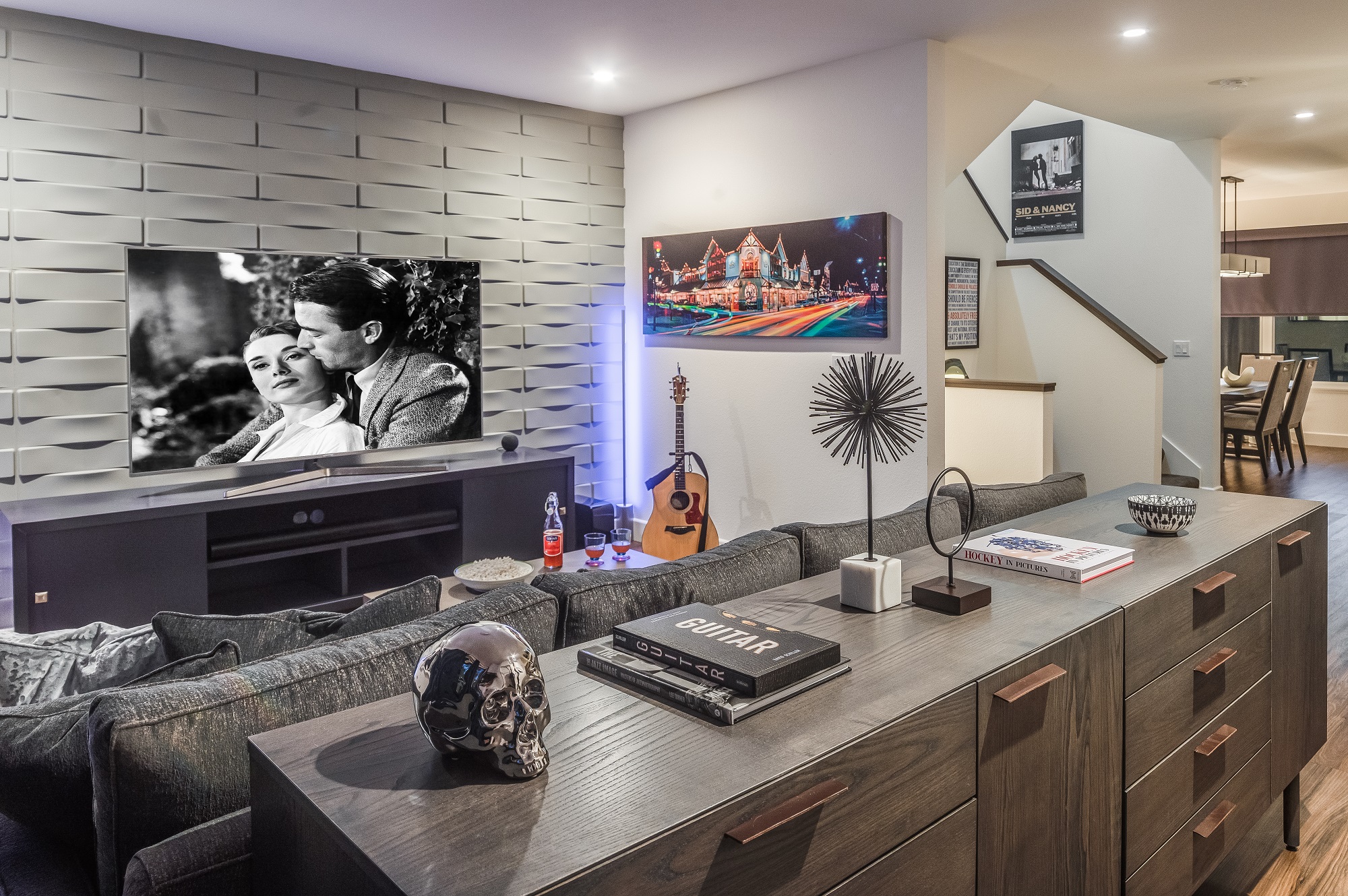
We chose a unique, three dimensional wall treatment for the living room where a plush sectional and LED tunable lights set the stage for comfy classic movie nights. A custom, extra-long media console and polished concrete coffee table round out the space.
Walls with a repeating whimsical black and white whale skeleton named Bruce adorn the walls of the powder room.
The adjacent patio boasts a resort-like feeling with a cozy fire table, a wall of up-lit boxwoods, and a black sofa and chairs for star gazing.
A gallery wall featuring a roster of some of my client’s favorite rock, punk, and jazz musicians adorns the stairwell.
On the third floor, the primary and guest bathrooms continue with the cement-textured quartz counters and same cerused cabinetry.
We completed this well-appointed home with a serene guest room in our established limited color palette, and a lounge/office/recording room which serves as a space for band photos and a gold record!
All photos by Bernardo Grijalva
Happy designing!
Labels:
3D wall,
bathroom,
condo,
dark,
dining room,
entry,
Fiorito Interior Design,
guest bedroom,
industrial,
interior design,
Jeff Fiorito,
kitchen,
living room,
minimal,
modern,
office,
powder room,
wallpaper
Monday, July 18, 2022
Famous Homes: The Gamble House
After my recent History of Furniture post about the Arts and Crafts movement here, let's examine one of the most famous Arts and Crafts homes located in Pasadena, California. Designed by architect brothers Charles Greene and Henry Greene for David B. Gamble, son of the Procter & Gamble founder James Gamble, the Gamble House is now both a National Historic Landmark and a California Historical Landmark.
Constructed in 1908–09, the house remained in the Gamble family until 1966 when they turned the house over to the city of Pasadena in a joint agreement with the University of Southern California (USC) School of Architecture. Because of this, the house has been maintained and luckily keeps most of its original furniture and furnishings designed specifically for the home.
The Gamble House is open for tours. Visit the website for more information and to purchase tickets!
Happy designing!
![]() |
| Gamble House. Photo by Jim Heaphy. |
Constructed in 1908–09, the house remained in the Gamble family until 1966 when they turned the house over to the city of Pasadena in a joint agreement with the University of Southern California (USC) School of Architecture. Because of this, the house has been maintained and luckily keeps most of its original furniture and furnishings designed specifically for the home.
The style is a prime example of the Arts and Crafts aesthetic, being inspired and influenced by Japanese architecture and interiors as well as the Arts and Crafts dedication to fine handcrafted elements and furnishings in honest, organic materials. Remember, the Arts and Crafts movement was in reaction to the machine-made furniture of the Industrial Revolution. The Gamble House displays a stunning variety of hand carved and hand fabricated pieces from many different wood species like teak, maple, oak, Port Orford cedar, and mahogany, along with metal, art glass, and semi-precious stones. The long low lines of the interior reflect an Asian sensibility and feel part of the shape and integrity of the land.
![]() |
| Stylized tree design on the front door, shown partly open. |
![]() |
| Hand railing of main staircase, and front entryway in background. |
![]() |
| Living room inglenook with Burmese teak queen-post trusses. |
![]() |
| Living room. Each piece of furniture in the living room was designed to occupy a specific location within the space. |
![]() |
| Detail of carved living-room frieze with adjacent boards, blocks, and iron straps — decorative elements that mimic functional features in other areas of the house. |
![]() |
| Sconce hanging from a leather strap in the living room. |
The Gamble House is open for tours. Visit the website for more information and to purchase tickets!
Happy designing!
Monday, July 4, 2022
Happy Independence Day 2022!
Hello followers and regular readers...for those in the United States, I wish you a very happy July 4th!
![]() |
| Photo: Marcus Nilsson |
Monday, June 20, 2022
History of Furniture: Arts and Crafts
As is so often the case with particular historical developments in art, interiors, clothing, even politics, a movement is usually a reaction to and against something that came immediately before it. Periods of excess lead to periods of austerity and vice versa, whether we are speaking of architecture, furniture, painting, sculpture, dance, or even literature. Such is the case with our next story in our History of Furniture series.
Formed in the late Victorian period (previously here), the movement known as Arts and Crafts came into being as a way to protest the new, and to some the menacing, Industrial Revolution. Roughly between 1880 and 1920, there arose a mistrust and dislike of machine-manufactured furniture and home goods. These objects were seen as too ornate simply for its own sake, soulless, tasteless, and removing humans from the natural world. There were dozens of high profile designers and architects, several of whom I will mention here, but they all felt what was lacking in the modern machine age was the touch of the craftsman, a sense of an object being made by hand out of an organic material like wood and stone.
It is understandable that the movement originated in Great Britain, the first part of the world to really see the proliferation of the Industrial Revolution. Major proponents of this movement include William Morris and Charles Rennie Mackintosh.
William Morris' Wiki entry exhaustively lists him as a "textile designer, poet, artist, novelist, architectural conservationist, printer, translator and socialist activist" and while all of that is true, he is most remembered for his textile and wallcovering designs. Influenced by the flat presentation of Japanese wood block prints and featuring natural, organic motifs, many of these original wallcoverings and fabrics are currently in production through Morris & Co. owned by the Sanderson Group.
Compatriot and fellow Arts and Crafts figure Charles Rennie Mackintosh, previously here in a Famous Homes post, created his own visual vernacular with his wife, the artist Margaret Macdonald Mackintosh. Also inspired by Japanese wood blocks and the honesty of handmade crafts, Mackintosh worked with even simpler shapes and forms that look more like cloisonné. Look at these rose designs made for the Mackintosh's masterpiece, Hill House, created for publishing magnate Walter Blackie in Helensburg, Scotland.
Greene and Greene's masterpiece is the Gamble House in Pasadena, California. Built for David B. Gamble, son of the Procter & Gamble founder James Gamble, the home is a National Historic Landmark, a California Historical Landmark, and open to the public for tours and events. Tour tickets can be purchased at Gamblehouse.org.
Happy designing!
Formed in the late Victorian period (previously here), the movement known as Arts and Crafts came into being as a way to protest the new, and to some the menacing, Industrial Revolution. Roughly between 1880 and 1920, there arose a mistrust and dislike of machine-manufactured furniture and home goods. These objects were seen as too ornate simply for its own sake, soulless, tasteless, and removing humans from the natural world. There were dozens of high profile designers and architects, several of whom I will mention here, but they all felt what was lacking in the modern machine age was the touch of the craftsman, a sense of an object being made by hand out of an organic material like wood and stone.
It is understandable that the movement originated in Great Britain, the first part of the world to really see the proliferation of the Industrial Revolution. Major proponents of this movement include William Morris and Charles Rennie Mackintosh.
William Morris' Wiki entry exhaustively lists him as a "textile designer, poet, artist, novelist, architectural conservationist, printer, translator and socialist activist" and while all of that is true, he is most remembered for his textile and wallcovering designs. Influenced by the flat presentation of Japanese wood block prints and featuring natural, organic motifs, many of these original wallcoverings and fabrics are currently in production through Morris & Co. owned by the Sanderson Group.
![]() |
| William Morris, age 53 |
Compatriot and fellow Arts and Crafts figure Charles Rennie Mackintosh, previously here in a Famous Homes post, created his own visual vernacular with his wife, the artist Margaret Macdonald Mackintosh. Also inspired by Japanese wood blocks and the honesty of handmade crafts, Mackintosh worked with even simpler shapes and forms that look more like cloisonné. Look at these rose designs made for the Mackintosh's masterpiece, Hill House, created for publishing magnate Walter Blackie in Helensburg, Scotland.
![]() |
| Charles Rennie Mackintosh |
It took a little while but Arts and Crafts eventually made its way to North America and held sway from roughly 1910 to 1925 or so. There were many different Arts and Crafts societies that sprang up around the United States, all dedicated to simplicity of form and design along with integrity of construction. Major figures included Gustav Stickley who made furniture that featured mortise and tenon construction reminiscent of traditional Japanese joinery, and Elbert Hubbard who created the Roycroft community of craftsmen in upstate New York. These legendary brands are again in production and can be purchased through Stickley.com. This style of furniture is often referred to as Mission Style but in actuality, Stickley rejected that name, claiming it to be misleading. The name refers to the Spanish missions of California and can be traced back to a very simple, chunky, near-Shaker chair made by A.J. Forbes around 1894 for San Francisco's Swedenborgian Church. New York furniture manufacturer and retailer Joseph P. McHugh copied these chairs and created a coordinating line of furnishings which resembled the pieces coming from the Arts and Crafts movement at the time. Thus the term Mission was born.
On the West Coast, Arts and Crafts manifested with the work of architects Julia Morgan and brothers Greene and Greene as American Craftsman (an offshoot of this is Frank Lloyd Wright's Prairie Style which we will examine in a future post of History of Furniture, as it deserves its own section). They each created buildings and interiors that changed the way people lived. Indeed, Greene and Greene's contributions led to the evolution of what is still referred to as the California Bungalow style which is seen everywhere in cities like Berkeley, Venice, and Pasadena.
![]() |
| Julia Morgan, St. John’s Presbyterian Church, Berkeley, Calif., 1908–16. Julia Morgan Collection, Environmental Design Archives, University of California, Berkeley |
Greene and Greene's masterpiece is the Gamble House in Pasadena, California. Built for David B. Gamble, son of the Procter & Gamble founder James Gamble, the home is a National Historic Landmark, a California Historical Landmark, and open to the public for tours and events. Tour tickets can be purchased at Gamblehouse.org.
There was also a great interest in pottery and metal work in the Arts and Crafts movement, as evidenced by the iconic mica-shade copper lamp, and many pottery companies like Grueby, Newcomb College, Rookwood, Roseville, and Weller.
Subscribe to:
Posts (Atom)


%2520Stickley%2520sideboard%25209005.02.jpg)